
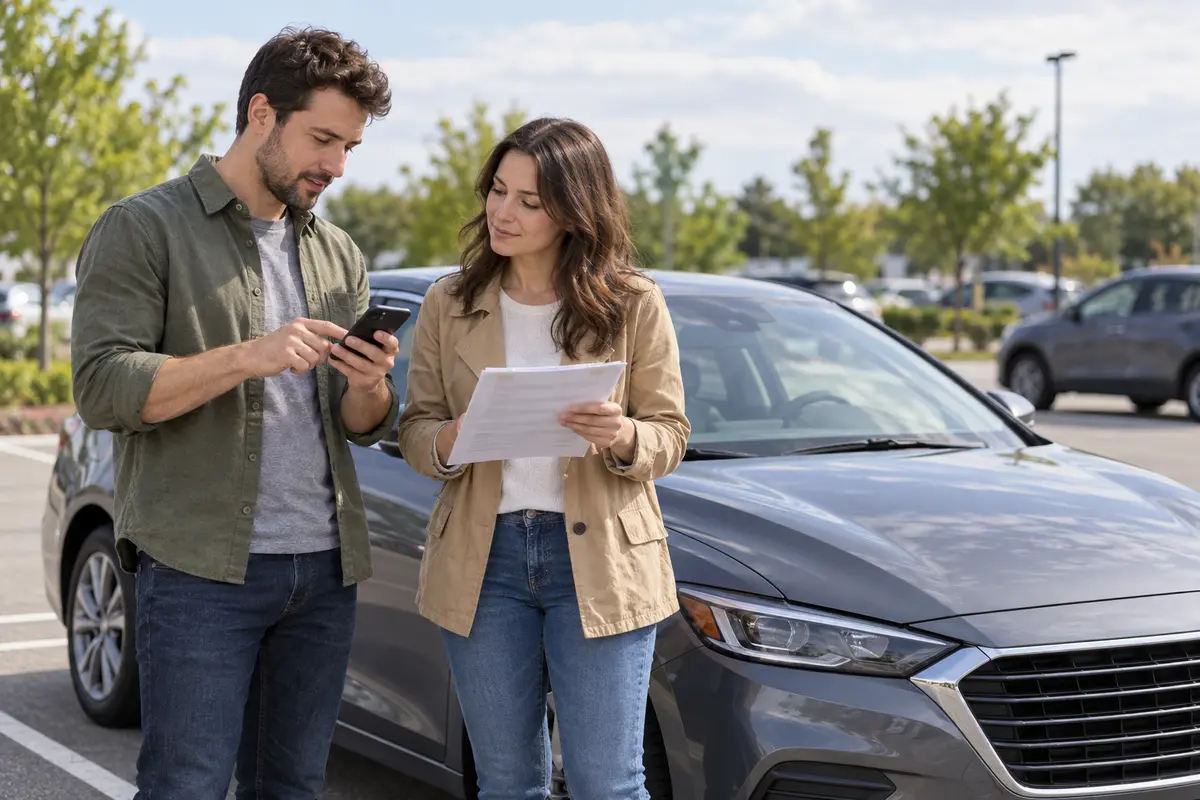
A car-viewing appointment can fail before either person arrives. The buyer may mean a different vehicle, the seller may assume the time is local, the meeting point may be too vague, or a requested inspection may never have been agreed. One short confirmation message can put the practical facts in one place.
This guide is for a private seller or dealership confirming an in-person used-car viewing. It does not verify either party, make a location safe, reserve the vehicle, guarantee a test drive or inspection, or create a sales contract. Local rules, dealership policies and individual circumstances still apply. The illustration above is fictional and is not evidence of a real vehicle, appointment or customer interaction.
1. Name the exact vehicle
Do not write only “the car.” Include the year, make, model and trim if the trim is verified. A dealer can add its internal stock number. A private seller can use a short internal reference or the last six characters of the VIN in a private message when that helps distinguish similar vehicles.
Keep the full VIN and ownership documents in an appropriate private channel. NHTSA’s VIN decoder can identify information encoded in a VIN from manufacturer-reported data. It is a useful identity cross-check, but it is not proof of ownership, current condition, mileage or every installed option.
If the listing changed after the conversation began, say so. A different price, mileage, location, condition note or availability status should not be hidden behind the old appointment message.
2. Write the full date, time and time zone
Use the weekday, calendar date and exact time. Add the time zone whenever either person is traveling, the conversation crosses regions or a device might display a different zone. “Saturday, September 26 at 2:30 p.m. Pacific Time” is clearer than “tomorrow afternoon.”
State an arrival window only if you truly offer one. If the appointment lasts a defined period, include the planned end time. Do not imply that a late arrival will be accepted unless you have agreed on a grace period.
3. Give an unambiguous meeting point
Provide the correct public business address or another agreed meeting location, plus the practical arrival instruction: which entrance, customer parking area, reception desk or person to ask for. Check the address before sending it. If the location changes, send a fresh confirmation instead of relying on a correction buried in an older thread.
Share only the personal information needed for the appointment. Avoid sending unredacted title documents, driver-license images, bank details, gate codes or unrelated home-access information in a routine confirmation. A meeting location and a promise that a meeting is “safe” are not the same thing; do not guarantee security you cannot establish.
4. Separate availability from reservation
Say whether the exact vehicle is currently available, pending, reserved or subject to sale before the appointment. An appointment does not automatically create a hold. If the seller has agreed to reserve the vehicle until a specific time, put the exact end of that hold and any written terms in the message. If no hold exists, say that plainly.
Avoid pressure language such as “send money now or lose the car.” If a deposit is discussed, handle it as a separate decision with clear written terms, the correct recipient and the applicable refund conditions. Do not use the appointment confirmation as proof that a deposit, payment method or refund is legitimate.
5. List the buyer’s requested checks
Repeat the specific items already agreed: for example, viewing the service-record index, seeing a known scratch in daylight, checking whether both keys are present, or reviewing the current odometer reading. This prevents the seller from preparing the wrong evidence and prevents the buyer from assuming that an unmentioned request was accepted.
Keep each item within its limits. A photograph is not a mechanical inspection. A service invoice does not prove current condition. A vehicle-history report does not show every mechanical problem. A demonstration that a feature works once is not a warranty.
If the request cannot be accommodated, answer before the buyer travels. “The vehicle cannot be placed on a lift at this location” is more useful than leaving the point unanswered.
6. Confirm the scope of the appointment
State what is planned: exterior and interior viewing, document review, an independent inspection, a road test, or only a stationary demonstration. Do not promise a test drive or access to a workshop unless the seller has agreed and any required license, insurance, supervision or facility conditions can be met.
For dealer purchases, the FTC’s used-car buying guidance recommends an independent mechanical inspection and explains that a vehicle-history report is not a substitute for one. Private-party procedures and local requirements can differ, so both parties should agree on the inspection location, responsibility for any fee, transport and timing before the appointment.
7. Give one contact and one change rule
Name the person or team that owns the appointment and the channel to use if either side is delayed. Include the latest time by which a long-distance buyer should reconfirm before departing. If a dealership changes the assigned employee, send the new name and preserve the verified vehicle facts instead of making the buyer restart the conversation.
Ask both sides to send a clear cancellation or rescheduling message rather than simply not arriving. A useful rule is: “If anything changes, reply in this thread before [time]. I will confirm the new date and time in writing.”
Copy-and-paste appointment confirmation template
Hello [buyer name] — confirming our viewing of the [year, make, model, verified trim; stock ID or short reference] on [weekday, full date] at [time and time zone]. We will meet at [complete location and arrival instruction].
The vehicle is currently [available / pending / reserved until exact time]. This appointment [does / does not] place it on hold.
We agreed to review [requested records, condition areas or features]. The planned appointment includes [stationary viewing / document review / inspection arrangement / road test subject to stated requirements]. [Name or team] will be your contact at [contact channel].
Please reconfirm by [time] before traveling. If either of us needs to cancel, reschedule or report a delay, we will reply in this thread and confirm the new plan in writing.
Remove every option that does not apply. Do not send bracketed choices, placeholder text or a promise that has not been approved.
A complete fictional example
Hello Maya — confirming the viewing of the fictional 2019 Harbor sedan, reference HS-214, on Saturday, September 26 at 2:30 p.m. Pacific Time. We will meet at the customer parking entrance at 100 Example Avenue and check in with Jordan at reception.
The vehicle is currently available. The appointment does not reserve it. We agreed to review the current odometer reading, the privacy-reviewed service-record index, both keys and the previously disclosed scratch on the right rear door. The plan is a stationary walk-around and document review. Any road test will depend on the site’s license, insurance and supervision requirements.
Please reply in this thread by 11:00 a.m. before leaving. If the vehicle’s availability or condition changes, I will update you here. If either of us needs a different time, we will confirm the replacement appointment in writing.
Every name, vehicle, identifier and address in this example is fictional. The message confirms logistics and agreed checks; it does not certify the vehicle or promise an outcome.
Use a fresh message when the plan changes
Reschedule: “The original appointment for [old date and time] is canceled. The proposed replacement is [new full date, time and zone] at [location]. Please reply ‘confirmed’ before traveling.”
Delay: “I am delayed by approximately [time]. I can arrive at [revised time and zone]. Please confirm that still works; otherwise we will choose another time.”
Vehicle no longer available: “The [exact vehicle reference] is no longer available, so the appointment is canceled. I will not substitute another vehicle unless you ask for alternatives.”
New condition information: “Since our last message, [specific verified change] occurred or was discovered. Here is the updated information. Please decide whether you still want to keep the appointment.”
Do not edit the old message and assume the other person saw the change. Send a dated correction that identifies which plan it replaces.
Keep history-report and payment requests separate
The FTC has warned about scammers who contact online car sellers and insist that the seller buy a vehicle-history report from a specific unfamiliar website. Its vehicle-history report scam guidance advises sellers to be cautious and explains that sellers can choose a legitimate report source rather than using a buyer’s demanded link.
An appointment confirmation should not require clicking an unknown link, sending a verification code, refunding an overpayment or sharing bank credentials. If a message introduces a new payment or report request, pause and verify it separately through an independently chosen channel.
Send a same-day check-in for a long trip
For a buyer traveling a significant distance, confirm the vehicle’s availability, the meeting contact and any material change on the day of departure. The buyer can reply with an estimated arrival time. This reduces avoidable travel, but it does not guarantee that the vehicle will remain available unless a specific hold was agreed.
If either person cannot confirm, postpone the trip rather than turning silence into consent.
Appointment confirmation checklist
- Name the exact vehicle and a private reference.
- Confirm the current mileage or material condition change when relevant.
- Write the weekday, calendar date, exact time and time zone.
- Give the complete meeting point and arrival instruction.
- State the current availability status.
- Say explicitly whether the appointment reserves the vehicle.
- List the specific records, condition areas or features requested.
- Describe the planned viewing, inspection or road-test scope.
- State any applicable license, insurance, supervision or facility conditions.
- Name the responsible contact and change channel.
- Set a same-day reconfirmation time for meaningful travel.
- Keep deposits, payment and unfamiliar report links out of routine logistics.
- Avoid guarantees about safety, condition, availability or sale outcome.
- Send a fresh dated message for a delay, reschedule, cancellation or new condition fact.
- Do not leave placeholders or unapproved promises in the final message.
A useful appointment confirmation is not persuasive copy. It is a compact record of what both sides actually agreed: the exact car, the exact time and place, the checks that will be available, the limits of the visit and the way changes will be handled.
Ready to list your car?
Put your vehicle details and photos together, then start your listing on AutoDream.
Create your listing

