
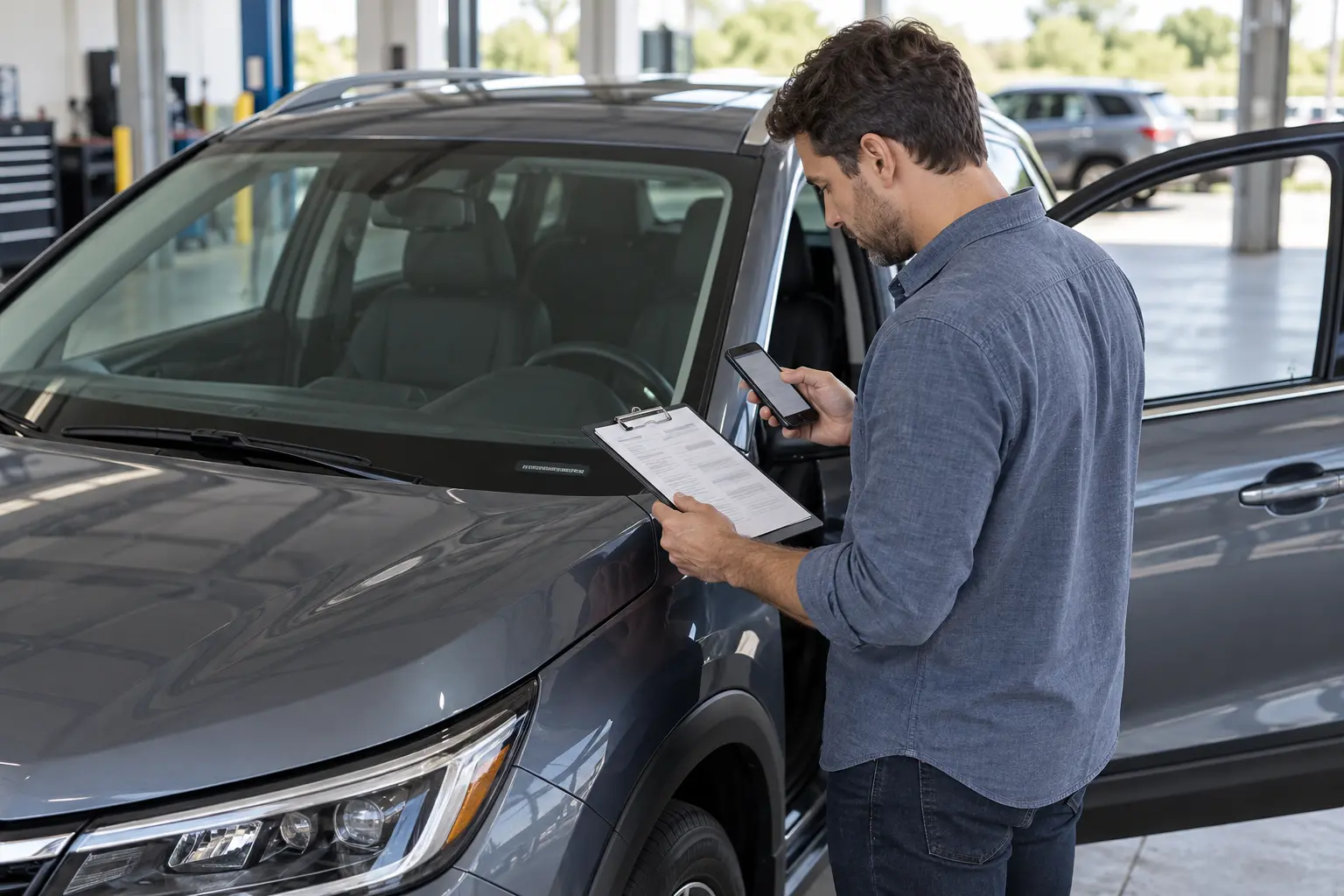
A vehicle identification number is more than a search-box input. It is the key that lets a buyer check whether the car in the advertisement, the car being shown, the documents being discussed and the records being searched all refer to the same vehicle.
This guide gives used-car buyers a simple VIN cross-check workflow to complete before a long trip, an inspection or any payment. It does not prove ownership, title status, present mechanical condition or seller identity by itself. The illustration above is fictional and contains no real VIN, vehicle, customer or inspection evidence.
1. Start one VIN comparison sheet
Create a record with one row for every source you receive. Copy the VIN exactly as shown; do not rely on the first or last few characters. Keep the source, capture date and result together.
| Source | What to record | What it does not prove |
|---|---|---|
| Online listing | Full VIN as written, listing URL, stock number and capture date. | That the VIN belongs to the pictured car or that the seller controls it. |
| Vehicle | VIN visible at the windshield and the applicable manufacturer label; note where and when viewed. | Ownership, title history or that every label is authentic. |
| Seller-provided document | VIN, document type, date and the exact name of the issuing source. | That an image is complete, current or unaltered. |
| NHTSA decoder | Decoded make, model year, vehicle type and any error message. | Current equipment, ownership, condition, title status or every installed option. |
| Recall lookup | VIN searched, date and exact result. | A complete repair history or a general safety guarantee. |
| History report | Provider, VIN, report date and the events or gaps actually returned. | Current mechanical condition or every event in the vehicle’s life. |
| Inspection work order | VIN recorded by the inspector, inspection date, scope and exclusions. | Items outside the scope, ownership or future reliability. |
Keep screenshots or copies only when appropriate, and redact unrelated account, payment and personal information. The goal is traceability, not collecting more private data than the decision requires.
2. Ask for the full VIN before committing to travel
If a listing omits the VIN, ask the seller or dealer for the complete number through the normal conversation channel. State why you need it: to match the vehicle, run defined official lookups and prepare an inspection. A partial VIN may help distinguish inventory internally, but it is not enough for a vehicle-specific history or recall check.
Record the listing before it changes. Save the URL, date, advertised year, make, model, trim, mileage, color and stock number. Do not assume a stock number is a VIN, and do not silently replace one character when a lookup fails.
3. Decode first; do not treat decoding as a history report
NHTSA’s official vPIC VIN decoder identifies information encoded in a VIN using data reported by manufacturers. Compare the decoded identity with the listing. A different make, model year, vehicle type or other central identity field is a reason to pause and ask for reconciliation.
A clean decode does not establish that the seller owns the car, that the title is clear, that the mileage is accurate, that a feature is installed or that the vehicle is mechanically sound. Likewise, a decoder error is not permission to guess the intended character. Recheck the source and ask the seller to show the number again.
4. Match the number to the actual vehicle
Before purchase—and preferably before paying for a remote inspection—ask for a clear, current view that connects the identifying area to the advertised car. During an in-person viewing, compare the full VIN on the vehicle with your comparison sheet and the transaction documents. Read it character by character.
- Use a wide view to establish which vehicle is being shown, then a close view for the identifier.
- Do not accept a loose label, typed message or cropped image as a substitute for matching the actual vehicle.
- Note damaged, obscured, loose or inconsistent identifying areas without diagnosing the cause.
- If two vehicle locations disagree, stop the process and seek appropriate professional or official help.
- Never alter, clean aggressively, remove or attempt to repair an identifier yourself.
A mirrored phone image, glare or a transcription error can create confusion, but those are questions to resolve with a new direct view—not explanations to assume.
5. Compare documents without treating an image as ownership proof
Match the VIN on the documents relevant to the actual transaction. The required documents vary by jurisdiction and seller type, so use the appropriate motor-vehicle agency and qualified professional for transfer requirements. Record the document type and source rather than calling every file a title.
An emailed photograph can help spot a mismatch, but it may be cropped, stale, incomplete or altered. Do not send money simply because a document image contains the same VIN. Seller identity, authority to sell, title status, lien handling, written terms and the physical vehicle still require their own checks.
6. Use the right official source for each question
The U.S. Department of Justice lists approved NMVTIS data providers for consumer vehicle-history reports. Its NMVTIS FAQ explains that reports can include state title data, title issue date, latest reported odometer data, theft information when available, brands and salvage history. It also explains that NMVTIS does not contain some information, such as repair history, and that reporting timing can vary.
The FTC’s used-car resources recommend getting a vehicle history report and make clear that a history report is not a substitute for an independent inspection. Use each result for the question it actually answers:
- Decoder: what the VIN encodes according to manufacturer-reported data.
- NMVTIS or another defined report: the categories and events available to that source.
- Recall lookup: the VIN-specific recall result displayed at the time of search.
- Inspection: dated observations within the inspector’s agreed scope.
- Transfer records: ownership and transaction matters handled by the applicable authority and written process.
A missing row or zero-result message is not automatically a clean history. Record the exact wording and follow the source’s support or discrepancy process.
7. Run the recall search separately
NHTSA’s recall lookup lets buyers search a vehicle by VIN. Save the date and exact result. Recall information is not the same as title history, a mechanical inspection or a promise that the car has no safety issue.
If the seller says a recall was repaired, ask for the relevant dated record and follow up with the manufacturer or authorized dealer when necessary. Do not convert “no unrepaired recalls displayed” into “all recalls completed forever.”
8. Verify the seller and location separately from the VIN
A valid VIN can be copied from a real vehicle and placed in a false advertisement. In September 2026, the FTC warned that scammers were cloning real dealership websites, listings and photos. Its dealer-website spoofing alert recommends independently researching the dealer, asking to see the vehicle and dealership, arranging a mobile inspection when distance prevents a visit, and walking away from wire-only advance-payment pressure.
Contact a dealership using contact details obtained independently from the suspicious advertisement when verification matters. Confirm that the exact stock number and VIN are in its inventory. A decoder result cannot authenticate a website, email address, bank account or person.
Fictional example: one character changes the decision
The following scenario is fictional and is not an AutoDream listing.
A buyer saves a listing for a gray crossover and copies the 17-character VIN into a comparison sheet. The NHTSA decoder returns a different model year than the listing. The seller sends a dashboard photo, but one middle character differs from the advertisement.
The buyer does not choose the version that makes the listing appear correct. Instead, the buyer asks for a continuous current video showing the whole vehicle, then the windshield identifier, and requests that the dealer confirm the stock number through its independently verified phone number. The dealer identifies a transcription error in the listing and updates it.
The buyer reruns the decoder, obtains a new history report for the corrected VIN, performs a current recall lookup and instructs the independent inspector to put that VIN on the work order. Only after all rows match does the buyer evaluate the car’s condition and written deal terms.
Pause the transaction when
- the seller will not provide a full usable VIN before demanding travel or payment;
- the VIN differs across the listing, vehicle, documents, history report or inspection order;
- a decoded central identity field conflicts with the advertised vehicle and is not reconciled;
- an identifier appears obscured, damaged, loose or inconsistent;
- the dealership cannot confirm the vehicle through independently obtained contact details;
- the seller pressures you to use an unfamiliar report site or wire money before basic verification;
- the vehicle cannot be made available for a reasonable independent inspection;
- someone asks you to ignore a mismatch as “probably a typo” without correcting the source.
VIN cross-check checklist
- Save the listing URL, details and date.
- Obtain the complete VIN through an appropriate channel.
- Copy every character exactly; never guess a correction.
- Decode the VIN with NHTSA vPIC and compare the core identity.
- Match the full VIN to the actual vehicle during a current view.
- Match the VIN to the applicable transaction documents.
- Use an approved NMVTIS provider when seeking NMVTIS data.
- Record the report provider, date, categories returned and gaps.
- Run a separate current NHTSA recall lookup.
- Verify the seller or dealership independently.
- Put the VIN on the independent inspection work order.
- Keep decoder, history, recall, inspection and ownership questions separate.
- Pause until every mismatch is explained and corrected at its source.
- Do not send payment because a VIN alone appears valid.
A successful VIN cross-check does not tell you to buy the car. It tells you that the evidence you are about to evaluate appears to concern the same vehicle—an essential starting point before inspection, negotiation and payment.
Ready to list your car?
Put your vehicle details and photos together, then start your listing on AutoDream.
Create your listing

