
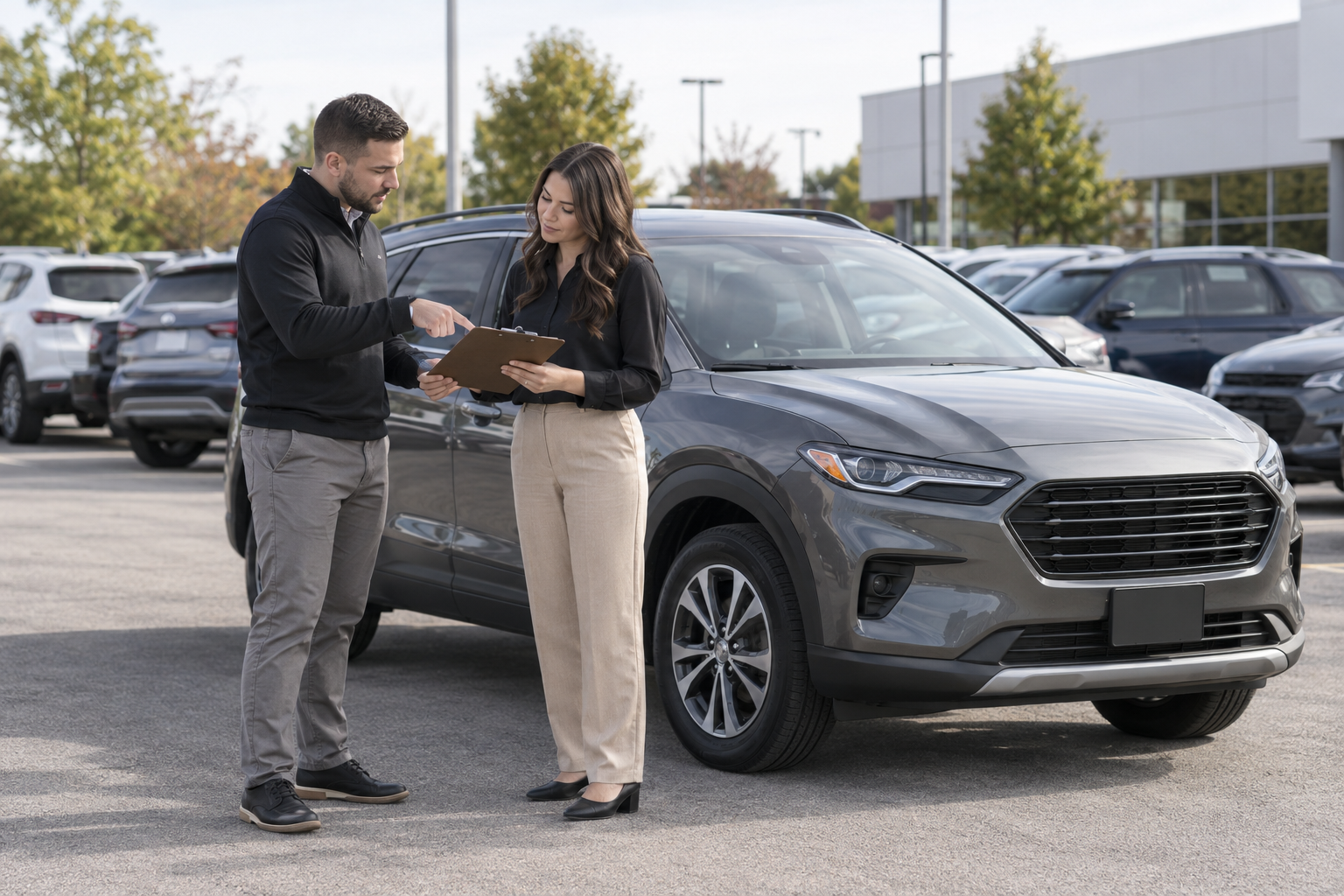
A buyer should not have to restart the conversation every time a dealership changes shifts. A good handoff lets the next employee understand the exact vehicle, the buyer's unanswered question, what has already been verified, what was promised and who owns the next action.
The goal is continuity, not a permanent transcript of every detail. This guide gives small dealerships a practical handoff note and review process without assuming that AutoDream or another platform automatically stores, assigns or transfers conversations. The illustration above is fictional; it is not a real dealership, listing or customer interaction.
1. Define what a complete handoff must accomplish
A handoff is complete only when the receiving employee can take the next correct action without guessing. Forwarding “Call this person” or a screenshot of a long message thread does not establish ownership, timing or the latest verified facts.
Every handoff should answer six questions:
- Which exact vehicle is involved?
- What did the buyer ask?
- Which facts were verified, by whom and when?
- What remains unknown or unresolved?
- What did the dealership promise to do?
- Who owns the next action, and by what time?
Use one approved system or secure location for the operational note. Do not scatter customer information across personal text threads, private email accounts, handwritten scraps and unrelated group chats. The system can be simple, but staff must know where the current record lives and which entry is authoritative.
2. Anchor the note to the exact vehicle
Start with the listing URL or approved inventory record, stock number, year, make and model. Add the full VIN only when the dealership's process requires it and the note is stored in an appropriately protected system. A public-facing or widely shared note may need a less sensitive internal identifier instead.
Confirm current availability before transferring the inquiry. “Vehicle 1842 was available when I checked at 2:10 p.m.” is a time-stamped fact. “It should still be here” is an assumption. If the vehicle is on hold, at service, awaiting inspection or already sold, name that status and the person who confirmed it.
Link to the current listing rather than pasting specifications from memory. If the listing and inventory record disagree on mileage, price, trim or included accessories, mark the conflict as unresolved and pause that claim until someone checks the vehicle or source record.
3. Capture the buyer's actual question
Summarize the buyer's question in neutral language, preserving the important detail. “Wants info” is too vague. “Asked whether the passenger-side rear-door scratch is through the paint and requested a close photo before traveling” tells the next employee what to do.
Separate the buyer's words from the dealership's conclusion:
- Buyer stated: plans to visit Saturday morning and wants to know whether the vehicle can be independently inspected.
- Verified dealership fact: Saturday viewing time is not yet confirmed.
- Next check: service manager must confirm lift availability.
Do not label a buyer “difficult,” “not serious,” “cheap” or “confused.” Record observable facts: questions asked, requested timing, offer amount if relevant, documents requested and whether the buyer consented to a follow-up. Neutral notes travel better between staff and reduce the chance that a subjective label shapes the next response.
4. Record only the contact information needed for the next step
Include the buyer's preferred name, approved contact channel, relevant time zone and any communication preference they stated. Do not copy a driver's license, bank details, Social Security number, credit application, full payment information or unrelated family details into a sales handoff note.
The FTC's guide to protecting personal information organizes data security around five principles: know what information the business has, keep only what it needs, protect it, dispose of it properly and plan for incidents. It also recommends limiting employee access to people with a business need.
That principle fits a buyer handoff: the next salesperson may need a name, communication channel and question, but not every document another department collected. Keep finance, identity and transaction records in the approved systems with the access rules that apply to them.
5. Separate verified facts, buyer statements and promises
Use three labeled fields instead of one free-form paragraph:
| Field | Example | Rule |
|---|---|---|
| Verified fact | Odometer displayed 48,216 miles at 3:05 p.m.; checked by Mina. | Include source, checker and time. |
| Buyer statement | Buyer says they will travel from another city. | Do not present it as independently verified. |
| Dealership promise | Jordan promised a new cargo-area photo by 10 a.m. tomorrow. | Name the promise, owner and deadline. |
| Unknown | Second key status not yet confirmed. | Assign a check; do not guess. |
A handoff should never convert “I will check” into “confirmed.” Link to the photo, invoice, inspection note or approved inventory record that supports a factual answer. Our guide to replying to a remote car buyer provides a matching fact-block structure for the customer-facing response.
The FTC's truth-in-advertising overview says advertising must be truthful, not misleading and appropriately supported. Consistent internal notes help the next employee avoid contradicting the listing or expanding an observation into an unsupported guarantee.
6. Handle price, warranty and coverage statements carefully
Record an offer as an offer, not an accepted price. State who has authority to accept it, whether any deadline was actually agreed and whether the buyer received a response. Do not invent another bidder or a countdown to create urgency.
For a U.S. dealership used-car transaction, do not let an informal handoff note replace the required documents. The FTC's Dealer's Guide to the Used Car Rule explains that most covered used-car dealers must display a Buyers Guide, that it identifies whether a vehicle is sold as-is or with a warranty, and that negotiated warranty changes must be reflected in the Guide. It also tells consumers to get promises in writing.
The handoff should point staff to the current Buyers Guide and written warranty or service-contract documents where applicable. It should not summarize coverage as “fully covered” or “basically as-is.” State the exact document that controls, the version checked and any change that still requires authorized written completion. State and transaction rules vary, so dealership procedures should be reviewed by appropriate compliance counsel.
7. Assign one owner and one deadline
The outgoing employee should name the receiving employee, not a department: “Priya owns the next reply.” The recipient should acknowledge the handoff. Until acceptance, the original employee or shift lead remains responsible for making sure the buyer is not abandoned.
Use a concrete next action:
- verify whether the second key is physically present by 9:30 a.m.;
- send the requested cargo-area photo after privacy review;
- confirm the viewing time and public meeting point;
- ask the service manager whether an independent inspection can be accommodated;
- tell the buyer the vehicle was sold and close the inquiry.
“Follow up soon” is not actionable. Use the buyer's time zone when needed and do not promise a deadline the receiving employee cannot meet. If a task depends on someone else, name both the dependency and the person who will update the buyer.
8. Send a warm transfer to the buyer
When practical, tell the buyer who will continue the conversation and what that person is doing. The message should reduce repetition without exposing internal notes:
Thanks for your questions about the [year, make and model]. I am handing this conversation to [name or role], who will confirm [specific open item] and reply by [time and time zone]. They have the vehicle link and the questions you already asked, so you should not need to repeat them.
If the new employee contacts the buyer from another approved number or account, identify the dealership and vehicle clearly. Do not ask the buyer to resend sensitive documents merely because the staff member changed. Confirm where approved records are stored and involve the correct department.
9. Keep the handoff inside approved, secure channels
The FTC's Start with Security guide emphasizes sensible access controls, secure authentication, protecting sensitive data during storage and transmission, and keeping security practices current. A sales handoff process should follow the dealership's approved systems and access policies rather than creating a new shadow database.
Do not paste passwords, login links, payment details, credit information or identity documents into a handoff note. Do not forward a suspicious attachment or link simply so the next employee can “take a look.” Escalate it through the dealership's security procedure.
When the business no longer needs the operational note, follow its retention and disposal policy. Closing a sale or an inquiry does not mean every employee should retain a private copy indefinitely.
A complete fictional handoff example
| Vehicle | Stock 1842 — 2020 fictional crossover; current listing link attached. |
|---|---|
| Status | Available at 4:20 p.m. on September 19; confirmed by inventory lead. |
| Buyer request | Wants a close photo of the rear cargo trim and asks whether an independent inspection can be arranged before traveling. |
| Verified facts | Cargo-trim scuff appears in listing photo 18; no separate close photo yet. Inspection arrangement not yet confirmed. |
| Promise | Outgoing employee promised an update by 10 a.m. Pacific tomorrow, not a completed inspection. |
| Next owner | Alex accepted the handoff at 4:26 p.m. |
| Next actions | Alex will make and review the requested photo, ask the service manager about inspection access and send one combined reply. |
| Privacy note | Only preferred name and approved message channel retained in this operational note; no financial or identity documents copied. |
All people, times, stock numbers, vehicle details and circumstances above are invented. The example shows the structure of a useful note, not a real AutoDream inquiry or dealership result.
Dealership buyer-conversation handoff checklist
- Identify the exact vehicle and link to the current listing.
- Time-stamp availability and name who checked it.
- Summarize the buyer's actual unanswered question.
- Separate verified facts, buyer statements, promises and unknowns.
- Link each important fact to its source.
- Keep only the contact information needed for the next action.
- Do not copy finance, identity or payment data into the sales note.
- Record offers and deadlines without changing their status.
- Point to the current Buyers Guide and written coverage documents when applicable.
- Name one receiving employee and obtain acknowledgment.
- Assign one specific next action and deadline.
- Tell the buyer who will reply and what remains open.
- Use approved systems, access controls and retention rules.
- Close or update the handoff when the action is complete.
A reliable handoff is small enough to read in one minute and precise enough to prevent a wrong answer. The next employee should know what the buyer needs, what the dealership can prove and exactly what must happen next.
Ready to list your car?
Put your vehicle details and photos together, then start your listing on AutoDream.
Create your listing

