
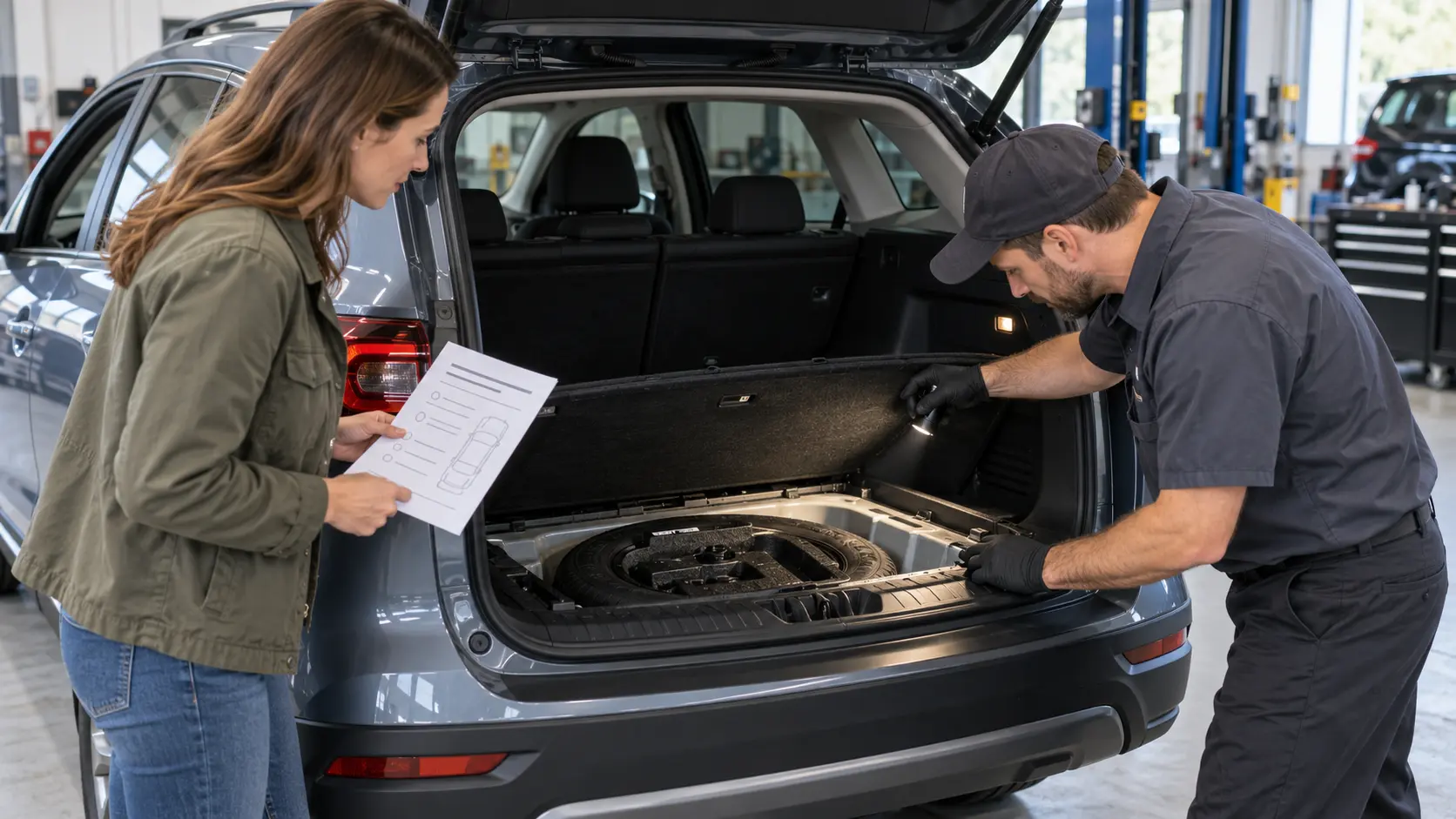
A used vehicle can travel far from the place where it was exposed to a hurricane, river overflow, flash flood or deep standing water. A title brand may identify that history, but one clean-looking document or history report cannot prove that water never entered the vehicle.
This guide gives buyers, private sellers and dealers a practical way to separate title history, known records, visible clues and present-condition inspection findings. It uses United States resources; elsewhere, use the applicable motor-vehicle authority, title system and safety guidance. The illustration above is fictional and is not evidence of a real flood-damaged vehicle, inspection or customer.
1. Treat a recently flooded vehicle as a safety situation
If the vehicle is still wet, was recently submerged or has an unknown electrical condition after flooding, do not begin with a normal start-up or road test. NHTSA's hurricane and flood-damaged vehicle guidance warns that damaged high-voltage batteries in electric and hybrid vehicles can create shock and fire risks. Follow the vehicle manufacturer's instructions and qualified emergency, towing or service guidance before moving, starting, charging or storing the vehicle.
This article is for evaluating a used vehicle after the immediate hazard has been controlled. It is not a procedure for entering floodwater, disconnecting a high-voltage battery or repairing water damage.
2. Match the vehicle before reviewing its history
Record the complete VIN from the physical vehicle and compare it with the listing, title or registration, history report and inspection work order. A report for a similar year and model—or for a mistyped VIN—does not describe the car in front of you.
- Compare all 17 VIN characters across each source.
- Record the odometer reading and its unit on the day of inspection.
- Note the current title jurisdiction and seller's name or authority to sell.
- Pause if the VIN differs, appears altered or cannot be matched to the documents.
3. Build an evidence stack, not a single-report verdict
Use several independent evidence types because each answers a different question:
| Evidence | What it can help establish | What it does not prove by itself |
|---|---|---|
| Current title | Current jurisdiction and any displayed brand. | That no unreported water exposure occurred. |
| NMVTIS vehicle-history report | Participating state-title data, title brands and certain junk, salvage and insurance total-loss information. | Complete repairs, maintenance, recalls or present condition. |
| Other history or insurance records | Additional reported events tied to the VIN. | That every incident was reported or coded correctly. |
| Seller, repair and insurance documents | Dated claims, work performed and statements from identified sources. | That hidden systems are unaffected. |
| Independent inspection | Present observations within the inspector's stated scope and access. | A complete lifetime history or future reliability. |
| Your observations | What was visible, smelled or operated at one time. | The cause, extent or repair quality without qualified evaluation. |
The U.S. Department of Justice explains that an NMVTIS report can include title brands such as flood, junk or salvage and certain total-loss information. Its consumer guidance also makes clear that NMVTIS is not a repair, maintenance or recall record. Use an approved provider and save the report date, VIN and source.
4. Read a clean title or report narrowly
Write exactly what the source says: for example, “The NMVTIS report obtained October 10, 2026 did not display a flood brand.” Do not convert that dated result into “never flooded.” Reporting can be incomplete or delayed, a vehicle can cross jurisdictions, and water exposure may not have produced an insurance claim or title brand.
The FTC's flood-damaged car guidance recommends checking vehicle history and still having the car inspected by an independent mechanic. A history report and inspection complement each other; neither replaces the other.
5. Inspect hidden low areas and systems methodically
Ask the seller for permission before lifting removable panels or trim. Do not disassemble safety systems, probe wiring or open high-voltage components. Photograph each observation with a wide context view and a closer detail view, then record where it was found.
- Odor: persistent mustiness, mildew or an unusually strong deodorizer can justify more investigation, but smell alone is not a diagnosis.
- Silt and waterlines: look in the spare-tire well, cargo-floor edges, seat rails, under accessible mats and in other low crevices.
- Carpet and trim: note mismatched, unusually new, loose or uneven material without assuming why it changed.
- Corrosion: record rust, discoloration or residue on unusual interior fasteners, brackets and accessible electrical connectors.
- Lighting and glass: check for persistent condensation, sediment or staining inside lamp assemblies and other sealed-looking areas.
- Electrical functions: test permitted lights, windows, locks, seat controls, displays, cameras and warning indicators; record each result instead of writing “electronics are fine.”
- Fluids and filters: ask a qualified inspector to evaluate contamination or replacement evidence rather than relying on color from a photograph.
NHTSA and the FTC both identify musty odors, dirt or waterlines in hidden areas, unusual corrosion, stained material and fogged lighting as warning signs worth checking. None of these observations alone establishes the depth, date or full effect of water exposure.
6. Give the independent inspector a focused brief
Choose an inspector who is independent of the sale and qualified for the vehicle's powertrain, electrical architecture and safety systems. Share the exact concerns and records before the inspection. For an electric or hybrid vehicle, confirm that the shop is equipped and trained for high-voltage evaluation.
Ask the written report to distinguish:
- areas inspected and areas that were inaccessible;
- visible corrosion, residue, moisture or previous cleaning;
- scan findings and warning indicators, with limits;
- electrical, restraint and safety-system checks actually performed;
- evidence of repair or replaced components, without guessing the cause;
- recommended specialist testing or disassembly not included;
- whether a normal road test was performed and under what conditions.
A pre-purchase inspection is a present-condition assessment, not a certification that a car was never flooded. Keep the inspector's limitations with the findings.
7. Sellers should disclose known facts and label unknowns
Do not hide a known flood title brand, insurance claim, water entry, drying procedure or water-related repair. Disclosure rules vary by jurisdiction, so sellers and dealers should check the applicable motor-vehicle and consumer-protection requirements. Even when a form is not discussed here, advertising should not contradict known records.
Precise listing note: “NMVTIS report obtained October 10, 2026 shows [exact title brand or no displayed flood brand]. Seller records show [known event and date, or no records available]. An independent inspection dated [date] observed [specific findings] and did not inspect [stated limits]. Buyer may review the redacted records and arrange an independent inspection.”
Avoid: “Never flooded,” “water damage fully fixed” or “electrical system 100% safe” unless competent, vehicle-specific evidence truly supports the full claim.
Keep original documents, redact unrelated personal information from sharing copies and label seller statements separately from third-party findings. If a fact is unknown, say that it is unknown and name the next verification step.
8. Buyer process before travel, payment or delivery
- Obtain the VIN and compare it with a current physical view of the vehicle.
- Check the current title information and obtain an NMVTIS report from an approved provider.
- Ask specifically about flood exposure, insurance claims, drying, interior replacement and electrical repair.
- Request supporting records, not just a verbal assurance.
- Review photos of low, hidden areas before traveling when the seller is remote.
- Arrange an independent inspection with a water-damage brief.
- Compare the title, reports, seller statements and inspection findings in one table.
- Pause if material facts conflict, access is refused or the inspector cannot evaluate an important system.
- Put agreed representations and next steps in writing before payment.
- Recheck documents and condition at delivery.
If the evidence cannot be reconciled, do not solve the uncertainty by lowering the price alone. First decide whether the identity, legal status, safety and condition questions can be answered well enough for the transaction.
9. Dealer intake: create a water-exposure review gate
For each stock unit, record the VIN source, title brand, NMVTIS report date, insurance or auction disclosures, visible observations, inspection provider, inaccessible areas, repair evidence, listing language, reviewer and next review trigger. Do not copy a conclusion from another vehicle of the same model.
Before publishing or delivering the vehicle, reconcile the public description with the title, Buyers Guide where applicable, inspection record and known repairs. If later evidence changes the conclusion, update every active channel and preserve what changed and when.
Fictional example: a clean-looking cabin is not the end of the review
The following example is fictional and is not an AutoDream listing or customer.
A buyer reviews a gray crossover with recently replaced cargo carpet. The current title copy shows no flood brand, and a dated NMVTIS report also shows no displayed flood brand. The seller says the carpet was replaced after a drink spill but has no invoice.
With permission, an independent inspector lifts the cargo floor and records silt-like residue and unusual corrosion around two low fasteners. The inspector does not claim a flood occurred; the report recommends further electrical and body inspection and lists several inaccessible areas.
The buyer records the clean title result, seller statement and inspection observations as three different evidence types. Because the explanation and observations are not reconciled, the buyer pauses the transaction instead of treating the clean report or new carpet as decisive proof.
Flood- and water-damage verification checklist
- Do not start, charge or normally move a recently flooded vehicle without qualified guidance.
- Match the physical VIN to every document and report.
- Check the current title and exact displayed brands.
- Obtain a dated NMVTIS report from an approved provider.
- Ask for insurance, auction, repair and drying records.
- Inspect low and hidden areas with permission.
- Record odors, residue, waterlines, corrosion and mismatched materials as observations—not conclusions.
- Test permitted electrical functions and save exact results.
- Use an independent inspector qualified for the vehicle.
- Keep report limits and inaccessible areas with the findings.
- Use precise, dated listing language and disclose known facts.
- Do not call one clean report proof that a vehicle was never flooded.
- Pause when the title, history, seller statement and condition evidence conflict.
- Recheck documents and vehicle condition before payment or delivery.
Good flood-damage verification is a reconciliation task. Match one vehicle to several dated sources, keep observations separate from diagnoses and make the decision from the combined evidence—not from a single report, smell or fresh carpet.
Ready to list your car?
Put your vehicle details and photos together, then start your listing on AutoDream.
Create your listing

