What if buying a used car in Italy online were far simpler than you've been led to believe? The reputation of the Italian used car market can feel daunting from the outside: unfamiliar regulations, listings in a foreign language, and the nagging uncertainty of whether a seller is genuinely trustworthy. It's the kind of friction that stops buyers in their tracks before they even start searching.
That frustration is completely valid. The process does have real complexities, from understanding transfer of ownership documentation to verifying a vehicle's legal status. But complexity isn't the same as impossibility, and the right knowledge transforms this challenge into a manageable, confident process.
This guide is built to help you buy a used car in Italy online with clarity and precision. You'll walk away understanding exactly which steps to follow, which documents you'll need, how to assess a seller's legitimacy, and how smart platforms like AutoDream are reshaping the experience for buyers navigating cross-border markets. From your first search to signing the final paperwork, every stage of the journey is covered here.
Key Takeaways
- The Italian used car market follows specific legal and documentation requirements - understanding them before you search is what separates a smooth transaction from a costly mistake.
- Knowing how to buy a used car in Italy online means mastering a structured process: from setting a realistic budget and identifying the right vehicle type to verifying seller legitimacy before any money changes hands.
- Seller verification and vehicle background checks are non-negotiable steps - the right tools and resources can expose red flags that listings alone will never reveal.
- The purchase is only the beginning: registration, insurance, and post-sale compliance each carry their own deadlines and requirements that every buyer must be prepared for.
- AI-powered platforms like AutoDream are redefining how buyers access and evaluate used vehicles across international markets, removing friction at every stage of the journey.
Table of Contents
Understanding the Online Used Car Market in Italy
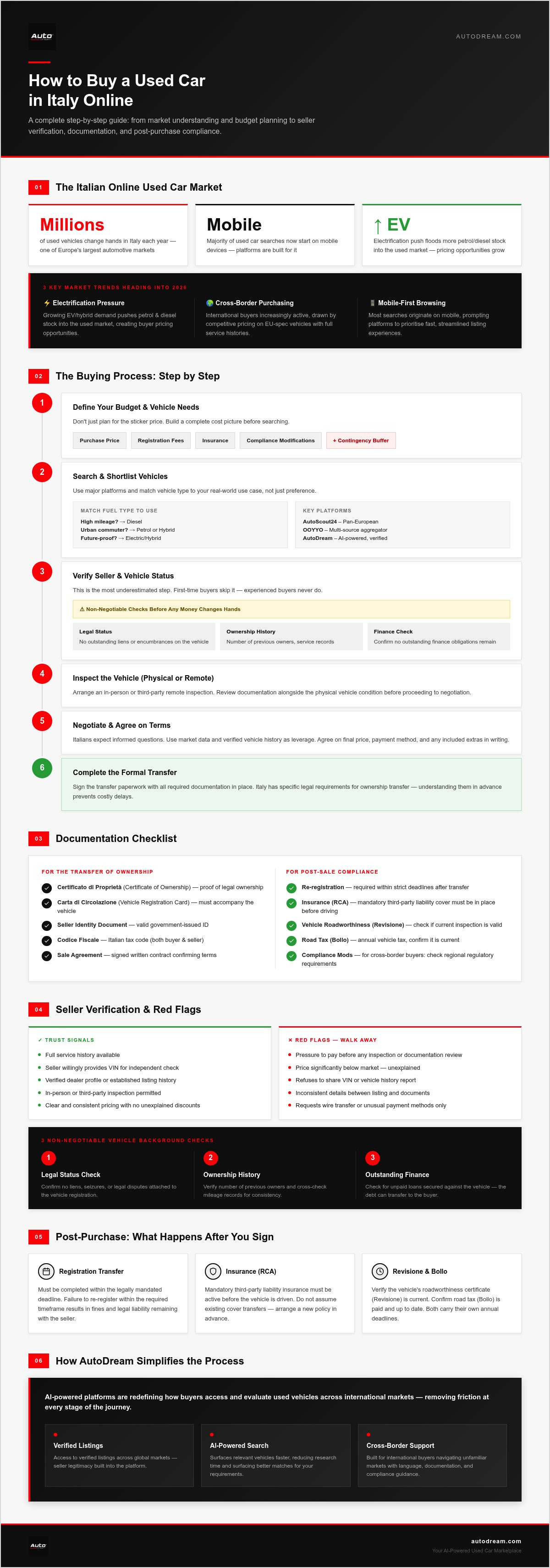
Italy sits among Europe's largest automotive markets, with millions of used vehicles changing hands each year. The shift toward digital channels has accelerated significantly, driven by broader consumer confidence in online transactions and the practical convenience of comparing hundreds of listings without leaving home. For anyone looking to buy a used car in Italy online, understanding how this market is structured is the essential first step.
Cultural attitudes toward car ownership in Italy remain strong. Vehicles are viewed as both practical necessities and personal statements, particularly in regions where public transport infrastructure is limited. This creates a dense, competitive marketplace where supply is high but so is buyer scrutiny. Italians tend to be knowledgeable, detail-oriented car buyers, which means listings are often detailed and sellers expect informed questions.
Several trends are shaping the market heading into 2026:
- Electrification pressure: Growing interest in hybrid and electric vehicles is pushing more petrol and diesel stock into the used market, increasing supply and creating pricing opportunities for buyers.
- Cross-border purchasing: International buyers are increasingly active, drawn by competitive pricing on European-spec vehicles with full service histories.
- Mobile-first browsing: The majority of used car searches in Italy now originate on mobile devices, prompting platforms to prioritise streamlined, fast-loading listing experiences.
Key Players in the Italian Online Car Market
AutoScout24 dominates as the most widely recognised pan-European platform, with a substantial Italian inventory. OOYYO aggregates listings from multiple sources, offering broader reach across regional sellers. Local dealerships maintain a significant online presence through their own websites and third-party platforms, while private sellers operate across both dedicated automotive sites and general classifieds. International sellers have also entered the space, listing vehicles targeted specifically at buyers seeking cross-border deals with transparent documentation.
What to Expect When Buying Online
The typical online purchase in Italy moves through several distinct phases: initial search and shortlisting, seller contact and document verification, physical or remote inspection, negotiation, and finally the formal transfer process. First-time buyers frequently underestimate the verification stage. Confirming a vehicle's legal status, ownership history, and outstanding finance obligations takes time and requires the right tools.
Preparation makes the difference. Before engaging any seller, buyers should define their vehicle requirements precisely, establish a clear budget that accounts for registration and compliance costs, and familiarise themselves with the documentation Italy requires for a legal transfer. Platforms like AutoDream support this process by connecting buyers with verified listings across global markets, using AI-powered tools to surface relevant vehicles and reduce the research burden at every stage.
Step-by-Step Guide to Buying a Used Car Online
A structured approach separates buyers who close confident deals from those who stall mid-process. Whether you're purchasing locally or looking to buy a used car in Italy online from abroad, the same principle holds: decisions made before you contact a single seller determine how smoothly everything that follows will go.
Defining Your Budget and Vehicle Needs
Start with a complete financial picture, not just the sticker price. The purchase price is one line item. Factor in registration fees, insurance, any compliance modifications required for your region, and a contingency buffer for mechanical issues that pre-purchase checks might miss. Buyers who skip this step routinely find themselves stretched after signing.
When selecting a vehicle type, match the car to your actual use case rather than preference alone. Consider:
- Annual mileage: High-mileage drivers benefit from diesel efficiency; urban commuters may find petrol or hybrid models more cost-effective over time.
- Fuel type trajectory: Growing electrification pressure in Europe is shifting more petrol and diesel vehicles into the used market, which creates pricing opportunities but also raises longer-term resale considerations.
- Practicality requirements: Cargo capacity, passenger count, and regional road conditions all narrow the field before you've opened a single listing.
Searching for Listings and Evaluating Options
Effective filtering is a skill. Use platform search tools to set firm boundaries on year range, mileage cap, and fuel type before browsing. Without these constraints, you'll spend hours comparing vehicles that don't actually fit your criteria.
When evaluating a listing, the headline figures only tell part of the story. Mileage matters, but service history consistency matters more. A vehicle with documented maintenance at regular intervals is a stronger candidate than a lower-mileage car with gaps in its records. Look for full-photo listings that include the interior, dashboard, wheel arches, and engine bay. Sparse imagery is a reliable indicator that the seller is either inexperienced or deliberately obscuring condition issues.
Distinguish between private sellers and dealerships early. Dealerships typically offer more structured documentation and may carry limited warranties; private sellers often price more aggressively but require more independent verification on your part.
Negotiation Tips for Online Purchases
Online negotiation rewards preparation. Before making an offer, research comparable listings to establish a credible price anchor. Lead with specific observations: reference the mileage, any visible wear in the photos, or the absence of a full service history. Vague lowball offers tend to end conversations; precise, evidence-based counteroffers keep them open.
Expect counteroffers and treat them as a signal of engagement rather than resistance. Set a firm walk-away figure before negotiations begin and don't revise it under pressure. The Italian used car market has sufficient inventory that patience is a genuine advantage for buyers.
Platforms like AutoDream's global car marketplace streamline this entire process by surfacing verified listings with the detail and transparency that makes informed negotiation possible from the outset.
Verifying Sellers and Ensuring Safe Transactions
Verification isn't a precaution - it's a prerequisite. The moment you decide to buy a used car in Italy online, the quality of your due diligence on the seller becomes just as important as the condition of the vehicle itself. Listings can be polished, prices can look compelling, and sellers can seem cooperative right up until the point they aren't. Knowing how to separate legitimate transactions from fraudulent ones is what keeps buyers protected.
How to Verify Seller Credibility
Start with platform-level signals. Sellers with verified profiles, consistent ratings across multiple transactions, and detailed response histories carry measurably lower risk than anonymous or newly created accounts. Read reviews critically - look for patterns in negative feedback rather than isolated complaints.
Request the following documentation before any negotiation progresses:
- Carta di circolazione (vehicle registration document): Confirms the vehicle's registered details and legal status in Italy.
- Certificato di proprietà or equivalent digital title record: Establishes the seller's legal ownership.
- Full service history records: Receipts, workshop stamps, and maintenance logs that align with the vehicle's stated mileage.
- Valid Italian MOT certificate (revisione): Confirms the vehicle has passed its most recent roadworthiness inspection.
Fraudulent listings share recognisable patterns. Prices positioned significantly below comparable market listings, sellers who resist video calls or live inspections, requests to communicate outside the platform, and vague or inconsistent answers about ownership history are all active warning signs. Trust the friction. If verification feels unusually difficult, that difficulty is information.
Running a background check on the vehicle's identification number through Italian transport authority databases can surface outstanding finance obligations, accident records, or stolen vehicle flags that the listing won't disclose. This step is non-negotiable when purchasing cross-border.
Ensuring a Secure Transaction
Never transfer funds via direct bank wire to a private individual before documentation has been fully verified. Bank transfers offer no recourse once completed. Where the transaction involves a significant sum, escrow services provide a structured hold on payment that releases only when agreed conditions are met, giving both parties a protected framework.
Protect your personal information throughout the process. Share identification documents only through encrypted channels or secure platform messaging systems. Avoid emailing copies of passports or driving licences to unverified parties, and never provide financial account details beyond what's required for the agreed payment method.
Platforms like AutoDream address this friction point structurally, connecting buyers with verified listings that carry the transparency needed to make informed decisions before a single payment is initiated. When you're looking to buy a used car in Italy online, starting within a marketplace built around credibility verification removes the most consequential risks from the outset.
Post-Purchase Steps: Registration, Insurance, and More
Closing the deal isn't the finish line. Once you've successfully managed to buy a used car in Italy online, a set of time-sensitive administrative tasks begins immediately. Miss the deadlines or submit incomplete documentation, and you'll face fines, delays, or a vehicle you legally can't drive. Getting these steps right is as important as the purchase itself.
Vehicle Registration Process in Italy
Registration in Italy is handled through the Motorizzazione Civile, the national transport authority, often in coordination with the Automobile Club d'Italia (ACI) or a local agenzia pratiche auto. The transfer of ownership must be formally recorded within 60 days of the sale date. Missing this window carries financial penalties that scale with the delay.
Documents required to complete registration include:
- Signed transfer declaration (atto di vendita): Completed and signed by both buyer and seller, confirming the sale terms.
- Carta di circolazione: The vehicle's circulation document, which must be updated to reflect the new owner's details.
- Valid identity documents: Passport or national ID for both parties involved in the transaction.
- Proof of insurance: Active Italian insurance coverage is required before the vehicle can be legally driven post-transfer.
- Payment of applicable taxes and fees: Transfer taxes and administrative fees are calculated based on vehicle type and engine capacity.
The most common registration pitfall is assuming the seller has already initiated the process. Confirm explicitly who is responsible for filing, and follow up with written confirmation. For cross-border purchases, additional documentation verifying the vehicle's import compliance may be required before domestic registration can proceed.
Choosing the Right Insurance
Italian law mandates a minimum of RCA coverage, Responsabilità Civile Auto, which is third-party liability insurance. This is non-negotiable and must be in place before the vehicle is driven. Beyond the legal minimum, buyers should evaluate:
- Kasko (comprehensive coverage): Covers damage to your own vehicle regardless of fault, recommended for higher-value purchases.
- Furto e incendio (theft and fire): A mid-tier option that extends beyond liability without full comprehensive cost.
- Cristalli and assistenza stradale: Glass coverage and roadside assistance add-ons that are often undervalued until they're needed.
Compare quotes across multiple Italian insurers before committing. Premiums vary based on the vehicle's age, engine size, your driving history, and the province of registration. Italian insurers use a classe di merito bonus-malus system, so your prior claims history directly affects your premium tier.
Post-purchase maintenance planning deserves equal attention. Locate a certified workshop familiar with your vehicle's make, schedule a full mechanical inspection within the first month of ownership, and establish a maintenance calendar aligned with the manufacturer's service intervals.
The administrative complexity that follows a purchase is precisely where preparation pays dividends. Explore the AutoDream global car marketplace to access verified listings that come with the documentation transparency needed to move confidently from purchase to registration without unnecessary delays.
Why Choose AutoDream for Your Used Car Purchase?
Every stage of the buying process described in this guide carries a common thread: the right platform removes friction before it becomes a problem. AutoDream is built around that principle. It's a smart global marketplace that connects buyers with a diverse range of used vehicles across multiple countries, combining AI-powered tools with a structure designed specifically to support confident, informed purchasing decisions.
For anyone looking to buy a used car in Italy online, the platform addresses the two challenges that derail most buyers: finding genuinely verified listings and navigating an unfamiliar market without losing time to dead ends. AutoDream solves both simultaneously.
Innovative Features of AutoDream
The AI-Powered Dealer Dashboard is the platform's most distinctive capability. It gives dealers the tools to manage and present inventory with a level of detail and consistency that makes buyer evaluation faster and more reliable. Listings surfaced through the dashboard carry structured data rather than ad-hoc descriptions, which means buyers spend less time chasing missing information and more time making decisions.
Multilingual support removes one of the most persistent barriers in cross-border purchasing. Language gaps don't just slow transactions; they introduce ambiguity at exactly the moments where precision matters most. AutoDream's multilingual functionality keeps communication clear across markets, so buyers engaging with Italian inventory aren't disadvantaged by the language of the listing.
Buyer confidence is reinforced through the platform's commitment to listing transparency. Featured Listing Placements highlight inventory that meets elevated standards of detail and documentation, giving buyers a reliable shortcut to the strongest candidates in any search.
Customer Testimonials and Success Stories
Buyers who've used AutoDream to navigate international markets consistently highlight the same advantages: the reduction in back-and-forth with sellers, the clarity of vehicle information presented upfront, and the structured experience that makes cross-border purchasing feel manageable rather than speculative.
Where competitors offer broad inventory with minimal curation, AutoDream's AI-driven approach surfaces relevant vehicles faster and presents them with the depth that informed buyers actually need. The difference isn't just convenience; it's the removal of the uncertainty that typically defines used car purchases across unfamiliar markets.
The result is a buying experience that moves at the speed of a confident decision. From your first search to your final documentation, AutoDream is built to keep you in control at every step. Explore the AutoDream global car marketplace and find your next vehicle with the clarity this process deserves.
Your Next Vehicle is Closer Than You Think
The process to buy a used car in Italy online is genuinely manageable when you approach it with the right structure. Set a complete budget before you search, verify sellers and vehicle documentation before any money moves, and treat post-purchase registration and insurance as part of the purchase plan, not an afterthought.
What separates a confident transaction from a costly one isn't luck; it's preparation and the quality of the platform you use. A global marketplace with diverse listings, AI tools built for smarter buying decisions, and expert support for international transactions removes the friction that stops most buyers before they even start.
That's precisely what AutoDream delivers. Whether you're navigating your first cross-border purchase or expanding a fleet across markets, the platform is built to move at the speed of an informed decision.
You've got the knowledge. Now take the next step. Start your journey to buy a used car in Italy with AutoDream today!
Frequently Asked Questions
What documents do I need to buy a used car in Italy?
You'll need the carta di circolazione (vehicle registration document), the certificato di proprietà or its digital equivalent confirming the seller's legal ownership, a valid Italian MOT certificate (revisione), and a signed transfer declaration (atto di vendita) completed by both parties. Full service history records and proof of active Italian insurance are also required before the vehicle can be legally driven.
For cross-border purchases, additional import compliance documentation may be necessary before domestic registration can proceed. Confirm every document is present before any payment is initiated.
Is it safe to buy a used car in Italy online?
Yes, it's safe when you follow a structured verification process. The risk doesn't come from buying online itself; it comes from skipping due diligence. Stick to platforms with verified seller profiles, request full documentation upfront, and run a vehicle identification number check through Italian transport authority databases to surface any outstanding finance, accident history, or stolen vehicle flags.
Using a structured marketplace to buy a used car in Italy online adds a layer of credibility from the start. Platforms like AutoDream connect buyers with listings that carry transparent documentation, reducing the verification burden at every stage.
How do I check the history of a used car?
Run the vehicle's identification number through Italian transport authority databases to access ownership history, outstanding finance obligations, and any stolen vehicle records. Cross-reference the mileage against service history receipts and workshop stamps to confirm consistency. Gaps between documented services and the vehicle's stated mileage are a reliable red flag worth investigating before progressing.
Third-party vehicle history report services can supplement official checks, particularly for cross-border purchases where records may span multiple countries.
Can I get financing for a used car purchased online?
Financing options do exist for used car purchases in Italy, typically through Italian banks, credit unions, or specialist auto finance providers. The terms available to you will depend on your residency status, credit history, and the lender's policies toward cross-border buyers. Some dealerships also arrange financing directly through partner institutions.
AutoDream does not offer direct vehicle financing, so buyers should secure pre-approval from a lender before beginning their search. Knowing your financing ceiling in advance strengthens your negotiating position considerably.
What should I look for during a used car inspection?
Request a live video walkthrough if a physical inspection isn't possible. Ask the seller to show the engine bay, wheel arches, door sills, and undercarriage, as these areas reveal rust, accident repairs, and structural concerns that exterior shots routinely miss. Check that the dashboard warning lights behave correctly at startup and that the mileage on the odometer matches the service history documentation.
For higher-value purchases, commissioning an independent mechanical inspection through a certified local workshop is a worthwhile investment. No listing photo substitutes for a trained eye on the vehicle itself.
Are there any additional fees when buying a car online?
Yes, and underestimating them is one of the most common buyer mistakes. Beyond the purchase price, budget for transfer taxes, registration fees calculated on vehicle type and engine capacity, insurance premiums, and any compliance modifications required for your region. If you're purchasing cross-border, import duties and additional administrative processing costs may apply before domestic registration can be completed.
Platform listing fees are typically absorbed by the seller, but confirm this with the platform before assuming. Build a complete cost model before you make an offer, not after.
How can I negotiate the price of a used car?
Effective negotiation starts with research. Identify comparable listings across multiple platforms to establish a credible price range, then anchor your offer to specific, observable details: mileage, service history gaps, visible wear in the listing photos, or the absence of a full revisione. Evidence-based counteroffers keep negotiations productive; vague lowball figures tend to end them.
Set a firm walk-away figure before any conversation begins and don't revise it under pressure. Italy's used car market carries sufficient inventory that patience works in a buyer's favour. The right vehicle at the right price is available; the process rewards those who don't rush it.
Ready to list your car?
Put your vehicle details and photos together, then start your listing on AutoDream.
Create your listing