
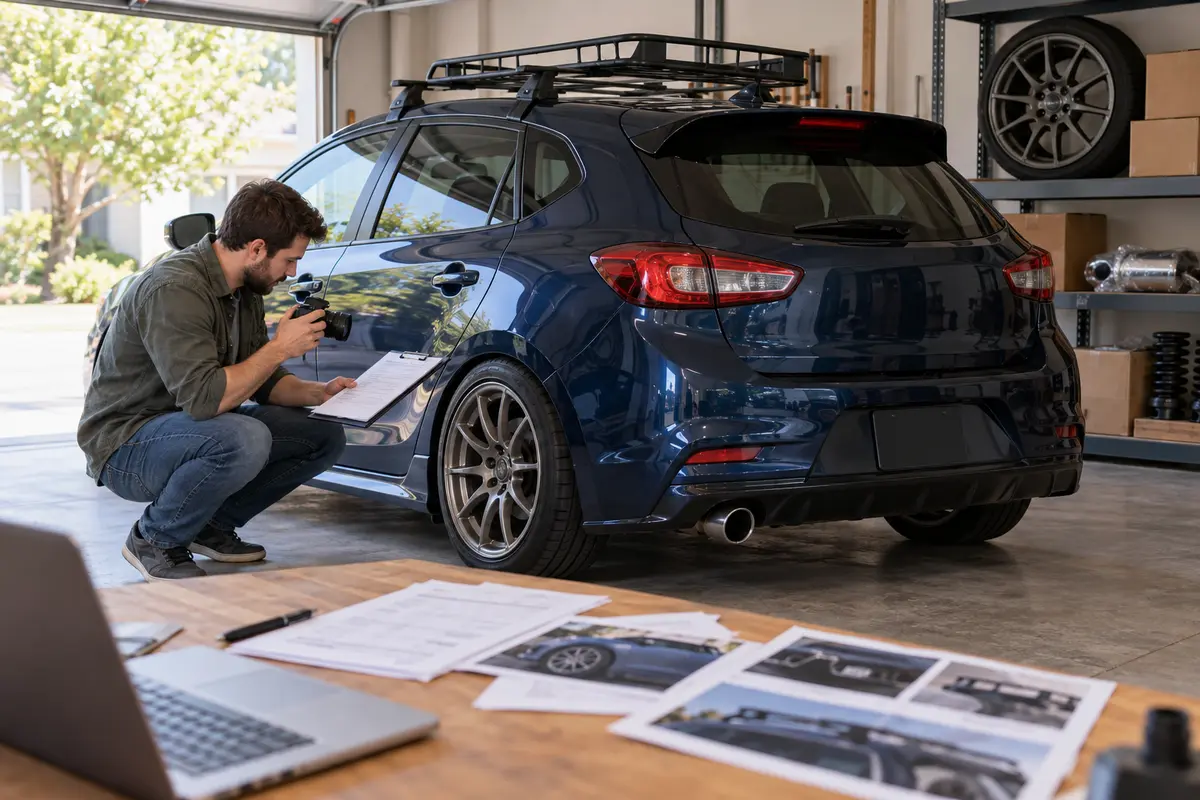
A modified car needs more than the word “custom.” A useful listing tells a buyer what changed from the original configuration, who performed the work, when it was done, what evidence exists, what the seller has personally verified, and which questions remain open. That information helps a buyer decide what to research and inspect before making an offer.
This guide is for a private seller documenting a used car with owner-installed, shop-installed or previously installed changes. It is not a certification that a modification is safe, legal, emissions-compliant, warranty-covered or suitable for a buyer's location. Rules and inspection requirements vary by vehicle and jurisdiction. The illustration above is fictional and is not evidence of a real vehicle, installation, inspection or approval.
1. Start with the exact car and its original baseline
Record the year, make, model, trim, VIN and current odometer reading before listing the changes. Check the physical vehicle and available manufacturer or dealer records rather than assuming that every feature normally associated with a trim is original to this car.
NHTSA's VIN decoder can return manufacturer-reported information encoded in a VIN. Use it as an identity cross-check, not as proof of every factory option, present component, ownership fact or modification. If the car's equipment does not match the records you have, describe the difference and keep the origin marked unknown until better evidence is found.
2. Build a modification inventory before writing the ad
Walk around the car, inspect the interior, review invoices and ask a knowledgeable shop about changes you cannot identify. Create one row per change. Do not combine an entire suspension, audio or exhaust system into one vague entry when the components have different origins or evidence.
| Field | What to record |
|---|---|
| System and component | For example: front springs, rear dampers, wheel set, head unit or rear muffler. |
| Part identity | Brand, part number and model only when visible or supported by a record. |
| Change from original | What was replaced, added, removed, reprogrammed or returned to stock. |
| Installer | Named shop, seller, prior owner or unknown. |
| Date and mileage | Exact values from an invoice, or clearly labeled estimates. |
| Evidence | Invoice, work order, part label, manual, dated photo or seller observation. |
| Current condition | What was tested or observed, plus any noise, wear, damage or warning light. |
| Original parts | What is included, missing, damaged or not confirmed to fit. |
Use “unknown” when a fact is unknown. A blank field or a confident guess is less helpful than a precise limit such as “installed before my ownership; installer and mileage not documented.”
3. Classify each item by origin and present state
Buyers often need to distinguish factory equipment from later changes. Apply one evidence-based label to each item:
- Factory-installed: supported by a manufacturer build record or equivalent vehicle-specific evidence.
- Dealer-installed: supported by a dealer invoice or work order that identifies this vehicle.
- Aftermarket, documented: the installed part and work are supported by a receipt, label, installation record or other specific evidence.
- Aftermarket, identity not confirmed: a visible change is present, but its exact brand, part number or history is unknown.
- Returned to original configuration: a prior change was removed; state what was restored, by whom and what evidence supports the statement.
- Partly reverted: some original components were reinstalled but other changes remain.
A part that looks original is not necessarily factory-installed, and a factory-brand accessory may have been fitted later. Describe the evidence, not the appearance alone.
4. Describe the effect on each system without sales shorthand
Replace words such as “upgraded,” “performance,” “stage,” “tuned” and “built” with the actual component and change. If a term comes from a part label or invoice, identify the source instead of presenting it as your independent conclusion.
| System | Useful listing details | Claims to avoid without proof |
|---|---|---|
| Wheels and tires | Wheel dimensions, tire size, visible condition, installed sensors and included original set. | “Perfect fit,” “no rubbing” or universal compatibility based only on appearance. |
| Suspension and brakes | Named components, ride-height change if measured, alignment record and current noises or wear. | Safety, handling or stopping-distance improvements without relevant testing. |
| Engine, intake, exhaust and software | Exact installed components, invoice, software provider/version if documented, warning lights and available original parts. | Horsepower, emissions compliance, fuel economy or “factory reliability” without current vehicle-specific evidence. |
| Lighting and body | Component identity, wiring changes, lens condition, operation observed and removed original pieces. | “DOT approved” or “street legal everywhere” from a logo, packaging or seller recollection. |
| Interior and safety-related equipment | Seat, belt, steering-wheel, airbag, control or mounting changes and any warning indicators. | Crash protection or restraint performance after a modification without qualified confirmation. |
| Electrical, audio and cameras | Added equipment, power source, visible wiring, included controls, known faults and whether factory functions remain. | Compatibility with every phone, subscription or future software version. |
| Towing, roof and cargo equipment | Hardware identity, keys, mounting points, included accessories and documented limits from the exact component. | A new vehicle tow or load rating inferred from an accessory. |
5. Match every important claim to evidence
The FTC's advertising substantiation policy explains that an objective advertising claim should have a reasonable basis before it is communicated. For a private listing, that is a practical standard even where a particular business-advertising rule may not apply in the same way.
Keep the evidence vehicle-specific whenever possible. An invoice that identifies the VIN and part number is stronger than a generic product page. A photograph can show that a component appears to be present, but it may not establish internal settings, correct installation or compliance. A dyno chart without the vehicle identity, date, configuration and test conditions should not become a precise horsepower claim.
Separate three kinds of statements:
- Documented: “Invoice dated May 14, 2024 lists part ABC-123 at 42,180 miles.”
- Observed: “I photographed the label ABC-123 on the installed component on September 30, 2026.”
- Reported but unverified: “The prior owner told me the software was changed; I do not have the file or invoice.”
6. Report current condition separately from installation history
An old installation invoice does not show how a part works today. State what you personally observed and when: warning lights at startup, noises, leaks, tire contact, uneven wear, loose trim, damaged wiring, missing controls or a function that was not tested. Avoid turning one short drive or a clear dashboard into a guarantee.
Use literal descriptions such as “exhaust is louder than the original system” or “front bumper has two drilled mounting holes.” Do not diagnose the cause of a sound or warning unless a qualified report supports it. If the car was inspected after the work, name the shop, date and scope; do not describe a limited check as approval of the entire modified vehicle.
7. Be precise about emissions, lighting and other compliance questions
Do not label a modified vehicle “street legal,” “EPA approved,” “CARB legal,” “DOT approved” or compliant in every state based on a sticker, seller memory or a generic product page. The exact vehicle, part, configuration and current jurisdiction matter, and requirements can change.
The EPA's current aftermarket-parts statement says aftermarket parts cannot bypass, tamper with or remove emissions controls. EPA also maintains an aftermarket defeat-device and tampering fact sheet. If emissions-related hardware or software has been changed, identify the exact parts and records and ask a qualified professional or the relevant authority about the current vehicle and location before making a compliance claim.
NHTSA's interpretation concerning aftermarket lighting explains that businesses may not knowingly make federally required safety equipment inoperative and that owner modifications remain subject to state law. That document does not certify a specific lamp or installation. List the component and what you know, and let the buyer verify the rules that apply where the car will be registered and driven.
8. List original parts and reversibility honestly
If original parts are included, inventory them individually. Photograph their condition and labels without exposing private information. State whether fasteners, wiring, keys, controllers, trim pieces and manuals are present. “Original parts included” should not mean a loose collection that has not been matched to the car.
A change is not automatically “fully reversible.” Returning to the original configuration may require missing hardware, programming, calibration, alignment, paint or professional labor. If you have not confirmed the process, say “original components shown are included; cost, completeness and feasibility of reinstallation have not been verified.”
Copy-and-paste modification section
Modifications and changes from original configuration
Component/system: [exact item]
What changed: [replaced, added, removed, programmed or restored]
Part identity: [brand/part number, or not confirmed]
Installed by: [shop/seller/prior owner/unknown]
Date and mileage: [documented values, estimate clearly labeled, or unknown]
Evidence available: [invoice/work order/label/photo/manual/none]
Current condition: [dated observation, known fault and untested function]
Original parts included: [itemized list and condition]
Open questions: [identity, calibration, compliance, warranty or inspection item]
Example: clear language for a fictional modified hatchback
“The car currently has 17-inch aftermarket wheels and a roof rack. The wheel backs are marked Example W17; I have not confirmed the offset from a manufacturer record. Tires are 225/45R17 and their condition is shown by position in the photos. A shop invoice dated June 8, 2025 at 51,240 miles lists replacement springs and an alignment; the current odometer reads 58,310. I hear no suspension noise on my normal route, but that observation is not an inspection.
The rear muffler was installed before I owned the car. I do not have the installation invoice or a verified performance figure. The exhaust is louder than the original system, and no dashboard warning light was illuminated during the September 30 photo session. I have not independently verified emissions or noise compliance for the buyer's location.
Included separately: four used factory-style wheels, the removed rear muffler and roof-rack keys. I have not confirmed that the loose fasteners are complete or that returning the car to its prior configuration requires no additional parts or labor. An independent inspection is welcome by arrangement.”
The example is fictional. It works because every fact has a source or limit, and it does not turn an observation into a performance, safety or compliance guarantee.
Pre-publish checklist
- Confirm the exact vehicle identity and current odometer reading.
- List every visible, documented or reported change by system.
- Separate factory, dealer-installed, aftermarket, reverted and unknown items.
- Record the part number, installer, date and mileage only when supported.
- Label statements as documented, observed, reported or unknown.
- Show relevant components and defects with current, unedited factual photos.
- Report warning lights, noises, damage and functions not tested.
- Remove unsupported horsepower, fuel-economy, safety and compatibility claims.
- Do not make broad legal or emissions-compliance claims from a sticker or product page.
- Itemize the original parts, hardware, controls and records actually included.
- State what an inspection did and did not cover.
- Offer the buyer a reasonable way to verify material changes before purchase.
A careful modification section does not need to persuade every buyer. Its job is to create a reliable starting record: what changed, what supports the description, what the seller observes now, what comes with the car and what still needs professional or jurisdiction-specific verification.
Ready to list your car?
Put your vehicle details and photos together, then start your listing on AutoDream.
Create your listing

