
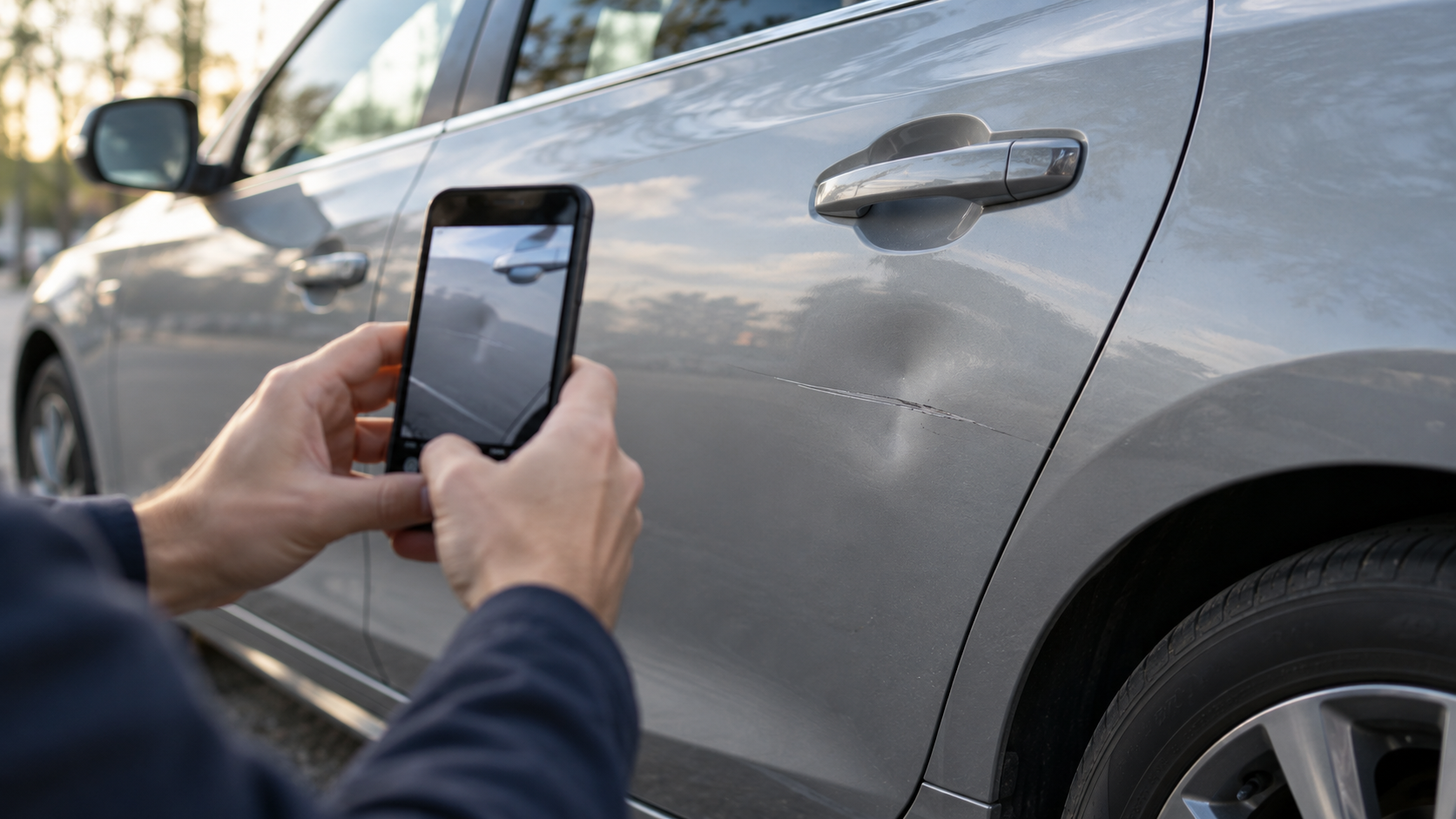
“Normal wear for its age” does not tell a buyer what is actually on the car. A stronger advertisement identifies each noticeable issue, says where it is, and pairs the description with a current photograph. You do not need to diagnose every mark or make the vehicle sound perfect.
This guide is for private sellers and dealerships writing a used-car listing. It focuses on visible condition, not a mechanical inspection or a legal disclosure checklist. Requirements differ by location and seller type, so check the rules that apply to the transaction.
1. Walk around the car and make a condition map
Inspect the car in daylight after removing dirt and loose belongings that would hide its surfaces. Work in the same order each time: front, passenger side, rear, driver side, wheels, glass, cabin and cargo area. Write down what you can actually see before trying to make the wording concise.
For every noticeable item, record five details:
- What: scratch, paint chip, scuff, dent, crack, stain, tear, fading or worn surface.
- Where: the exact panel or interior area, such as the right rear door or the outer edge of the driver's seat bolster.
- Extent: one mark or several, and an approximate size when a photograph alone could mislead.
- Current state: whether it is visible now, repaired, or awaiting repair.
- Evidence: the photo number or repair document that supports the description.
Use ordinary words consistently. Do not switch between “rear bumper,” “back panel” and “quarter panel” if you are unsure which part is affected. A location such as “left side of the rear bumper cover” is more useful than an uncertain technical label.
2. Replace vague adjectives with observable facts
Words such as “minor,” “excellent” and “like new” depend on the reader's expectations. They can summarize an impression, but they should not replace the actual details.
Compare these examples:
- Vague: “A few minor scratches.” Specific: “Two scratches on the lower right rear door; the longer one is approximately 3 inches (8 cm). See photos 12 and 13.”
- Vague: “Small parking dent.” Specific: “Shallow dent above the left rear wheel opening, visible from the side; paint appears intact in the current photos.”
- Vague: “Clean interior.” Specific: “No tears noticed on the passenger seats. The driver's outer seat bolster has surface creasing and a worn patch shown in photo 18.”
- Vague: “Usual wheel wear.” Specific: “Scuffs on the outer rim of the front-right wheel, shown in close-up.”
Only state what you have checked. “Paint appears intact” is an observation; “no damage underneath” is a diagnosis you may not be able to support. If a body shop inspected or repaired an area, identify the dated document you have rather than expanding its conclusion.
3. Describe interior wear area by area
Interior wear is easier to understand when it is tied to a surface and a photo. Check the driver's seat and controls first because they are handled most often, then the other seats, headliner, carpet, dashboard, door trim and cargo area.
- Seats: note creasing, worn bolsters, stains, loose stitching, tears or repaired areas.
- Controls: show worn steering-wheel material, faded symbols, cracked trim or damaged buttons. Do not claim a system works merely because its button looks intact.
- Carpet and cargo space: identify stains, fraying, punctures and missing panels or covers.
- Odor: describe a persistent odor you have noticed, but avoid absolute claims such as “smoke-free” unless you have a sound basis for them.
Separate appearance from operation. “The climate-control display has scratches” describes a surface; “the climate control operates” is a different claim that should be checked independently.
4. Use three photographs for an important mark
A single close-up can make it hard to tell where a defect is, while a distant photograph can make it impossible to judge. For a noticeable dent, scratch or tear, use:
- An overview that identifies the car, panel or cabin area.
- A medium view that locates the mark on that area.
- A sharp close-up that shows its edges and surface.
If size is not obvious, include a familiar reference beside the mark without covering it, or give an approximate measurement in the text. Photograph in even daylight when possible. Reflections can hide a dent, so take a second angle if the contour disappears in the first image.
Basic cropping and exposure correction can make a photograph easier to see. Do not digitally remove a scratch, reshape a dent, clone clean upholstery over a stain, or use a beauty filter that changes the vehicle's apparent condition. Keep the detailed images with the listing instead of promising to reveal them only after a buyer travels.
5. Explain repairs and unknowns without guessing
A repaired area still belongs in the condition history when it is relevant to the listing. Say what was done, when, by whom if documented, and what record is available. For example: “The right rear bumper cover was refinished in March 2025; invoice available.” Do not turn a paint invoice into a claim that no other damage occurred.
If you cannot tell whether a line is a surface transfer or a deeper scratch, say that it is a visible mark and provide the close-up. If you do not know what caused a dent, do not invent a parking-lot story. An honest “cause unknown” is better than a confident explanation you cannot verify.
A history report and photographs also have limits. The FTC's used-car resources explain that a vehicle history report is not a substitute for an independent inspection and recommend an inspection for hidden damage. Your listing should help a buyer decide what to examine; it should not present photographs as proof of the car's complete mechanical condition.
6. A separate note for U.S. dealers
Condition wording in an online advertisement does not replace dealer-specific paperwork or state requirements. The FTC's Dealer's Guide to the Used Car Rule says most U.S. dealers who offer more than five used vehicles in a 12-month period must comply with the Rule, with stated exemptions. The required Buyers Guide addresses warranty status and other prescribed information; it is not a photo-based condition report.
The FTC also says the same truth-in-advertising standards apply across media, including online advertising. Review the agency's truth-in-advertising overview, then check state and local rules relevant to your dealership. Keep the ad, inspection notes, repair records and Buyers Guide consistent instead of assuming one document corrects a misleading statement in another.
A fictional condition-description example
Exterior: two scratches on the lower right rear door, approximately 3 inches and 1 inch long; close-ups are photos 12–13. A shallow dent is visible above the left rear wheel opening in photos 14–15. The front-right wheel has scuffs around part of the outer rim, shown in photo 16.
Interior: the driver's outer seat bolster has creasing and one worn patch; no tear noticed there. The cargo-floor carpet has a stain near the rear edge. See photos 18–20.
Repair record: the right rear bumper cover was refinished in March 2025; invoice available. I have not obtained an independent condition inspection for this listing.
This example describes an imaginary vehicle. The measurements, repair and photo numbers are placeholders to demonstrate structure, not facts about a current AutoDream listing.
Condition checklist before publishing
- Every notable mark has a clear name and exact location.
- Approximate measurements include a unit.
- Overview and close-up photos show the same current condition.
- No filter or edit hides a defect.
- Appearance claims are separated from mechanical claims.
- Repairs are described only as far as records support them.
- Unknown causes and unverified conclusions remain clearly unknown.
- The listing is updated if new damage occurs or a repair is completed.
Before a buyer arrives, compare the listing with the actual car one more time. Then use the seller's viewing preparation checklist to organize records and the appointment. A condition description succeeds when the buyer can locate each stated issue and ask a better question about it.
Ready to list your car?
Put your vehicle details and photos together, then start your listing on AutoDream.
Create your listing

