
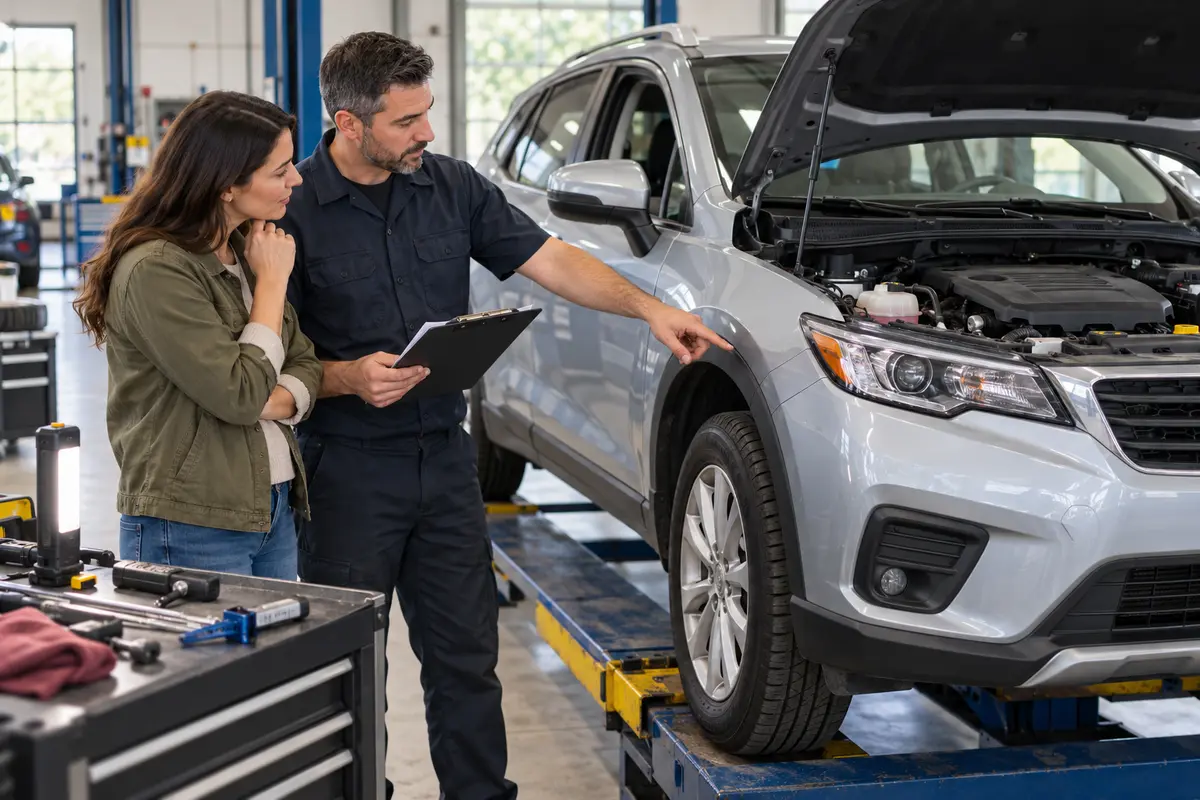
An independent inspection works best when the buyer, seller and mechanic agree on the practical details before the car reaches a workshop. A vague request to “check everything” can leave important questions unanswered, while a clear work order can identify what was examined, what was not, and which findings need a specialist or a second opinion.
This guide is for a buyer arranging a pre-purchase inspection of a used car. It is not a universal inspection standard, a safety certificate, a warranty or a prediction of future reliability. The inspection scope, shop practices, road-test permissions and legal requirements vary by vehicle, location and seller. The illustration above is fictional and is not evidence that a real vehicle was inspected or passed.
1. Get the seller's agreement before booking
Ask the seller whether the exact vehicle can be inspected by a mechanic you choose. Put the appointment, location, expected duration, transportation plan and fee responsibility in writing. If the car cannot leave a dealer's lot, ask whether a mobile inspector can visit or whether the seller can take it to the selected facility.
The FTC's used-car buying guidance tells dealer customers that a history report is not a substitute for an independent inspection. It also suggests considering another dealer when a dealer will not allow one. Private-party logistics can differ, so agree on access rather than assuming the seller must release the car.
Do not send an inspection fee to an unknown seller or hand over a deposit merely because an appointment was proposed. Confirm the shop independently, understand its payment policy, and keep the inspection decision separate from any purchase or reservation terms.
2. Identify the exact car on the work order
Give the shop the year, make, model, VIN and current odometer reading before the inspection. Ask the technician to match the VIN on the vehicle to the work order and written report. This helps prevent findings from being attached to the wrong car.
NHTSA's VIN decoder can identify information encoded in a VIN from manufacturer-reported data. Use it as an identity cross-check, not as proof of ownership, current mileage, installed options or condition. Resolve any mismatch among the car, listing, documents and decoded identity before relying on the report.
3. Choose a shop that is independent of the sale
Ask whether the shop routinely inspects the relevant vehicle type and whether it has the equipment and training needed for that car. A hybrid, electric vehicle, heavily modified car, specialty model or vehicle with advanced driver-assistance equipment may require expertise beyond a general visual check.
The FTC's auto-repair guidance recommends asking whether a technician has experience with the same make or model and checking relevant licenses where required. It also notes that certifications indicate certain knowledge standards but are not, by themselves, a guarantee of honest or correct work.
Ask whether the shop performs only inspections or also sells repairs. Either business model can produce useful work, but you should know who may benefit from the recommended repair. For expensive or complicated findings, consider a second opinion before making a purchase or authorizing work.
4. Define the inspection scope and exclusions
Ask for the shop's inspection checklist before the appointment. Do not assume that a quoted inspection includes a lift, road test, diagnostic scan, battery assessment, paint-depth measurement, compression test, alignment measurement, fluid analysis or specialist review. Each can require different equipment, time, access or authorization.
| Area | Questions to put on the work order | Possible limit to record |
|---|---|---|
| Identity and mileage | Did the VIN and odometer match the booking information? | Ownership and title are not established by a mechanical inspection. |
| Exterior and structure | Which visible panels, glass, lights, seals and accessible structural areas were examined? | Hidden damage may require disassembly or a body specialist. |
| Underside and leaks | Was the vehicle safely lifted, and which accessible areas were viewed? | Shields, dirt or recent cleaning can limit visibility. |
| Tires, wheels and brakes | Were condition, visible damage and available measurements recorded by position? | A snapshot does not predict remaining service life. |
| Engine, cooling and transmission | What operating checks were performed, and at what temperature? | No brief check can expose every intermittent or future problem. |
| Electrical systems and warning lights | Which controls were operated, and were any warning indicators present? | Feature presence and one successful test do not establish long-term reliability. |
| Diagnostic scan | Was a scan included, which modules were accessed, and were codes saved? | No-code results do not prove that every system is fault-free. |
| Road test | Was a road test authorized, completed and suitable for the symptoms being checked? | Traffic, speed, weather or insurance restrictions may limit it. |
| Hybrid or EV systems | Does the shop provide an appropriate battery and high-voltage-system assessment? | A dashboard range estimate is not a battery-health certificate. |
The shop should mark anything it could not inspect. “Not checked,” “not accessible,” “test not authorized” and “specialist review recommended” are useful findings, not empty spaces to be treated as a pass.
5. Give the mechanic the evidence and questions that matter
Send the listing, known defect notes, relevant service records, warning-light photos and the seller's answers before the appointment. Identify symptoms precisely: when they occur, whether the car is cold or warm, the speed range, sound location and any recent repair. Do not ask the mechanic to confirm a conclusion you have already chosen.
Keep sources separate. A seller statement is reported information. An invoice documents the work written on it. A history report summarizes certain recorded events. The mechanic's findings describe the checks performed at the inspection. None automatically proves the others.
6. Ask for a written report you can actually use
The FTC recommends requesting a written report with estimated repair costs and making sure the report identifies the car by make, model and VIN. Before booking, ask whether the shop's report will include:
- inspection date, location and vehicle identity;
- the checklist or stated scope;
- observations and measurements by component or position;
- photographs when they clarify a finding;
- diagnostic codes or test results actually obtained;
- items not checked and the reason;
- recommended next tests or specialist reviews;
- repair priorities and an estimate where the shop offers one;
- the technician or shop contact for questions.
Ask the technician to distinguish observations, diagnoses and recommendations. “Oil residue visible near the lower engine cover” is an observation. Its source may require cleaning, tracing or disassembly. A repair estimate should state its assumptions; it is not a promise that no other work will be needed.
7. Keep the inspection, history, recalls and warranty separate
An independent mechanical inspection evaluates the car within its stated scope at a particular time. It does not replace a title check, ownership verification, history report, recall lookup, warranty review or final contract review.
NHTSA's recall lookup lets a user check a specific VIN or license plate for open safety recalls. Record the lookup date and follow NHTSA's directions for an open recall. A zero-result lookup does not certify the vehicle's overall safety or mechanical condition, and recall information can change.
For a dealer sale, compare the inspection with the current Buyers Guide and written warranty or “as is” terms. The inspection does not expand coverage by itself. Put any negotiated repair, price change or condition of sale in the final written documents rather than relying on a conversation.
8. Turn findings into a decision, not a pass-or-fail sticker
Read the report with the mechanic while the details are fresh. Sort each material item into one of four groups:
| Decision group | Meaning | Next step |
|---|---|---|
| Understood | The finding and likely consequence are clear enough for your decision. | Accept it, negotiate written terms, or decline. |
| Needs evidence | The finding is incomplete or conflicts with another source. | Request a record, targeted test or specialist opinion. |
| Not inspected | The area or function was outside scope or inaccessible. | Decide whether the uncertainty is acceptable or arrange another check. |
| Deal breaker | The cost, risk or uncertainty exceeds your limit. | Pause or walk away without converting the inspection fee into pressure to buy. |
Set those limits before you see the report. A sunk inspection fee is not a reason to purchase a car that no longer fits your needs. Conversely, a list of ordinary maintenance items is not automatically a reason to reject a vehicle; the useful question is whether the condition, price, written terms and remaining uncertainty work for you.
A practical inspection request
I am interested in the [year, make, model and VIN]. Before deciding, I would like an independent pre-purchase inspection at [shop] on [full date and time]. The shop estimates [duration] and [fee], which [buyer/seller] will pay. Please confirm whether the vehicle may leave the property, whether a road test is permitted, who will transport it, and who the shop should contact for access. I will ask the shop to identify the vehicle, follow its written checklist, record anything it cannot inspect, and send me the report. This appointment is not a promise to buy or a guarantee that the vehicle will pass.
Replace every bracketed field and remove any sentence that is not true. Keep reservation, deposit and purchase terms in separate written records.
A fictional inspection plan
A buyer is considering a fictional 2019 crossover. The seller agrees that a local independent shop can inspect it on Tuesday. The buyer confirms a fee, pays the shop directly, sends the listing and a photo of an intermittent warning light, and asks whether a lift, road test and diagnostic scan are included.
The report matches the VIN, records tire and brake observations by wheel position, notes fluid residue that needs tracing, saves one diagnostic code and states that the road test was shortened by heavy traffic. The shop provides an estimate for the clearly identified work and recommends a specialist diagnosis for the unresolved warning. The buyer does not call the car “passed.” The buyer compares the written findings, price, warranty documents and remaining uncertainty before deciding.
Every vehicle, person, finding, shop and price arrangement in this example is fictional. It illustrates documentation and decision boundaries, not a real inspection outcome.
Independent inspection checklist
- Confirm the seller allows an independent inspection.
- Choose the shop yourself and verify its contact details.
- Ask about relevant vehicle experience, equipment and credentials.
- Put the date, location, duration, fee and transport plan in writing.
- Identify the exact vehicle by year, make, model, VIN and odometer reading.
- Ask the shop to match the VIN on the car and report.
- Review the inspection checklist and every exclusion before booking.
- Confirm whether lift access, a road test and a diagnostic scan are included.
- Share known symptoms, records and condition questions.
- Request measurements, photos and codes when they support a finding.
- Require uninspected or inaccessible items to be labeled.
- Ask for a written report with repair estimates and assumptions.
- Keep the mechanical inspection separate from title, history and recall checks.
- Compare findings with warranty and final sale documents.
- Get a second opinion for expensive, complex or uncertain recommendations.
- Decide which unknowns you will accept before negotiating.
- Put any repair or price agreement in writing.
- Walk away if access, identity or material findings cannot be resolved.
A useful inspection does not make a used car risk-free. It gives you a dated record of the exact vehicle, the checks that were performed, the findings that were documented and the uncertainties that remain—enough structure to make a more deliberate buying decision.
Ready to list your car?
Put your vehicle details and photos together, then start your listing on AutoDream.
Create your listing

