
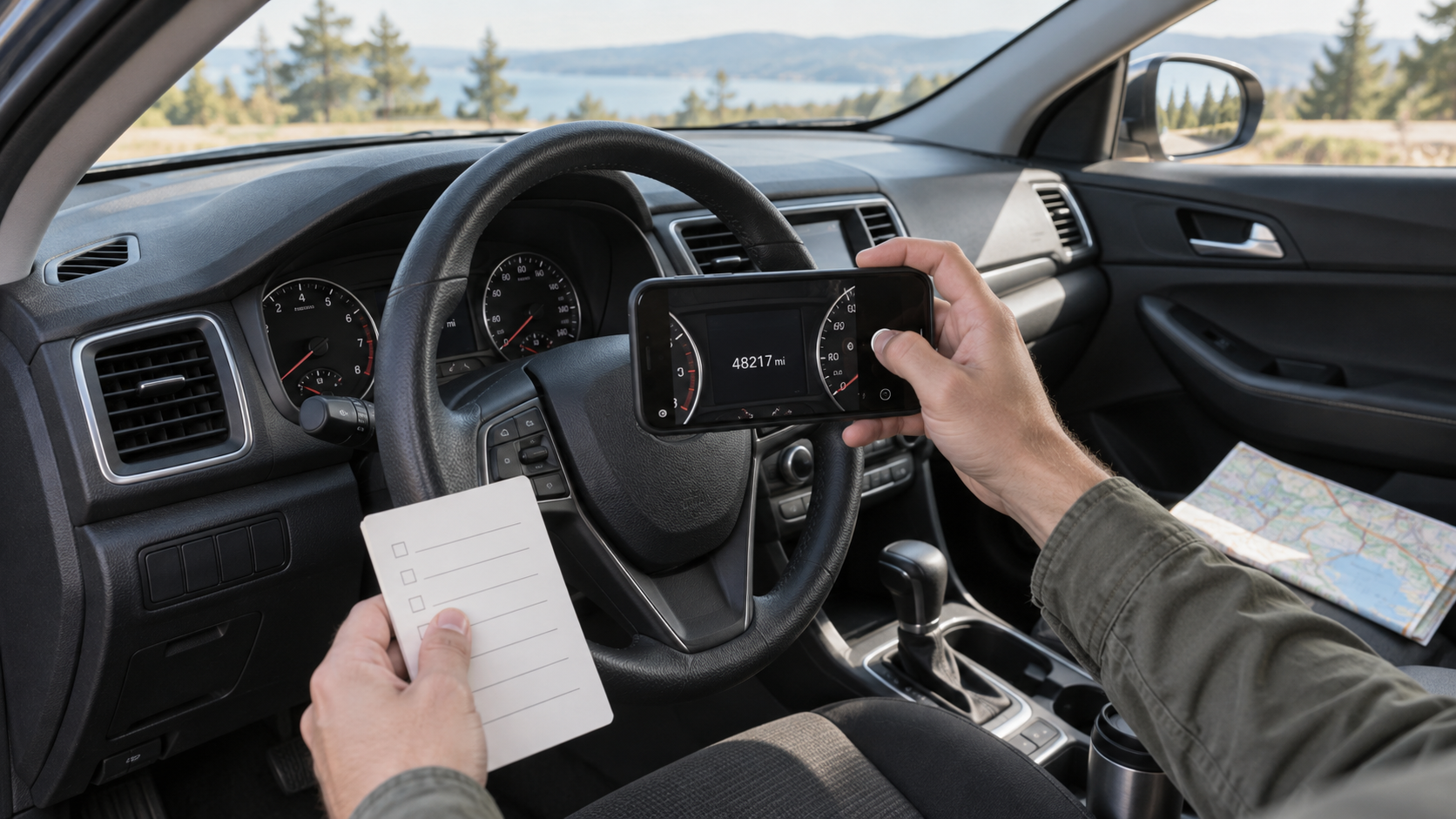
A number such as 48,217 is not a complete mileage description. A remote buyer needs to know whether the odometer shows miles or kilometers, whether your second number is a conversion, which currency your price uses and where the vehicle is physically located.
Write the vehicle's actual displayed reading first and keep its original unit attached to it. Then add an approximate conversion if that helps your audience. Apply the same clarity to the price and location. The illustration above is fictional and is not an odometer record, inspection image or real AutoDream listing.
1. Record the original odometer reading and unit
Look at the vehicle's instrument cluster and record the displayed value exactly as you see it. Add mi for miles or km for kilometers every time you repeat the number. Do not rely on a buyer to infer the unit from your country, the car's origin or the language on the dashboard.
A useful listing line is: Odometer displayed 48,217 mi on September 12, 2026. A weak version is simply: Mileage 48,217. The first tells a remote buyer what was displayed, in which unit and when it was checked.
If the dashboard can switch display units, state which unit the recorded figure represents. Do not assume changing a screen setting changes the vehicle's underlying distance history. If a service record, inspection or title document uses another unit, quote that record accurately and explain the difference instead of rewriting it.
2. Take one clear supporting photograph
Photograph the entire instrument cluster with the vehicle safely parked and the display awake. Make the digits and unit label readable in the original file. Avoid a close crop that removes the unit or makes it impossible to recognize the display as part of the car.
- Use the current reading, not an older gallery photo.
- Keep warning lights and visible information as they actually appear.
- Do not retouch digits, remove a warning or add a unit label.
- Check reflections and focus before leaving the vehicle.
- Keep VINs, documents, addresses and other unrelated private information outside the frame.
A photo supports what you observed; it does not prove the vehicle's complete mileage history. If the reading is inconsistent with paperwork or you know the odometer was replaced, disclose what you know and obtain the transfer guidance required where the sale will take place.
3. Add a conversion without replacing the original
The NIST Guide to the SI conversion table gives the international mile-to-kilometer factor as exactly 1.609344. To convert miles to kilometers, multiply by 1.609344. To convert kilometers to miles, divide by 1.609344.
| Original display | Calculation | Buyer-friendly wording |
|---|---|---|
| 48,217 mi | 48,217 × 1.609344 = 77,597.739648 km | 48,217 mi (approximately 77,598 km) |
| 96,500 km | 96,500 ÷ 1.609344 = 59,962.320... mi | 96,500 km (approximately 59,962 mi) |
Round only the converted figure to a sensible whole unit for the listing, and label it approximately or about. Never round or recalculate the original odometer reading. Save the calculation in your listing notes so you can answer a buyer consistently later.
4. Name the asking-price currency
A dollar sign alone can be ambiguous because several currencies use it. Write the amount with an explicit three-letter currency code, such as USD 24,900, only after confirming that the code matches the currency you are actually requesting. The ISO 4217 overview explains that standardized three-letter currency codes are designed to improve clarity and reduce errors.
Keep one asking currency as the source price. If you also show a converted estimate, identify the exchange-rate source and the date or time checked, and make clear that the converted amount is approximate. Exchange rates move; a copied conversion should not quietly become a guaranteed sale price.
For business advertising in the United States, the FTC's advertising guidance says claims must be truthful, not deceptive or unfair, and evidence-based. Laws vary by seller and location, but private sellers can use the same practical discipline: say what the price includes, identify known mandatory seller charges separately when applicable, and do not advertise a currency or total that you will not honor.
5. State where the vehicle actually is
Give the city, state or province, and country where the car can currently be viewed or collected. For example: Sherman Oaks, California, United States. Do not use the seller's nationality, registration country or intended destination as a substitute for the vehicle's present location.
Keep the public location useful but not overly specific. A street address, storage-unit number or private-home details can wait until you have identified the buyer and agreed on a safe appointment. If the car will move before a viewing, state that clearly rather than listing two locations without explanation.
Location also does not promise export eligibility, import approval, shipping cost or delivery. Those questions depend on the exact vehicle, route and applicable rules. Keep them separate from the basic listing facts.
6. Use one consistent format everywhere
Repeat the same source values in the title, description, photo caption and buyer replies. If you update the odometer or price on one marketplace, update every copy you control. A simple internal record can contain:
- original odometer value and unit;
- date the display was checked;
- optional converted value and calculation;
- asking amount and currency code;
- physical vehicle location;
- date each public listing was updated; and
- name of the person who verified the changes.
If a service invoice uses kilometers while the dashboard and listing use miles, preserve both source records. For example: Current display: 48,217 mi. The May 2026 service invoice records 76,940 km as written by the shop. Do not force two records to match by editing one of them.
A complete fictional listing example
Odometer displayed 48,217 mi on September 12, 2026 (approximately 77,598 km). Asking price: USD 24,900. Vehicle location: Sherman Oaks, California, United States. The dashboard photo shows the displayed reading and unit; the conversion is provided only for convenience. Viewing is by appointment.
All values and circumstances in this example are invented for the guide. Replace every detail with information verified for your vehicle.
A short reply to a remote buyer
The dashboard currently displays [reading] [mi/km]. That is approximately [converted reading] [km/mi]. The asking price is [currency code] [amount], and the car is physically located in [city, region, country]. Would you like the current dashboard photo or a walk-around next?
Replace every bracketed field before sending. If you have not verified a value, say that you will check it instead of guessing.
Final clarity checklist
- The odometer's original displayed number appears first.
- Every mileage number includes mi or km.
- The supporting photo shows the current digits and unit without edits.
- Any converted mileage is checked, rounded sensibly and labeled approximate.
- The asking price uses an explicit currency code.
- Any exchange-rate estimate includes a source and check date.
- The location identifies the vehicle's current city, region and country without exposing a private address.
- The same values appear in every active listing and buyer reply.
Clear units do not make a car more or less traveled; they prevent two people from discussing different numbers. Verify the display, preserve the source unit, label conversions and make the price and location just as specific.
Ready to list your car?
Put your vehicle details and photos together, then start your listing on AutoDream.
Create your listing

