
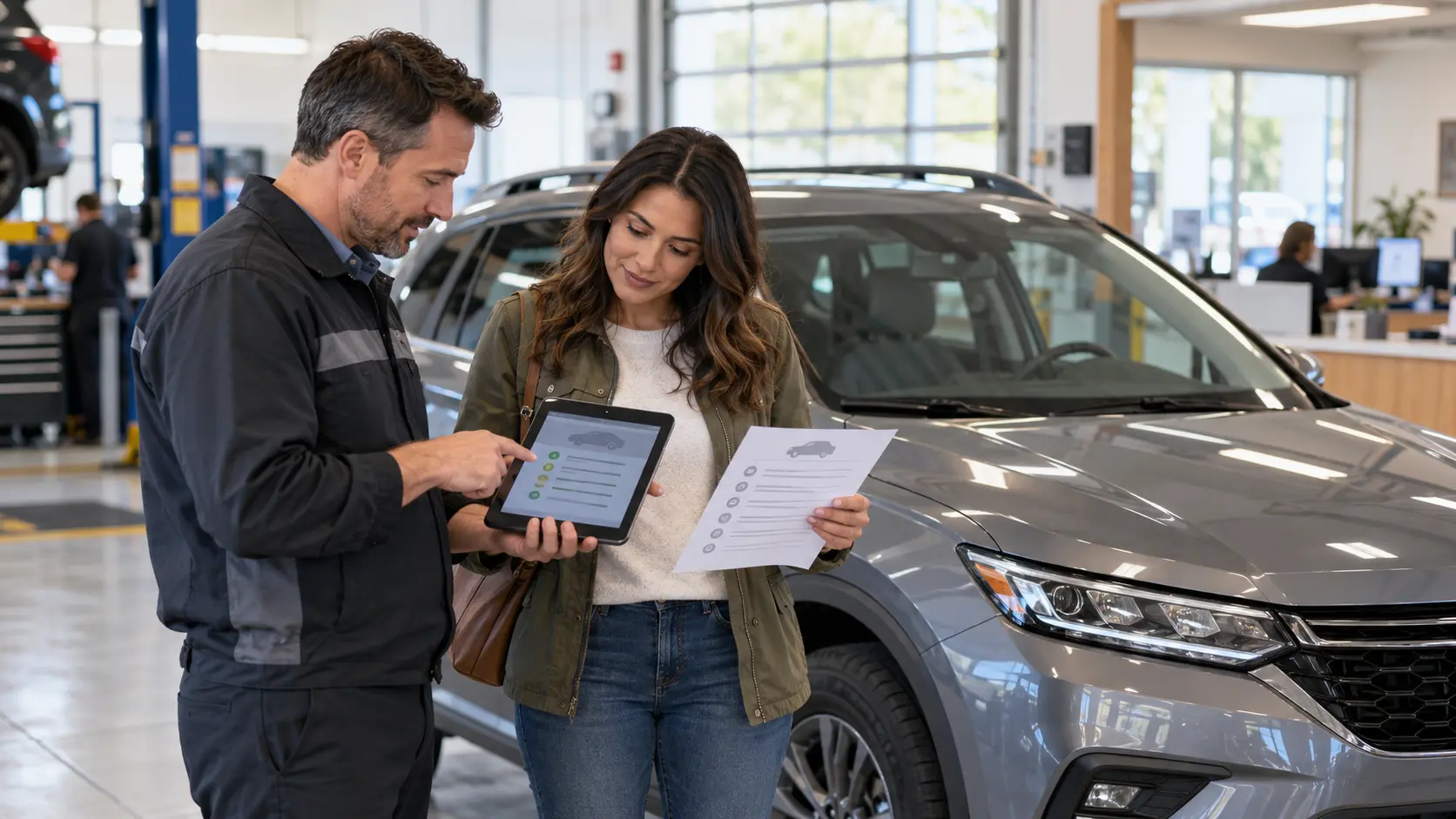
An open safety recall is not the same thing as a general maintenance item, a warranty claim or a vehicle-history entry. It is a manufacturer safety campaign for a specific defect and population of vehicles. Before a used car is listed, inspected, purchased or delivered, buyers and sellers should check the exact vehicle identification number, read the current instructions and keep any repair claim tied to evidence.
This guide uses United States resources. In another country, use the applicable national safety authority and the vehicle manufacturer's local recall process. A recall lookup is one safety check, not a mechanical inspection, title check or promise that the vehicle has no other problems. The illustration above is fictional and is not evidence of a real recall, repair, customer or vehicle.
1. Confirm the VIN before checking recall status
Start with the same 17-character VIN across the listing, the vehicle and the transaction documents. Read it from the windshield plate or certification label when you can, then compare it with the title or registration and the seller's records. A copied or mistyped VIN can produce a result for a different vehicle.
- Record the VIN exactly, preserving every character.
- Compare the physical VIN with the listing and documents.
- Pause if any character differs or a VIN location appears altered.
- Do not use a license plate result as a substitute when the plate points to a different or previously owned vehicle.
NHTSA's recall lookup accepts a VIN or, for supported searches, a license plate. NHTSA notes that plate information comes from state motor-vehicle records and recommends a VIN search when the plate result identifies the wrong vehicle.
2. Run a dated VIN lookup and save the result
Search the VIN close to the decision point: before publishing a seller's recall statement, before traveling, before paying and again before delivery if time has passed. Save the result date, the exact VIN used and the recall campaign details. A screenshot or PDF can preserve the snapshot, but it should not replace a fresh search.
| Record | Why it matters |
|---|---|
| VIN searched | Connects the result to one specific vehicle. |
| Date and local time | Shows when the lookup was performed. |
| Campaign number and component | Identifies the recall being discussed. |
| Current lookup status | Separates an open result from a zero-result snapshot. |
| Manufacturer instructions | Captures any urgent use, parking or contact direction. |
| Next action and owner | Names who will call, schedule, repair or recheck. |
3. Understand what the lookup does not prove
A VIN result showing no unrepaired recalls is useful, but it is not a lifetime recall certificate or a complete safety evaluation. NHTSA explains that its VIN and plate results may not show recently announced recalls before all affected VINs are identified, recalls more than 15 years old in some circumstances, certain small-manufacturer campaigns, non-safety customer-service campaigns or a safety recall that was already repaired.
Keep these evidence types separate:
- Open-recall result: a current VIN-specific safety campaign that still needs the stated remedy.
- Zero open-result snapshot: no unrepaired recall appeared for that VIN in that lookup at that time, subject to the tool's stated limits.
- Repair order: a dealer document that may show a remedy was completed for the VIN and campaign listed.
- Vehicle-history report: a separate record that may contain events but is not the authoritative recall lookup.
- Mechanical inspection: a present-condition assessment that does not replace the manufacturer's recall remedy.
4. Follow urgent recall instructions before arranging a viewing
Read the campaign instructions, not just the component name. NHTSA tells owners to follow manufacturer directions, including any Do Not Drive or Park Outside warning. If the result contains an urgent instruction, do not schedule a normal road test or move the vehicle casually. Contact the manufacturer or an authorized dealership for the correct next step.
NHTSA states that U.S. vehicle safety-recall repairs are free at the vehicle manufacturer's dealership. Call with the VIN and campaign number and ask:
- Is the remedy currently available for this VIN?
- Does the notice include driving, parking, charging or towing instructions?
- Which authorized location can perform the remedy?
- Is an appointment required, and is the necessary part available?
- What document will show completion for this VIN and campaign?
Do not advertise a recall as repaired merely because an appointment exists or a part was ordered.
5. Use precise recall language in the listing
A truthful listing should state what was checked, when it was checked and what evidence exists. Avoid broad phrases such as "recall-free," "all safety issues fixed" or "100% safe." Those claims reach beyond a dated lookup or repair order.
Clear snapshot wording: "NHTSA VIN lookup performed October 9, 2026. The result showed one unrepaired safety recall for the listed campaign. The manufacturer instructions and current repair availability should be confirmed with an authorized dealer before driving or purchase."
Clear completion wording: "A repair order dated October 8, 2026 identifies this VIN and campaign as completed. Buyer should run a fresh VIN lookup and review the repair order."
Avoid: "No recalls ever" or "dealer checked everything."
For U.S. dealer sales, the FTC's Dealer's Guide to the Used Car Rule explains that the Buyers Guide tells consumers to obtain a vehicle-history report and check for open safety recalls. The Buyers Guide's warranty disclosures and a recall check answer different questions; do not combine them into one promise.
6. Verify a claimed repair by VIN and campaign
If a seller says the remedy was completed, ask for a repair order or manufacturer/dealer record that identifies the vehicle, campaign and completed operation. Redact unrelated personal information before sharing it, but keep the fields needed to match the record.
| Completion field | Check |
|---|---|
| VIN | Matches the physical vehicle and listing. |
| Campaign number | Matches the recall discussed. |
| Repair date | Is present and plausible. |
| Operation or remedy | Shows completed work, not only diagnosis, scheduling or parts ordering. |
| Authorized facility | Can clarify the record when permission and privacy rules allow. |
| Fresh lookup | Is checked again, allowing for possible reporting delay. |
If the repair record and current lookup disagree, pause the recall claim and contact the manufacturer or authorized dealer. Do not alter the document or infer that the database will update by a certain deadline unless the responsible organization confirms it.
7. Buyer workflow before travel, payment or delivery
- Obtain the VIN from the seller and compare it with a vehicle photo or live view.
- Run a fresh NHTSA VIN lookup yourself.
- Read every campaign's instructions and remedy status.
- Ask whether the vehicle can be driven and whether the remedy is available.
- Review any repair order by VIN and campaign.
- Keep recall status separate from title, history, warranty and inspection findings.
- Recheck close to delivery if the transaction is not immediate.
- Stop if the VIN, campaign, documents or seller's description cannot be reconciled.
The FTC's used-car buying guidance also advises buyers to get promises in writing and use an independent inspection. An open-recall check adds to those steps; it does not replace them.
8. Dealer intake and delivery control
Dealers can create one recall record per stock unit: VIN source, lookup date, campaign number, current status, urgent instructions, appointment, remedy availability, completion document, reviewer and next recheck. Update the public listing when the evidence changes. Do not copy a status from a similar year, make and model, because recall eligibility is VIN-specific.
At delivery, rerun the lookup or confirm the record is still current. Keep the recall record with the inventory file, but do not publish customer names, addresses or unrelated service history.
Fictional example: an appointment is not a completed remedy
The following example is fictional and does not describe an AutoDream customer, dealer or listed vehicle.
A seller runs the exact VIN and finds one open recall with no urgent driving restriction in the displayed instructions. The seller calls an authorized dealer. The remedy exists, but the part is not yet at that location, so an appointment is placed on hold.
The listing states the dated lookup result and does not say the recall is fixed. A buyer repeats the search, reviews the campaign instructions and arranges an independent inspection for other condition questions. When the part arrives, the authorized dealer performs the remedy and provides a VIN- and campaign-matched repair order. The seller updates the listing only after receiving that evidence and asks the buyer to verify the current lookup again.
Open-recall verification checklist
- Match the 17-character VIN across the car, listing and documents.
- Run the official VIN recall lookup close to the transaction date.
- Save the VIN, lookup time, campaign and current result.
- Read all manufacturer instructions, including urgent warnings.
- Contact the manufacturer or authorized dealer about remedy availability.
- Do not treat an appointment or ordered part as a completed repair.
- Describe the recall status with a date and evidence, not a guarantee.
- Match any repair order to the VIN and campaign.
- Use a fresh lookup to check a claimed completion.
- Keep recall, warranty, title, history and inspection evidence separate.
- Pause if the VIN, status, record or seller statement conflicts.
- Recheck before delivery when time has passed.
A careful recall check answers a narrow but important question: what does the current official VIN result say, what instructions apply now, and what evidence supports a claimed remedy? Record those answers precisely, then continue the rest of the used-car verification process.
Ready to list your car?
Put your vehicle details and photos together, then start your listing on AutoDream.
Create your listing

