
A buyer asks whether the car has ever been repainted, whether a feature is original, or whether a warning light was repaired. You do not know. The strongest answer is not a guess and not a vague “probably.” It is a short, useful record of what you can verify, what remains unknown and what you will do next.
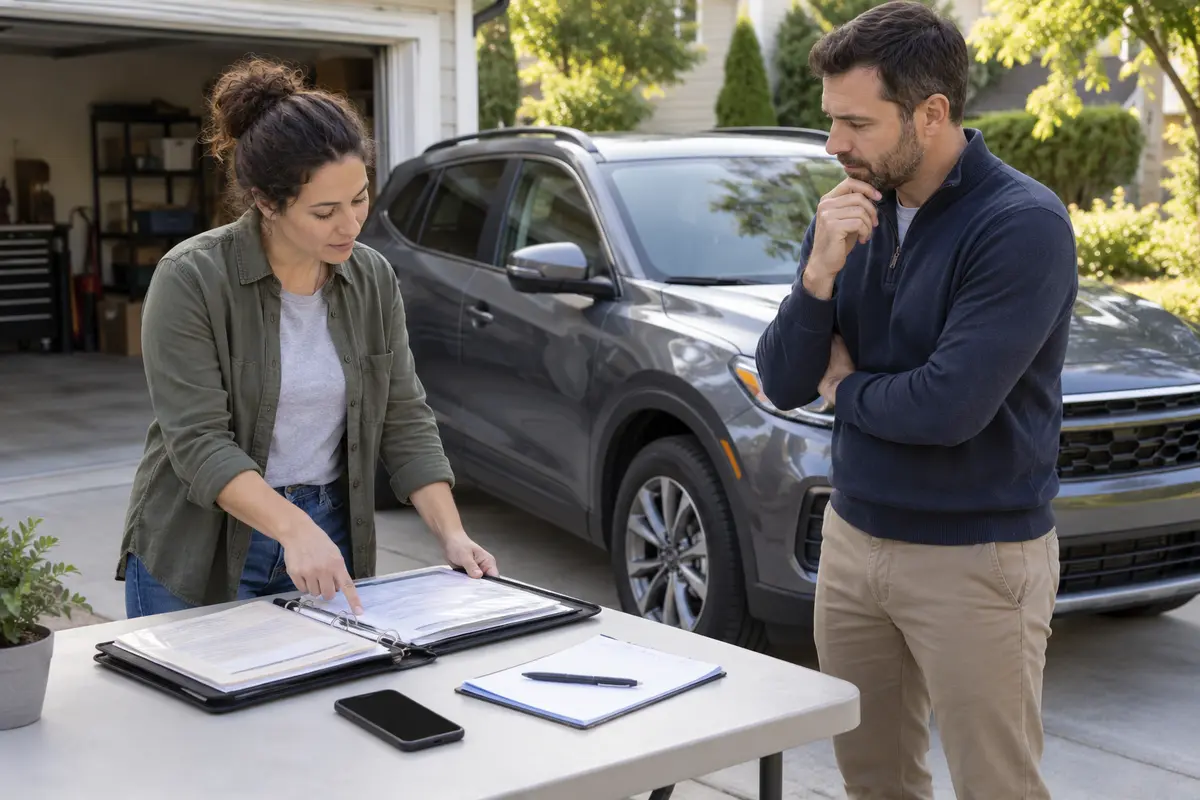
This guide gives private sellers a repeatable way to answer questions when the evidence is incomplete. It does not replace a title search, inspection, diagnosis, recall lookup, warranty decision or legal advice. The illustration above is fictional and is not evidence of a real listing, customer conversation, inspection or verified answer.
Use a four-part answer
A reliable reply can usually fit into four parts:
- State the verified fact: say what you know now.
- Name the source: explain whether it comes from a document, the car itself, a shop, the prior owner or your own observation.
- Mark the limit: say exactly what you do not know or have not confirmed.
- Offer the next check: identify a realistic source, test or person who may answer the question.
Simple formula: “What I can confirm is [fact], based on [source]. I do not have evidence for [unknown]. I can [specific check] and send you the result by [time], or you are welcome to verify it during an independent inspection.”
The FTC's advertising substantiation policy says objective advertising claims should have a reasonable basis before they are communicated. Although a private seller's legal obligations can differ from a dealer's, the practical lesson is clear: do not convert an assumption into a factual listing claim.
1. Classify the question before answering
Different questions require different evidence. Put the buyer's question into one category so you know where to look and what not to promise.
| Question type | Examples | Possible evidence |
|---|---|---|
| Vehicle identity and equipment | Which trim is it? Was this feature factory-installed? | VIN, manufacturer information, build record, physical labels, vehicle-specific invoice. |
| Current condition and function | Does the air conditioning work? What causes that noise? | Dated observation, demonstration, diagnostic report or independent inspection. |
| Maintenance and repair history | When was the transmission serviced? Was the bumper repaired? | Invoice, work order, service history, dated photograph or prior-owner statement clearly labeled as such. |
| Title, odometer and loss history | Has it had a salvage brand? Is the mileage original? | Current title records, transfer documents, odometer records and a vehicle-history source with stated limits. |
| Recall and safety information | Are all recalls completed? Is this modification safe? | VIN-specific recall lookup, manufacturer or dealer record, and a qualified professional's scoped assessment. |
| Warranty, subscription or future cost | Will the warranty transfer? How long will the battery last? | Current written terms and a decision from the responsible provider; not seller prediction. |
If one question spans several categories, separate it. “Has it ever been in an accident, and is it safe now?” asks about recorded history and present condition. A history report may help with the first part, while an inspection may help with the second; neither automatically answers both.
2. Start with the narrow fact you can support
Use the smallest accurate statement. “The air conditioning blew cold during my 20-minute drive on September 30” is an observation. “The air conditioning has no problems” is a much broader conclusion. “The invoice lists front brake pads at 48,120 miles” describes a document; it does not prove the current remaining pad thickness.
Identify the source in the same sentence whenever it matters:
- “The current odometer displays 72,410 miles; photo taken today.”
- “A repair order from ABC Shop dated March 4 lists a water-pump replacement.”
- “The prior owner told me the left door was repainted, but I do not have the body-shop invoice.”
- “I have not tested the rear heated seats.”
A seller recollection can be useful, but label it as recollection. A document can be useful, but describe what the document actually says. A photograph can show visible condition at one time, but it is not a diagnosis.
3. Say “I don’t know” precisely
A bare “I don't know” can sound dismissive. A precise limit is more useful:
- “I do not have records covering the first two years of ownership.”
- “I have not confirmed whether that wheel design was factory-installed on this VIN.”
- “I can hear the noise, but I do not know its cause.”
- “I have a receipt for the part, but not for installation.”
- “The report I have does not show a loss record, but I cannot promise that every event was reported.”
Do not use “as far as I know” to hide an important gap. Name the gap. Avoid “never,” “always,” “perfect,” “original,” “one owner,” “no accidents,” “all recalls done,” “still under warranty” and similar absolute claims unless the evidence actually supports the exact statement.
4. Offer one specific next check
A useful follow-up names the source, action and timing. Do not promise a result you cannot control.
| Buyer asks | Better seller reply |
|---|---|
| “Is this the top trim?” | “The badge says X, but I have not verified the trim from a vehicle-specific build record. I can check the VIN information and send the result, including any mismatch.” |
| “Has it ever been in an accident?” | “I have no accident invoice from my ownership. I do not know the complete earlier history. I can share the report I already have, and you may use your preferred provider or inspection.” |
| “Why is the warning light on?” | “The light is currently on. I do not know the cause and will not diagnose it from a message. I can obtain a written diagnostic report, or you can arrange an independent inspection.” |
| “Were all recalls repaired?” | “I have one recall-repair invoice, but I have not confirmed the current VIN result today. I will check the official lookup and share the date and result.” |
| “Is the warranty transferable?” | “I have the original warranty booklet, but I cannot confirm transfer or remaining coverage. Please verify this VIN with the warranty provider; I can provide the relevant document.” |
| “How long will the battery last?” | “I cannot predict future battery life. I can share the current dashboard observation, charging records I have and any available battery assessment, with their dates and limits.” |
When the buyer's question requires disassembly, a road test, special equipment, account access or a decision from a third party, say so. Do not improvise a test that is unsafe or beyond your competence.
Use official tools for the questions they can answer
NHTSA's VIN decoder can identify information encoded in a 17-character VIN from manufacturer-reported data. It does not establish ownership, current equipment, condition or every option. If the decoder and the car appear to disagree, report the mismatch rather than choosing the answer you prefer.
NHTSA's recall lookup can show certain unrepaired recalls for a VIN or license plate. NHTSA also lists important limits: results may omit repaired recalls, some newly announced recalls, older recalls, certain small manufacturers and international vehicles. Record the lookup date and result; do not turn “0 unrepaired recalls” into a general safety guarantee.
The U.S. Department of Justice's NMVTIS consumer guidance explains that NMVTIS can provide title, latest reported odometer, brand history and certain theft or salvage information. It is a defined history source, not a complete maintenance record or mechanical inspection. Use an approved NMVTIS data provider when seeking an NMVTIS report.
Do not let an unknown answer become a scam shortcut
A buyer may reasonably ask for more evidence, but a stranger who insists that you purchase a report from one specific unfamiliar website creates a different risk. The FTC's vehicle-history-report scam warning describes requests designed to collect a seller's money, card number or personal information.
You can respond: “I will share the report I already have, or you may purchase a report from a provider you trust. I will not enter payment or personal information on a buyer-selected unfamiliar site.” Keep evidence-sharing separate from deposits, payment links and account credentials.
Keep a small follow-up log
When you promise to check something, write it down. This prevents different buyers from receiving different answers.
| Field | Example |
|---|---|
| Question | Is the second key fully functional? |
| Current answer | Key is present; remote functions not tested. |
| Source to check | Test lock, unlock and start functions at the car. |
| Owner and due time | Seller, October 1 by 5:00 p.m. local time. |
| Result | Record each tested function and any failure. |
| Listing impact | Update included-items section if the current wording is incomplete. |
If the answer reveals that the public listing is wrong or materially incomplete, correct the listing before repeating the old text to another buyer. Keep the old claim out of screenshots, copied messages and other active channels.
Ready-to-send message templates
When a record is missing
“I can confirm [documented fact] from [record and date]. I do not have a record for [missing period or work]. I am checking [specific source] and will send whatever it shows by [time]. If it remains undocumented, I will keep it marked unknown.”
When a condition needs diagnosis
“I can confirm [specific symptom] under [specific conditions]. I do not know the cause and do not want to guess. I can provide a written shop finding, or you may arrange an independent inspection before deciding.”
When a feature was not tested
“The feature is present, but I have not tested [exact function]. I will test [safe, specific steps] and send a dated result. Presence alone should not be treated as proof that every function works.”
When only a prior-owner statement exists
“The prior owner reported [statement]. I do not have an invoice or independent confirmation, so I am sharing it as reported information, not a verified fact.”
Checklist before you press send
- Repeat the buyer's exact question so you answer the right issue.
- Separate identity, history, current condition, recall, warranty and future-performance questions.
- State only the fact supported by the source you name.
- Label personal observation, seller recollection, third-party statement and document evidence differently.
- Say exactly what remains unknown or untested.
- Offer one safe, realistic and time-specific next check.
- Do not diagnose a warning, noise or safety concern from a message.
- Do not promise a clean title, no accidents, completed recalls or warranty coverage without appropriate current evidence.
- Use official tools only within their stated scope and record the lookup date.
- Do not buy a report from an unfamiliar site merely because a stranger insists.
- Log the promised follow-up and send the result, including an inconclusive result.
- Correct the listing when the verified answer changes a material public claim.
“I don't know yet” can be a professional answer when it is paired with a source, a limit and a next step. The goal is not to sound certain. The goal is to give the buyer a record they can understand and verify.
Ready to list your car?
Put your vehicle details and photos together, then start your listing on AutoDream.
Create your listing

