
What if a single missing digital signature was the only thing standing between you and your dream vehicle being seized at the port? For many global buyers, the sheer volume of paperwork for buying a car overseas feels less like a process, and more like a barrier designed to keep the world's best automotive engineering out of reach. You've likely felt that familiar anxiety while staring at a foreign title, wondering if the authenticity is verifiable or if a 25% Section 232 tariff is about to disrupt your acquisition strategy.
We've designed this 2026 guide to transform that confusion into a streamlined, high-tech advantage. You'll master the essential documentation required for a frictionless transfer, from the August 2024 EPA Form 3520-1 to the latest Euro 7 compliance certificates. We'll break down the specific regional requirements across 15 countries and provide a digital-first checklist that ensures your ownership transfer is as sophisticated and secure as the vehicle itself. By the end of this breakdown, you'll have the confidence to move past logistical hurdles and focus on the drive ahead.
Key Takeaways
- Master the art of structuring a legally binding international Bill of Sale and learn to distinguish between domestic titles and export certificates for a secure ownership transfer.
- Navigate the 2026 landscape of technical compliance, including Euro 7 standards and updated EPA/DOT forms, to ensure your vehicle meets all local safety and environmental regulations.
- Ensure your Commercial Invoice and Bill of Sale align perfectly to prevent costly delays or customs seizures during the regulatory bridge.
- Discover how to simplify the complex paperwork for buying a car overseas by utilizing AI-powered multilingual chat and digital dashboards for real-time document clarification.
- Secure your global investment with a comprehensive understanding of the Bill of Lading and Marine Insurance certificates required for protected high-seas transit.
Table of Contents
- The Foundation: Core Ownership and Transactional Documents
- Technical Compliance: Proving the Vehicle Meets Local Standards
- Customs and Export-Import Formalities: The Regulatory Bridge
- Logistics and Financial Paperwork: Securing the Transaction
- The 2026 Digital Advantage: Streamlining Paperwork with AutoDream
The Foundation: Core Ownership and Transactional Documents
The journey to global car ownership begins with a robust legal foundation. In 2026, the traditional paper trail has evolved into a sophisticated digital framework, yet the core principles of ownership transfer remain constant. You aren't just buying a machine; you're acquiring a legal entity that must be recognized across borders. Mastering the initial paperwork for buying a car overseas is the only way to ensure your investment is protected from the moment the transaction is initiated. This process requires an intelligent approach to document verification and a keen eye for jurisdictional nuances.
The International Bill of Sale
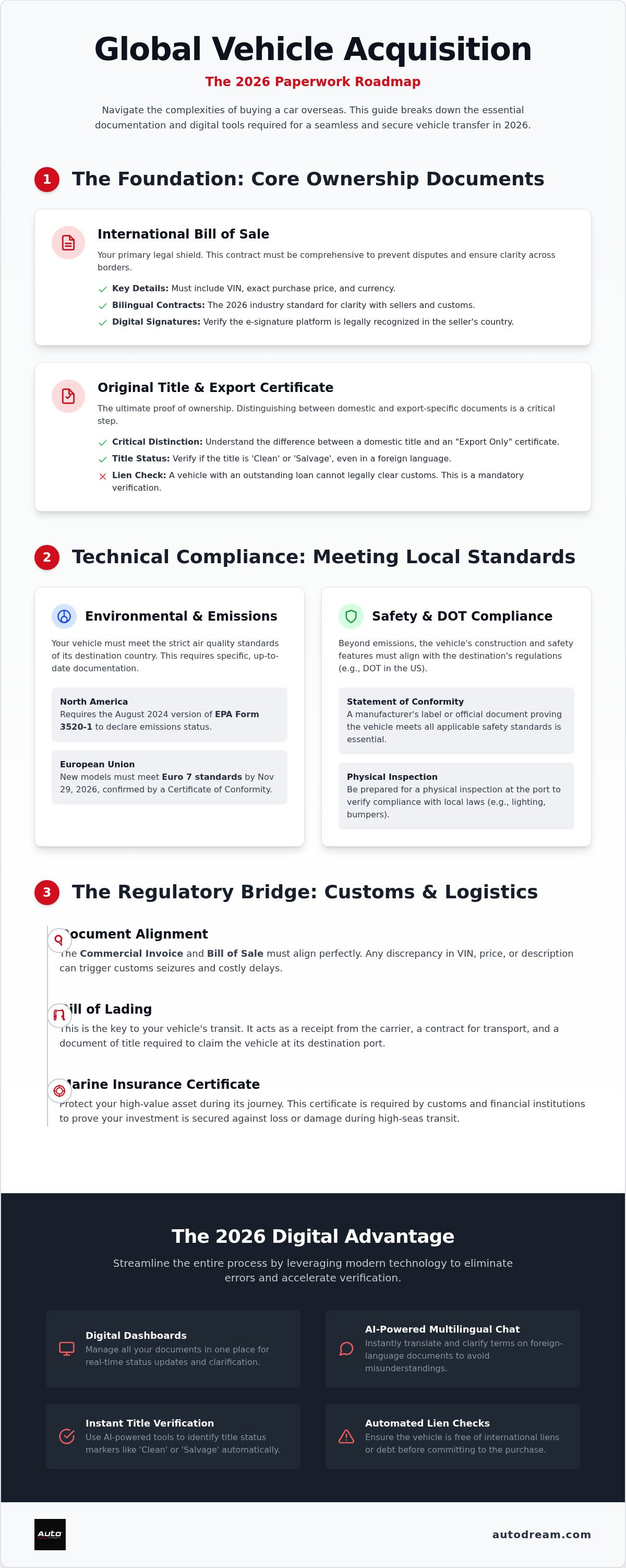
A legally binding international contract is your primary shield against future disputes. This document must go beyond a simple receipt. It needs to specify the Vehicle Identification Number (VIN), the exact purchase price, and the specific currency used for the transaction. In 2026, bilingual contracts have become the industry standard. These dual-language documents ensure that both the buyer and the customs officials in the destination country have a crystal-clear understanding of the terms. You should always include 'as-is' clauses to define the vehicle’s condition at the time of sale, protecting you from unforeseen liability. While digital signatures are now legally valid in most global jurisdictions, you must verify that the specific e-signature platform used is recognized by the local authorities in the seller's country.
The Original Title and Export Certificate
Distinguishing between a domestic title and an export certificate is a critical pivot point in your acquisition. In markets like Japan or the UAE, vehicles intended for shipping are often issued an 'Export Only' certificate, which replaces the standard domestic registration. This distinction is vital when dealing with a Grey import vehicle, where the regulatory path differs from official manufacturer distribution channels. You must be able to identify a 'Clean Title' versus a 'Salvage Title', even when the document is written in a foreign language. AutoDream’s AI-powered tools assist in this verification by instantly identifying these status markers. Furthermore, you must verify that the vehicle is free of any international liens or debt. A vehicle with an outstanding loan cannot legally clear customs, making lien verification a mandatory step in your digital checklist.
Seller Identification and Notarization
Sophisticated verification of the seller is the final piece of the foundational puzzle. You should always request government-issued identification or verify the seller’s credentials through registered dealer databases. In many European and Asian jurisdictions, local notarization of the Bill of Sale is mandatory. This physical or digital seal of authentication proves to your home country's customs office that the transaction was witnessed and approved by a legal authority. It’s a small step that prevents massive delays during the import phase.
Technical Compliance: Proving the Vehicle Meets Local Standards
Securing ownership documentation is merely the initial phase of a global acquisition. The physical engineering of the vehicle must harmonize with the technical frameworks of your home country. This is where the paperwork for buying a car overseas evolves from transactional records into specific engineering declarations. Whether you are acquiring a precision-engineered European sedan or a high-performance electric vehicle, demonstrating that the emissions and safety systems meet local benchmarks is mandatory. This technical validation ensures your new asset is road-legal and ready for immediate registration.
Environmental and Emission Documentation
Global air quality standards represent a significant hurdle for cross-border acquisitions. For the North American market, you must utilize the August 2024 version of EPA Form 3520-1 to declare the vehicle's emissions status. In the European Union, the regulatory landscape is advancing rapidly. New vehicle models must comply with Euro 7 standards starting November 29, 2026, which include new regulations for non-exhaust emissions like brake and tire particles. A Certificate of Conformity serves as the primary technical passport for EU vehicles, confirming the model adheres to all unified regulatory standards. Using AutoDream’s detailed listing insights allows you to verify a vehicle's original fuel type and mileage metrics before initiating the import process.
Safety and Bumper Standards
Safety compliance is equally rigorous and requires precise documentation. The U.S. Customs and Border Protection mandates the DOT Form HS-7 (specifically the November 2020 v3 version) to verify that the vehicle meets Federal Motor Vehicle Safety Standards. If the car was not originally manufactured for your local market, you may need to document specific modifications, such as lighting adjustments or bumper reinforcements. A Registered Importer (RI) often oversees these changes and provides the necessary technical paperwork to clear these hurdles.
The 25-year rule remains a vital exemption for classic car enthusiasts. In 2026, vehicles manufactured in or before 2001 are generally exempt from these modern safety and emissions standards, significantly reducing the required technical documentation. However, for sophisticated modern luxury EVs, you should obtain a Manufacturer Letter of Compliance. This document confirms that the specific VIN meets the safety standards of the destination country, often bypassing the need for extensive physical modifications. By centralizing these technical records early, you remove the friction from the final stages of your global acquisition.
Customs and Export-Import Formalities: The Regulatory Bridge
Once technical compliance is established, you must cross the regulatory bridge of customs. This is where the paperwork for buying a car overseas becomes a precise alignment of value and origin. Every digit on your Commercial Invoice must mirror the Bill of Sale perfectly. Any discrepancy, even a minor currency conversion error, can trigger an audit that delays your vehicle's release for weeks. You're not just moving a car; you're moving a high-value asset through a digital security framework that demands total transparency.
The Shipper’s Export Declaration (SED) is the seller's primary responsibility in this chain. It acts as the official record of the vehicle leaving its origin country for a foreign port. If you're buying from a private seller, they might not be familiar with this specific digital filing. You'll need to ensure this record is generated correctly to avoid the vehicle being flagged as "abandoned" at the port of departure. For high-value acquisitions, a "Formal Entry" is typically required by customs. This process involves a customs bond and detailed declarations of the vehicle's Harmonized Tariff Schedule (HTS) code to ensure the correct duties are applied before the vehicle enters the local fleet.
Valuation and Duty Documentation
The 2026 tariff environment is exceptionally complex. While the standard U.S. import duty for passenger cars remains 2.5%, other categories face steeper hurdles. Light trucks are subject to a 25% duty, and as of May 1, 2026, a 25% tariff applies to all vehicles imported from the European Union. If your acquisition comes from Canada, be aware of the 50% ad valorem duty effective August 19, 2026. You must provide official declarations to prove "Fair Market Value," especially for classic models. Checking the NHTSA importation FAQs can clarify how these valuation rules interact with the 25-year safety exemption for older collector cars.
The Deregistration Process
A vehicle cannot be legally in transit if it is still registered to a seller in its home country. You must obtain "Export Plate" paperwork or a certificate of deregistration from the local transport authorities. This critical component of the paperwork for buying a car overseas proves the car is no longer part of the foreign fleet. It must be linked to your Bill of Lading to create a seamless chain of custody. Without this proof, your home country may refuse to issue a new title, leaving the vehicle in a legal limbo that prevents road registration. AutoDream’s AI-powered dashboard helps you track these status changes in real-time across 15 countries.
Logistics and Financial Paperwork: Securing the Transaction
Securing the physical transit of your vehicle requires a shift from regulatory compliance to logistical precision. At this stage, the paperwork for buying a car overseas serves as your primary defense against transit damage and financial fraud. You're no longer just filing forms; you're establishing a chain of custody that spans oceans. By integrating sophisticated tracking with verified financial records, you ensure that your asset is protected from the moment it leaves the seller's hands until it reaches your local port. This phase is about creating a frictionless movement of both the machine and the capital behind it; for those traveling to oversee these logistics in the Dominican Republic or Latin America, SimpleStay.ai offers verified accommodations to simplify your stay.
Shipping and Transit Records
The Bill of Lading (BoL) is the most critical document in this category. It acts as both a receipt for the vehicle and a contract of carriage. You must distinguish between the Master Bill of Lading, issued by the carrier to the freight forwarder, and the House Bill of Lading, issued by the forwarder to you. Your legal protection depends on having the correct House BoL to claim ownership at the destination. Additionally, a comprehensive Condition Report must be generated at the port of departure. This digital record serves as your primary evidence for any insurance claims if the vehicle sustains damage during high-seas transit. If you're importing a vehicle with spare parts or extra tires, ensure the container packing list is exhaustive. Customs officials will compare this list against the physical contents to prevent delays. For a deeper dive into these protocols, explore The Visionary Guide to Secure Cross-Border Vehicle Transactions in 2026.
Financial Security and Escrow
Protecting your capital is as vital as protecting the car itself. In 2026, sophisticated buyers use digital escrow platforms to hold funds until all documentation is verified. These escrow records provide a transparent safety net, ensuring the seller only receives payment once the Bill of Lading and deregistration certificates are uploaded. You must also maintain a clear 'Proof of Payment' to satisfy anti-money laundering (AML) compliance standards in both the origin and destination countries. These financial records prove the legitimacy of the transaction and prevent your funds from being flagged by international banking systems. By centralizing these records, you move toward a sense of total readiness for the final arrival notice.
The Arrival Notice is the final trigger in your documentation chain. This document, sent by the carrier or agent, notifies you that the vehicle has reached the local port and is ready for pickup. It signifies the successful completion of the transit phase and the start of final local registration. To manage these complex global records with ease, you can leverage the AI-Powered Dealer Dashboard to centralize every export-import file in a single, visionary interface.
The 2026 Digital Advantage: Streamlining Paperwork with AutoDream
Modernizing the acquisition process means moving beyond manual verification. While previous sections detailed the specific forms required, the actual management of paperwork for buying a car overseas is where most buyers encounter friction. AutoDream serves as the intelligent bridge, replacing anxiety with automated precision. By utilizing high-tech tools designed for the 2026 market, you can navigate the 15-country marketplace with the foresight of a local expert. It's about empowering your global reach through smart, integrated logic.
The AI-Powered Dealer Dashboard is the centerpiece of this visionary approach. It centralizes every export-import record, from the initial Bill of Sale to the final Arrival Notice, in a single interface. This removes the risk of missing a critical digital signature or misplacing a compliance certificate. When dealing with foreign languages, the AI-powered multilingual chat provides instant clarification on complex document clauses. It doesn't just translate words; it interprets the legal logic of foreign titles to ensure you're getting a clean asset. This level of connectivity ensures that the documentation hurdles of 15 different countries are solved before they become delays.
Visionary Tools for Modern Buyers
Intelligence is the ultimate safeguard against documentation risk. AutoDream’s platform performs platform-level background checks on sellers, providing verified insights that manual searches simply can't match. Before you even sign a contract, automated distance insights and mileage data calculate logistical hurdles and potential tariff impacts. This proactive logic ensures your strategy is sound from the start. For those looking to master the digital landscape, exploring Essential Online Car Shopping Tools for the Visionary 2026 Global Buyer provides the necessary technological edge. The smart marketplace connects you with dealers who are already integrated into this efficient ecosystem, ensuring a seamless document exchange.
Closing the Deal with Confidence
The final stage of your journey is the assembly of what we call the 'Envelope of Success.' This is the complete digital and physical set of records required for your first local registration. By using AutoDream’s analytics, you can accurately price your import for the local market, accounting for the 2026 duty rates and shipping costs discussed earlier. This data-driven confidence transforms a complex cross-border purchase into a triumphant personal goal. You've mastered the paperwork for buying a car overseas; now it's time to enjoy the drive. You can start your next search or manage your current acquisition at AutoDream today.
Master the Global Horizon of Vehicle Acquisition
The landscape of international trade has shifted toward a future where data precision defines success. You've navigated the complexities of Euro 7 standards, secured your financial interests with digital escrow, and aligned your commercial invoices with surgical accuracy. Successfully managing the paperwork for buying a car overseas is no longer a manual struggle; it's a strategic operation powered by foresight. By understanding the synergy between technical compliance and logistical security, you've removed the primary barriers to global ownership.
AutoDream acts as your intelligent facilitator, providing AI-powered multilingual document support and marketplace connectivity across 15 countries. Our sophisticated dealer management tools centralize every record, ensuring your ownership transfer is as seamless as the technology that drives it. By removing the friction of cross-border logistics, we empower you to focus on the drive rather than the documentation. This isn't just about buying a car; it's about leveraging a visionary ecosystem to achieve your personal goals.
Explore high-end global listings and start your visionary purchase on AutoDream. The world's most exceptional engineering is now within your reach, backed by the security of a platform built for the modern era.
Frequently Asked Questions
What is the most important document when buying a car overseas?
The original vehicle title or its regional equivalent, such as an export certificate, is the most critical document in your possession. This record establishes your legal right to the asset and is required by every customs authority to initiate the import process. Without it, you cannot prove ownership or cancel the previous foreign registration.
Can I buy a car overseas without a physical title?
You cannot legally complete a cross-border acquisition without a physical title or a certified digital export record. Customs officials require the original document to verify that the vehicle isn't stolen and is free of liens. If a seller claims the title is missing, it's a significant red flag that could lead to your vehicle being permanently seized at the border.
How do I verify if an international car title is authentic?
Authenticating a foreign title requires cross-referencing the Vehicle Identification Number (VIN) with the origin country’s official transport database. You should look for security watermarks and official stamps that match the jurisdiction's current standards. AutoDream's AI-powered tools can instantly translate and flag inconsistencies in the paperwork for buying a car overseas, ensuring you aren't dealing with a forged document.
Do I need a customs broker to handle the paperwork for me?
A customs broker isn't legally mandatory for personal imports, but they provide an essential layer of security for high-value transactions. They manage the complex 2026 tariff codes and ensure that forms like the EPA 3520-1 are filed without errors. Their expertise prevents the logistical friction that often leads to costly port delays and storage fees.
What happens if my paperwork is incomplete at the port of entry?
Incomplete documentation at the port of entry results in the immediate detention of your vehicle. You'll face daily storage charges, known as demurrage, which can escalate quickly. If the missing forms aren't provided within a specific timeframe, customs authorities have the power to seize the vehicle or order its immediate export back to the origin country at your expense.
How does the 25-year rule affect the paperwork for classic car imports?
The 25-year rule drastically simplifies the paperwork for buying a car overseas by exempting vehicles manufactured in or before 2001 from modern safety and emissions standards. You still need the core ownership documents, but you won't need to prove compliance with Euro 7 or modern DOT bumper requirements. This exemption makes classic car imports a much more streamlined process for global collectors.
Are digital signatures legally accepted for international car sales?
Digital signatures are widely accepted in 2026, provided they are executed through secure, encrypted platforms that comply with global legal standards. Most customs authorities now recognize e-signatures on Bills of Sale and commercial invoices. You should verify that the specific platform used is recognized in both the seller's country and your destination to ensure a frictionless transfer of ownership.
How much does it cost to process the paperwork for an overseas car purchase?
Processing costs are determined by the complexity of the transaction and the specific duties applied to the vehicle. You'll need to account for international courier fees for original documents, customs bond costs, and potential brokerage fees. While these expenses are separate from the vehicle price, they are necessary investments to ensure your acquisition is legally recognized and road-ready.
Ready to list your car?
Put your vehicle details and photos together, then start your listing on AutoDream.
Create your listing