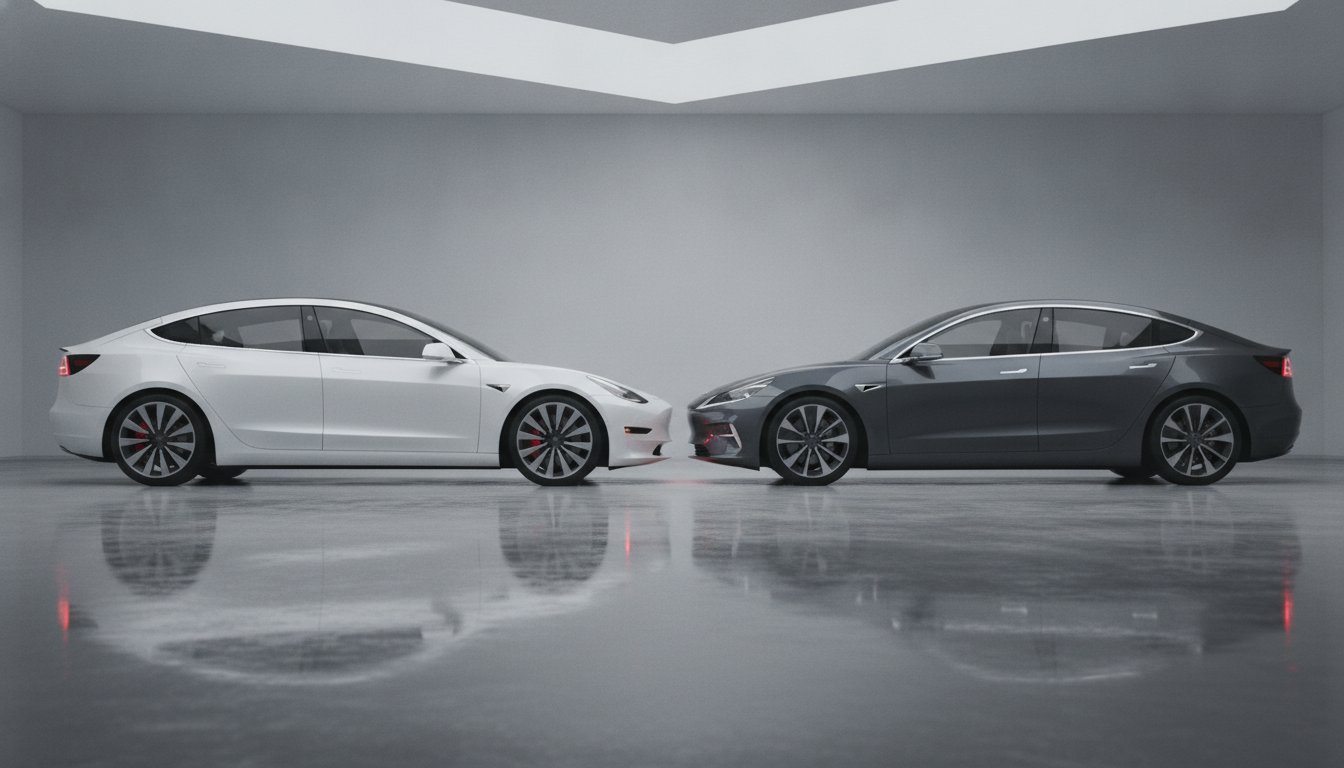
For over a decade, the Tesla Model 3 has been the default choice for premium electric performance, yet by mid-2026, the data suggests that the hardware-first approach of the BYD Seal is challenging that legacy. You've likely felt the growing tension between Tesla's established software ecosystem and the sophisticated engineering coming from international competitors. This 2026 comparison guide will clarify which of these electric titans dominates the global market. We'll explore the critical nuances of the BYD Seal vs Tesla Model 3 to help you decide which vehicle serves as the ultimate catalyst for your driving goals.
Whether you're concerned about long-term software support or the complexities of sourcing specific trims across borders, you'll gain total clarity on performance benchmarks and international warranty standards. We'll preview the 82.5 kWh Blade Battery technology, Tesla's latest Highland refresh capabilities, and the logistical insights needed to secure these vehicles from anywhere in the world. By the end of this analysis, you'll have the foresight to choose a future-proof EV that aligns with a high-tech, connected lifestyle.
Key Takeaways
- Understand how BYD’s Blade Battery 2.0 and Cell-to-Body technology challenge Tesla’s energy density and structural rigidity in the 2026 market.
- Compare the ergonomic shift between Tesla’s digital minimalism and BYD’s hardware-rich luxury to determine your ideal cabin environment.
- Analyze the BYD Seal vs Tesla Model 3 through a global lens, using smart distance insights to calculate the true cost of cross-border acquisition.
- Discover which sedan offers superior long-term value by evaluating software support lifecycles and projected resale equity for 2026 models.
- Learn how to navigate international EV standards and secure competitive deals across 15+ global markets using advanced AI-powered tools.
Table of Contents
The 2026 EV Rivalry: Contextualising the BYD Seal and Tesla Model 3
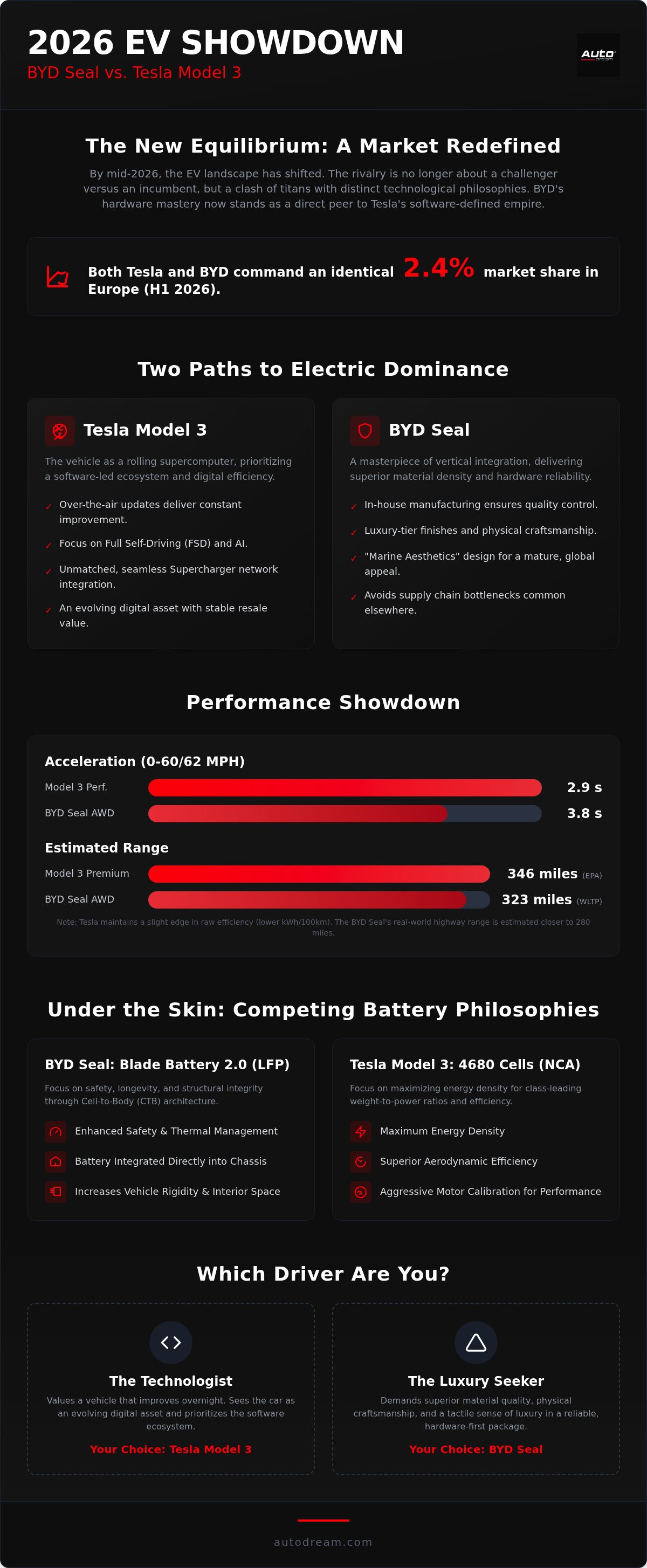
The global electric vehicle market reached a historic equilibrium in early 2026. Data from the first half of the year shows both Tesla and BYD holding an identical 2.4% market share in Europe. This milestone signifies the end of the "challenger" era for Chinese brands, as the BYD Seal has officially moved from an underdog to a legitimate peer. The BYD Seal vs Tesla Model 3 debate is no longer about which car is the safe bet, but which technological philosophy aligns with your personal goals. Tesla continues to double down on its vision of the car as a rolling supercomputer, prioritizing Full Self-Driving (FSD) and software-led ecosystems. Conversely, BYD has mastered vertical integration, manufacturing almost every component in-house to ensure hardware reliability and luxury-tier finishes.
Identifying your buyer persona is the first step in this decision. Are you a technologist who values a vehicle that improves overnight via code, or are you a luxury-seeker who demands superior material density and physical craftsmanship? With Chinese EV brands seeing sales surge by 130.8% year-on-year in June 2026, the international market has clearly embraced this hardware-first alternative. These two models now dominate global listings because they represent the pinnacle of their respective manufacturing cultures.
Tesla Model 3: The Software-Defined Standard
Tesla's 2026 lineup benefits from the refined Highland refresh, which cemented the Model 3 as the benchmark for digital efficiency. The introduction of a new "Standard" trim for 2026 provides a high-value entry point for buyers who prioritize the Supercharger network's seamless integration. While other networks have expanded, Tesla's ecosystem remains a vital advantage for long-distance travel. Tesla’s extreme manufacturing efficiency also keeps used car pricing stable, making it a predictable investment for professionals. It's the top choice for those who view a vehicle as an evolving digital asset rather than just a machine.
BYD Seal: The Hardware-Centric Challenger
The 2026 BYD Seal represents a pivot toward sophisticated, tactile luxury. Through its "Marine Aesthetics" design language, BYD has created a car that feels more mature and globally resonant than its predecessors. Because BYD controls its entire supply chain, it avoids the logistical bottlenecks that plague other manufacturers. Reviewing the BYD Seal technical specifications shows how this vertical integration allows for the implementation of Cell-to-Body (CTB) technology, enhancing both safety and interior space. For the global buyer, the 2026 Seal is a premium alternative that offers a more traditional sense of luxury compared to the minimalist, screen-heavy Model 3.
Performance and Powertrain: Blade Battery vs. Tesla Engineering
The 2026 iteration of the BYD Seal vs Tesla Model 3 rivalry is defined by competing battery philosophies. BYD’s Blade Battery 2.0, utilizing Lithium Iron Phosphate (LFP) chemistry, prioritizes safety and structural integrity through its Cell-to-Body (CTB) architecture. This design integrates the battery directly into the chassis, which significantly increases vehicle rigidity and optimizes thermal management. In contrast, Tesla’s engineering focus remains on maximizing energy density, utilizing refined 4680 cell updates and NCA chemistry in its Premium and Performance trims to deliver class-leading weight-to-power ratios.
Real-world performance in 2026 reveals a tightening gap. While the BYD Seal Excellence AWD boasts a WLTP range of 323 miles (520 km), actual highway performance at 120km/h typically settles closer to 280 miles. Tesla’s Model 3 Premium AWD, with an EPA-estimated 346 miles, maintains a slight edge in raw efficiency. It often achieves lower kWh per 100km benchmarks due to superior aerodynamic coefficients and aggressive motor calibration. Both vehicles have moved beyond range anxiety, focusing instead on how that energy is deployed during high-speed transit.
Acceleration and Handling Dynamics
The Tesla Model 3 Performance remains the acceleration king, hitting 0-60 mph in a staggering 2.9 seconds. However, the BYD Seal Excellence AWD is a formidable peer, reaching 62 mph in 3.8 seconds. Handling dynamics have diverged. Tesla utilizes its sophisticated Track Mode to provide granular control over torque distribution, favoring a firm, communicative ride. BYD counters with iTAC (Intelligent Torque Adaptation Control), which shifts torque based on wheel speed sensors to maintain stability without sacrificing the Seal’s comfort-biased suspension. It's a choice between the Model 3's surgical precision and the Seal's grand-touring composure.
Charging Infrastructure and Speed
Energy replenishment is where Tesla’s V4 Supercharging ecosystem still shines, adding up to 185 miles of range in just 15 minutes for the Premium AWD model. BYD’s high-voltage architecture has improved significantly for 2026, allowing the Seal to charge from 10% to 80% in 37 minutes using a 150 kW fast charger. Both manufacturers have now adopted plug-and-charge as a global standard, removing friction from the daily user experience. For those looking to capitalize on these engineering feats, you can explore global inventory insights to find the exact battery and motor configuration that fits your regional infrastructure.
Interior Sophistication and Intelligent User Experience
The 2026 interior experience of the BYD Seal vs Tesla Model 3 presents a stark choice between digital reductionism and hardware-driven luxury. Tesla's cabin is a masterclass in minimalism, having removed almost all physical switchgear, including steering column stalks, in its latest refresh. This creates a serene, focused environment, but it requires a learning curve for basic functions like gear selection and signaling. Conversely, the BYD Seal embraces a more tactile, "maximalist" philosophy. It retains essential physical buttons on the center console while featuring its signature 15.6-inch rotating touchscreen that adapts to your preferred viewing orientation for navigation or entertainment.
Material quality and cabin acoustics have become major differentiators in 2026. Tesla's vegan leather is renowned for its durability and stain resistance, yet the cabin can still suffer from road noise at high speeds despite recent improvements. BYD has addressed this by utilizing double-layered acoustic glass and extensive insulation, resulting in a cabin that feels more isolated from the outside world. This focus on "perceived luxury" positions the Seal as a more traditional premium contender, whereas the Model 3 feels like a high-tech laboratory designed for the autonomous era.
Infotainment and Connectivity
Tesla's proprietary OS remains the benchmark for fluidity and ecosystem integration, offering native support for YouTube, Netflix, and high-end gaming. Its AI voice assistant handles complex navigation and climate tasks with zero friction. BYD’s DiLink 5.0 AI integration has narrowed this gap significantly by 2026. It now features a more intuitive app store and a voice assistant capable of multi-zone recognition. This allows passengers to control individual window settings or climate zones using natural language. While Tesla leads in the frequency of over-the-air (OTA) updates, BYD's 2026 software architecture now supports deep-system updates that improve motor efficiency and sensor calibration remotely.
Safety and Autonomy
Safety benchmarks for 2026 show that both vehicles remain at the top of their class, each securing 5-star Euro NCAP and ANCAP ratings. Tesla’s Full Self-Driving (FSD) vision-based system continues to evolve, offering impressive door-to-door navigation in supported regions through its neural network-based logic. BYD Pilot 4.0 counters with a robust sensor suite that includes LiDAR and high-resolution cameras, specifically tuned for the complex urban environments of Europe and the UAE. While Tesla relies on pure vision, BYD’s multi-modal approach provides an extra layer of redundancy that appeals to adopters who prefer hardware-backed autonomous safety.
Global Sourcing: Pricing, Range, and Cross-Border Logistics
The 2026 global market offers a sophisticated landscape for those looking to capitalize on international price variances. When comparing the BYD Seal vs Tesla Model 3, the total cost of acquisition extends far beyond the initial listing price. For instance, a BYD Seal Excellence AWD starts at £48,730 in the UK, yet sourcing the same model from a different European hub might reveal arbitrage opportunities driven by local means-tested subsidies. Tesla’s pricing structure is similarly dynamic; while the entry-level Standard trim starts at $38,380 in the US, European registrations often carry different tax burdens. Distance insights are essential for calculating these hidden costs, ensuring that shipping fees and import duties don't erode your savings.
Navigating the logistical hurdles of cross-border EV transactions requires foresight and precise documentation. Exporting a vehicle from the UAE or Europe involves specific paperwork regarding battery safety and customs clearance that varies by destination. Warranty portability remains a pragmatic concern for the global buyer. While Tesla’s established service infrastructure provides a safety net, BYD’s presence in over 15 international markets has significantly bolstered its support network by 2026. It's vital to confirm that a specific VIN’s warranty is serviceable in your home country before finalizing the transfer.
Identifying the Best Value Markets
Visionary buyers leverage essential online car shopping tools to identify the most cost-effective regions for their purchase. In 2026, many European incentives favor vehicles produced within the EU, which can affect the final price of a Tesla Model 3 depending on its factory of origin. Additionally, the impact of mileage on the resale value of used international EVs is a critical metric. High-use vehicles from certain markets may depreciate faster, making the initial "deal" less attractive over a five-year ownership cycle.
Secure Cross-Border Transactions
Verification is the cornerstone of any successful international purchase. Following a guide to secure cross-border vehicle transactions helps mitigate the risks of sight-unseen deals. Modern platforms now utilize AI-powered multilingual chat to remove the friction of global negotiation, allowing for precise communication between buyers and sellers in different time zones. This technology ensures that technical queries about battery health or shipping logistics are resolved with total clarity. To optimize your sourcing strategy, access our AI-powered dealer dashboard and gain instant insights into global inventory and shipping logistics.
The Final Verdict: Which Smart Sedan Wins in 2026?
The 2026 landscape has reached a point of sophisticated maturity, where the choice in the BYD Seal vs Tesla Model 3 rivalry depends on whether you value a software-defined ecosystem or a hardware-centric luxury experience. Tesla remains the "Efficiency King," squeezing every kilometer out of its battery with surgical precision and providing a digital environment that evolves overnight. BYD has claimed the title of "Luxury Contender," offering a tactile richness and material density that the minimalist Model 3 deliberately avoids. Both vehicles have proven their reliability, yet they serve different visions of the electric future.
Resale value projections for 2026 favor Tesla’s established brand equity in North America and established Western markets, where its software ecosystem creates high user retention. However, BYD’s rising global status is rapidly closing the gap in Europe and the UAE. Tesla’s long-term software support provides a predictable depreciation curve for technologists. Conversely, BYD’s Blade Battery longevity is increasingly seen as a hedge against long-term battery degradation, potentially bolstering its mid-term value for pragmatic owners. Making the move from research to purchase requires a platform that understands these regional nuances and provides the transparency needed for cross-border transactions.
Why Choose the Tesla Model 3?
Tesla is the definitive choice for the software enthusiast and the long-distance commuter who relies on a seamless, integrated charging network. If you live in a region with high Supercharger density, the frictionless experience of the Tesla OS remains unmatched. It's a car designed for those who want their vehicle to function as a rolling smart device. For those looking at the secondary market to maximize their investment, our guide to buying a used tesla internationally provides the technical roadmap needed to secure a high-quality Highland refresh from global inventory.
Why Choose the BYD Seal?
The BYD Seal appeals to the buyer seeking premium materials and a sense of traditional luxury that feels more substantial than Tesla’s Spartan cabin. Its Blade Battery technology offers superior safety and thermal stability, making it the ideal choice for extreme climates where battery health is a primary concern. It's the hardware-superior choice for those who prioritize physical comfort and structural rigidity. To facilitate your acquisition or manage your current inventory, you can learn how to list and find premium EVs on AutoDream, where our AI-powered tools bridge the gap between local research and global transactions.
Ultimately, your geographical location and specific technical requirements are the final arbiters. Choose the Model 3 for an evolving digital asset that prioritizes efficiency. Choose the Seal for a refined, hardware-first machine that delivers a premium grand-touring experience. Both are titans of the 2026 market, and both represent a confident step toward a connected, electrified world.
Drive the Global Electric Evolution
The 2026 rivalry between the BYD Seal vs Tesla Model 3 represents more than a spec sheet battle; it's a choice between two distinct visions of progress. You've seen that while Tesla remains a software-defined icon, BYD has successfully positioned the Seal as a hardware-superior luxury alternative. Choosing the right titan depends on your personal requirements for range, autonomy, and material craftsmanship. Navigating this complex global market doesn't have to be a logistical hurdle.
With listings across 15+ countries and sophisticated distance and shipping insights, our platform acts as the high-tech bridge to your next vehicle. We utilize AI-powered multilingual support to ensure every negotiation is precise and transparent, regardless of where your ideal car is located. It's time to move beyond the research phase and take command of your driving experience. Find your ideal Tesla or BYD on the AutoDream Global Marketplace and embrace a more connected, visionary way to travel. The next horizon of electric mobility is ready for you.
Frequently Asked Questions
Which has a better real-world range: BYD Seal or Tesla Model 3?
Tesla generally maintains a slight edge in real-world range. While the BYD Seal Excellence AWD offers a respectable 323 miles on the WLTP cycle, Tesla’s Model 3 Premium AWD targets an EPA-estimated 346 miles. Tesla’s superior aerodynamic efficiency and aggressive energy management often translate to better highway performance at 120km/h. This makes Tesla the preferred choice for long-distance commuters, though BYD's range remains highly competitive for most international needs.
Is the BYD Seal cheaper than the Tesla Model 3 in 2026?
Pricing varies significantly by region and trim level. In the UK, the BYD Seal starts at £45,730 for the Design trim, while the performance-oriented Excellence AWD is £48,730. Tesla’s entry-level Standard trim in the US is priced at $38,380, but the Performance model reaches $56,380. Sophisticated buyers should use global marketplace tools to compare local taxes and subsidies, as these often shift the final acquisition cost by thousands of dollars.
Can I buy a BYD Seal in the US or UK via an international marketplace?
The BYD Seal is officially available in the UK and European markets, making it accessible through regional listings. However, as of August 2026, BYD hasn't officially entered the US passenger car market. While international marketplaces can facilitate cross-border insights, US buyers must navigate complex import regulations and a potential lack of local service infrastructure. UK buyers have much smoother access to both new and used inventory via established dealer networks.
How does the BYD Blade Battery compare to Tesla’s 4680 cells?
These batteries represent different engineering priorities. BYD’s Blade Battery utilizes Lithium Iron Phosphate (LFP) chemistry and Cell-to-Body technology to prioritize thermal stability and safety. It's designed to withstand extreme physical stress. Tesla’s 4680 cells focus on maximizing energy density and reducing manufacturing costs to improve overall range. While Tesla leads in power-to-weight ratios, BYD’s structural integration provides enhanced chassis rigidity and cabin space, making it a formidable peer in battery tech.
Does Tesla’s warranty cover cars bought from another country?
Tesla’s warranty is generally region-specific. While the company operates a global service network, a vehicle's warranty is usually tied to the market where it was originally sold. If you import a Tesla from the US to Europe, you'll likely face challenges with warranty claims and software compatibility. It's essential to verify the specific VIN’s coverage status with local service centers before finalizing any international purchase to ensure your investment remains protected.
Is BYD’s software as good as Tesla’s in 2026?
Tesla still holds the lead in software fluidity and ecosystem integration. Its OS offers a seamless experience with native gaming and entertainment apps that feel like a high-end smartphone. However, BYD’s DiLink 5.0 has made massive strides by 2026. It features a highly responsive 15.6-inch rotating screen and a multi-zone AI voice assistant. While Tesla wins on code optimization, BYD offers more hardware flexibility and physical controls that many luxury seekers prefer.
What are the main import duties for shipping a Tesla internationally?
Import duties depend entirely on the destination country and the vehicle's origin. Many regions, including several EU member states, apply means-tested incentives that favor locally produced EVs. You'll typically encounter a mix of customs duties, Value Added Tax (VAT), and environmental levies. Using a platform with automatic distance and shipping insights is the most efficient way to calculate these costs across 15 plus international markets accurately without encountering unexpected financial hurdles.
Which car has better autonomous driving features in 2026?
This depends on your preference for vision-based or sensor-rich systems. Tesla’s Full Self-Driving (FSD) utilizes a pure-vision neural network that excels at door-to-door navigation in supported regions. The BYD Seal vs Tesla Model 3 debate in this area often highlights BYD’s use of LiDAR and high-resolution cameras in its Pilot 4.0 suite. This multi-modal approach provides redundant safety layers that many drivers prefer for navigating complex urban environments.
Ready to list your car?
Put your vehicle details and photos together, then start your listing on AutoDream.
Create your listing