
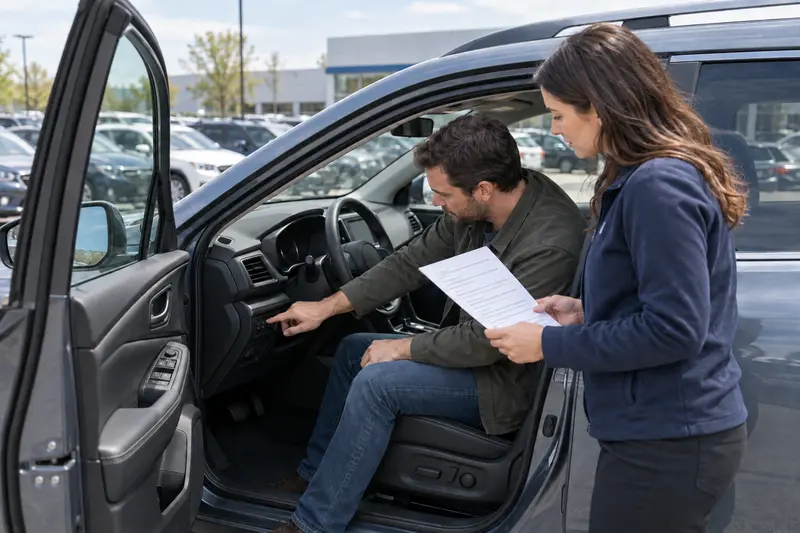
A used car’s trim name and option list can change its price, comfort and equipment—but a badge, copied advertisement or generic VIN report does not prove every feature is present. Two cars from the same model year may look similar while having different drivetrains, seats, safety hardware, audio systems, wheels or towing equipment.
These 12 questions help a buyer turn “fully loaded” into a list of facts that can be checked. They do not prove ownership, condition or legal compliance, and they do not replace an independent inspection, history report, written contract or model-specific professional advice. The illustration above is fictional and is not evidence of a real vehicle or customer interaction.
1. “What are the exact year, make, model, trim and VIN?”
Start with the exact vehicle, not a similar car from the same year. Ask the seller to send the complete VIN privately and to state the trim in writing. Compare the VIN shown on the vehicle with the listing and appropriate documents when you inspect the car.
NHTSA’s VIN decoder identifies information encoded in a VIN using manufacturer-reported data. It is a useful identity cross-check, but it is not proof of title, current condition, mileage, ownership or every installed option. If the decode and the advertisement disagree, pause and resolve the mismatch before relying on either one.
2. “What evidence supports the trim name?”
Ask whether the trim came from the original window sticker, a manufacturer build record, a dealer inventory system, a badge, a prior advertisement or someone’s assumption. Those sources do not have equal weight. A badge can be replaced; a copied listing can belong to another vehicle.
Request the most direct record available for that VIN, then compare it with the actual car. If the seller cannot verify the trim, describe the vehicle by confirmed equipment rather than accepting an unsupported label.
3. “Do you have the original window sticker or a VIN-specific build sheet?”
An original window sticker or manufacturer build record can help separate standard equipment from factory options. Check that the VIN on the document matches the vehicle and that the document is complete. A generic brochure or web page for the model year shows what may have been offered, not necessarily what this car received.
If no VIN-specific document is available, ask the vehicle manufacturer or an authorized source what records can be retrieved. Treat screenshots from unknown sources as leads to verify, not final proof.
4. “Can you show each important feature on the actual car?”
Turn package names into observable items. If the listing claims heated and ventilated seats, a surround-view camera, adaptive lighting, a premium audio system, a power liftgate or a towing package, ask the seller to show the relevant controls, hardware and operation on this vehicle.
A button proves that a control exists, not that the system works correctly. A menu icon may represent unavailable hardware, a disabled feature or a setting that requires separate activation. Record what was demonstrated and what remains unknown.
5. “Which items are factory-installed, dealer-installed or aftermarket?”
Ask the seller to place every nonstandard item in one of three groups: factory option, dealer-installed accessory or aftermarket modification. Examples include wheels, suspension components, remote starters, cameras, alarms, infotainment units, charging equipment, roof racks and towing hardware.
For an aftermarket item, ask who installed it, when, what documentation is available and whether original parts are included. Our guide to listing two wheel-and-tire sets shows how fitment evidence, TPMS details and included hardware should be separated from appearance or prior use.
6. “Does every claimed feature work now?”
Ask for a direct answer for the features that matter to you. Test them during an appropriate inspection with the vehicle safely parked or driven according to the owner’s instructions. Check both sides or seating positions when a feature is position-specific.
“Equipped with” and “operating correctly” are different claims. If a feature is intermittent, disabled or awaiting repair, record that separately. FTC business guidance says advertising claims must be truthful, nondeceptive and evidence-based; see the FTC’s advertising and marketing guidance.
7. “Which keys, remotes, cables, covers and accessories are included?”
Ask for a written inventory of the items delivered with the car: keys, smart-key cards, wheel-lock key, charging cables, cargo cover, removable seats, spare wheel or repair kit, roof-rack parts, tow accessories and manuals. Photograph or list the items during the viewing.
Do not assume an item shown in an old photograph is included. If replacement or programming may be required, verify the process and cost independently before relying on an estimate.
8. “Does any feature depend on software, an account or a subscription?”
Some connected, navigation, driver-assistance, remote-control or entertainment functions can depend on software status, regional availability, a transferable account or a paid service. Ask whether the seller personally tested the feature after any reset or ownership change and whether it transfers to the next owner.
Confirm the current terms with the manufacturer or service provider. Do not treat a screen tile, old receipt or expired trial as proof of permanent access. Keep the hardware present on the car separate from the service that activates it.
9. “Are the wheels, towing equipment and seating configuration original?”
Confirm wheel and tire sizes, seating count, removable components, tow hitch, wiring and any load-related equipment. Ask whether those items match the VIN-specific specification or were changed later. Visual fit does not prove compatibility, capacity or safe installation.
Do not rely on a generic maximum tow rating or payload figure. Vehicle configuration matters, and labels or manufacturer documentation may provide VIN-specific limits. If towing or load capacity is important, have an appropriate professional verify the actual setup.
10. “Did a repair replace or remove any original equipment?”
Ask whether collision repair, glass replacement, seat replacement, wheel changes, infotainment work or body-panel repair altered sensors, cameras, lights, trim pieces or other equipment. A vehicle may retain the same trim name while a repaired component differs from the original.
A vehicle history report can help identify certain recorded title, brand, odometer, total-loss and salvage information, but it does not prove every repair or option. The U.S. Department of Justice’s NMVTIS explanation describes the report’s scope and notes that repair, recall and maintenance information are not intended to be included. Inspect the actual car and records separately.
11. “Is the feature covered by any written warranty?”
Ask whether the vehicle is sold as is, with a dealer warranty, with remaining manufacturer coverage or with an optional service contract. Then read the actual written documents for exclusions, term, mileage, deductible, covered components and transfer rules. A feature being present does not mean its repair is covered.
For covered U.S. dealers, the FTC’s Dealer’s Guide to the Used Car Rule explains the Buyers Guide and its warranty disclosures. Compare the listing, Buyers Guide, purchase documents and any service contract; do not rely on an oral summary when the written terms differ.
12. “Will you put the verified equipment list in writing?”
Before purchase, ask for a concise written summary of the trim, the important confirmed options, aftermarket equipment, included accessories, known nonworking features and any item the seller could not verify. For a dealer purchase, compare that summary with the buyer’s order and other final documents.
The FTC’s used-car buying guidance advises buyers to get promises in writing. A written equipment list does not replace inspection or contract review, but it reduces the risk of a verbal package name being remembered differently later.
Use an evidence table, not a “fully loaded” label
| Claim | Best available check | Status |
|---|---|---|
| Exact trim | Matching VIN-specific manufacturer record plus actual vehicle | Verified / unresolved |
| Factory option | VIN-specific document and visible hardware or control | Present / not found |
| Working feature | Safe demonstration and appropriate inspection | Works / intermittent / not tested |
| Aftermarket item | Installation record, part identity and inspection | Documented / unknown |
| Included accessory | Physical inventory and written sale terms | Included / excluded |
| Warranty coverage | Current written warranty or service contract | Covered / excluded / unclear |
“Unresolved” is a useful result. It tells you not to price, buy or advertise the vehicle as though the answer were known.
A fictional verification example
A fictional advertisement describes a crossover as the highest trim and lists a premium audio package, heated rear seats, a tow package and two keys. The VIN decoder confirms the vehicle family but does not establish every option.
The seller provides a VIN-matched build record showing the audio package. The buyer finds the rear-seat heating controls and tests both sides. The hitch is present, but no wiring information or installation record is available, so towing capability remains unresolved. Only one key is physically available, and the final written equipment list is corrected before the buyer decides.
The buyer did not assume the vehicle was unsuitable. The buyer separated four claims into verified, present-but-unverified and incorrect categories, then based the decision on the evidence actually available. This example is fictional and does not predict a purchase outcome.
Trim and equipment verification checklist
- Record the exact year, make, model, trim and VIN.
- Compare the VIN on the vehicle with the listing and documents.
- Ask what evidence supports the trim name.
- Request the original window sticker or VIN-specific build record when available.
- Separate standard equipment from factory options.
- Separate factory, dealer-installed and aftermarket items.
- Ask the seller to demonstrate every important feature.
- Record working, intermittent and untested items separately.
- Inventory keys, remotes, cables, covers and removable accessories.
- Check whether software, account or subscription access transfers.
- Verify wheel, tire, seating and towing configuration.
- Ask whether repairs replaced or removed original equipment.
- Read written warranty and service-contract terms.
- Keep history-report information separate from present equipment.
- Put verified equipment, exceptions and unknowns in writing.
- Carry unresolved items into an independent inspection and final contract review.
A trim name is only the beginning. The useful question is not whether a car sounds well equipped, but which features belong to this VIN, are physically present, work now, transfer to the buyer and appear in the written sale terms.
Ready to list your car?
Put your vehicle details and photos together, then start your listing on AutoDream.
Create your listing

