
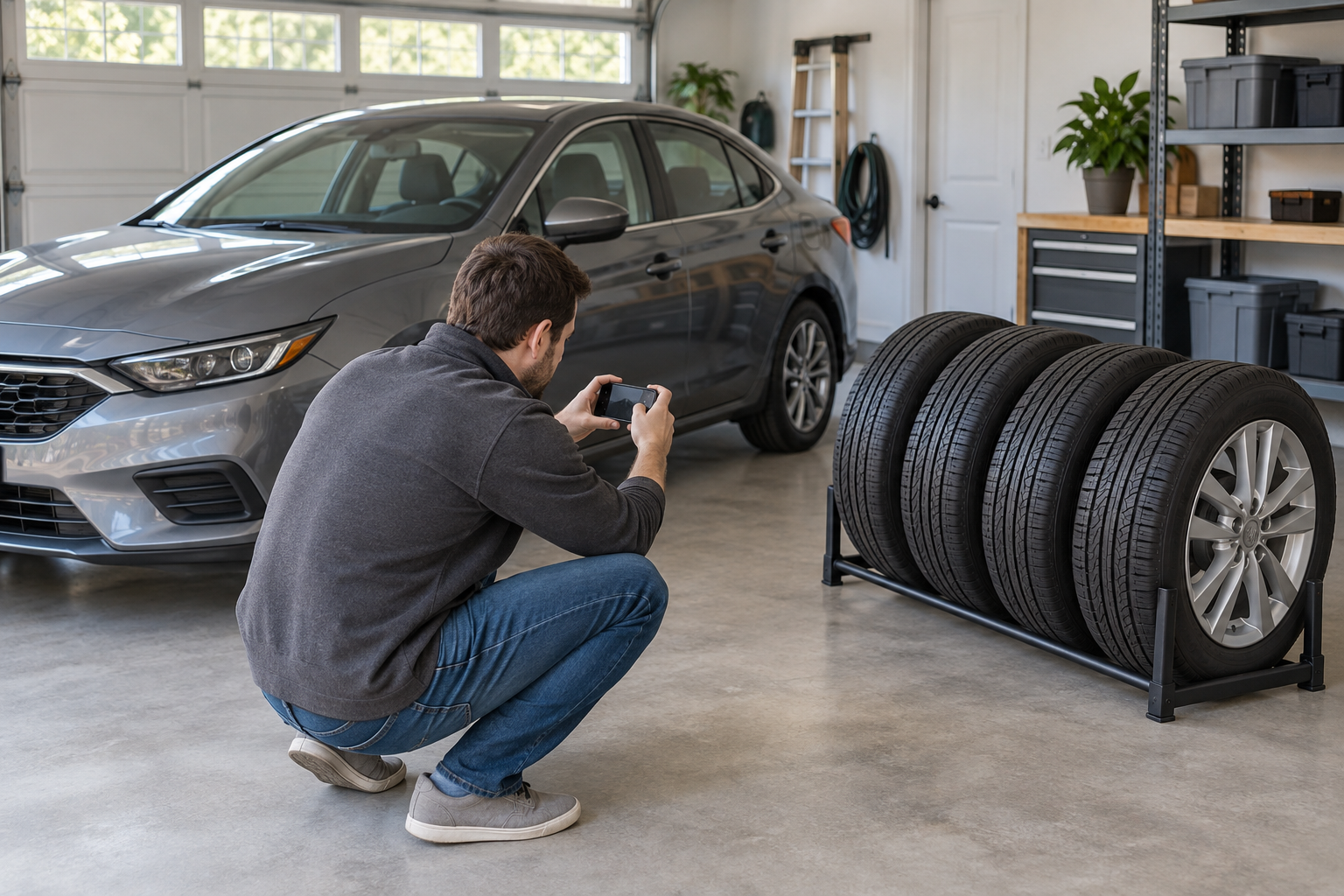
Including a second set of wheels can make a car listing more useful, but the phrase “comes with winter wheels” leaves important questions unanswered. A buyer needs to know what is included, what is mounted now, how each set is identified, what condition is visible and which compatibility claims have actually been verified.
This guide gives private sellers and dealership staff a practical way to document two wheel-and-tire sets without presenting photographs as an inspection or promising that every component will fit or perform safely. Requirements and terminology vary, so use the vehicle manufacturer's information and qualified tire or wheel advice when fitment is uncertain. The illustration above is fictional; it is not a real vehicle, listing or inspection.
1. Define exactly what “two sets” means
Begin with a count. State whether the sale includes four wheels with tires currently mounted on the car plus four additional wheels with tires, or a different combination. Loose tires, bare wheels, a temporary spare and a wheel-and-tire assembly are not interchangeable.
Name each group by its current role rather than making assumptions: “Set A is installed on the vehicle” and “Set B is stored on a rack.” If you call a set winter, summer or all-season, copy the category from the tire markings or manufacturer information you checked. Do not infer it from tread appearance alone.
List small items separately. Center caps, lug bolts or nuts, wheel locks, a locking key, hub-centric rings, tire bags and storage racks may not be included automatically. A clear inclusion list prevents a buyer from treating a background object in a photo as part of the sale.
2. Make an eight-item inventory
Treat every wheel-and-tire assembly as its own item. Photograph and record the identifying information for all four positions in each set. Matching tires can have different manufacture dates, repairs or wear, and one wheel can have damage that the others do not.
| Field | What to record | What not to assume |
|---|---|---|
| Set and item | A1–A4 for the installed set; B1–B4 for the additional set | That every item in a set is identical |
| Tire identification | Brand, model, category and full size as printed | That tread pattern alone identifies the tire |
| Tire date | Last four TIN digits for each tire when visible | That all four were made together |
| Wheel details | Diameter and any verified manufacturer or part markings | Offset, load rating or fitment from appearance |
| Condition | Visible wear, damage, repairs and measured tread depth | Remaining life or safety from photos |
| Hardware | Caps, fasteners, locks, key, rings and sensors known to be included | That hardware transfers between both sets |
Keep the item labels in the photos and notes. A buyer should be able to match “B3 has curb rash” to one specific wheel instead of guessing which wheel a general description refers to.
3. Verify size and fitment without guessing
NHTSA's TireWise guidance tells consumers to find the correct tire size in the owner's manual or on the Tire and Loading Information label. Compare that source with the full size printed on both sets and state what you checked. If the sizes differ, do not describe one as equivalent without reliable vehicle- and wheel-specific support.
Tire size is only part of wheel compatibility. Bolt pattern, wheel width and diameter, offset, center bore, brake clearance, load capacity, fasteners and tire-pressure monitoring system compatibility can matter. “These were on the car last year” or “the bolt holes line up” is not proof of correct fitment.
If you have an invoice or manufacturer application record identifying the vehicle and parts, cite it accurately and offer a privacy-safe copy. Otherwise say that compatibility has not been independently verified and recommend confirmation by the vehicle or wheel manufacturer or a qualified installer. Do not invent a part number from an unreadable casting.
4. Document visible condition one item at a time
Photograph each wheel face straight on, then add close-ups of the rim edge and any curb rash, corrosion, chips, cracks, bends or repairs you can actually observe. Show the inner barrel only when it is safely accessible; do not crawl under a raised vehicle or remove a mounted wheel solely for the listing.
For each tire, photograph the tread across its width and both accessible sidewalls. Note cuts, bulges, cracking, puncture repairs, uneven wear or embedded objects without diagnosing their cause. Our guide to describing visible damage clearly uses the same wide, location and close-up method.
If you report tread depth, name the unit and the tool used, measure more than one place across the tread and record the date. “Approximately 6/32 inch at the three points measured on B2 on September 17” is more useful than “plenty of tread.” A seller measurement and a photograph are not a professional safety assessment.
5. Record the date code for every tire
NHTSA explains that the last four digits of the Tire Identification Number identify the week and year of manufacture. For example, a code ending in 3524 indicates the 35th week of 2024. The complete code may appear on only one sidewall, so say “not visible while mounted” rather than copying another tire's code.
Date is one input, not a condition guarantee. Storage, heat, maintenance, loading, impact and visible damage also matter. Do not call an older tire safe because it has deep tread, or unsafe based only on its date, unless a qualified source has evaluated it. Give the buyer the item-level information and allow an appropriate professional check.
NHTSA's tire retailer resources emphasize recording the tire's type, size, manufacture date and ratings. Capturing those fields consistently makes the listing easier to verify and makes discrepancies easier to spot.
6. Explain TPMS and mounting hardware
State whether tire-pressure monitoring sensors are confirmed present, absent or unknown in the additional set. If the set was last installed, record whether the vehicle recognized the sensors and the approximate date, but do not promise plug-and-play operation now. Sensors can require compatible hardware, programming or a relearn procedure, and batteries can age.
Identify which fasteners belong with each wheel set and whether the locking key is included. Photograph hardware in a labeled container without showing personal paperwork. If spacers, rings or non-original fasteners were used, disclose them and avoid recommending reuse unless compatibility has been verified for the exact application.
7. Check tire recalls separately
Vehicle recall results do not automatically establish tire recall status. NHTSA provides a separate recall search for vehicles, tires and equipment. Use the tire identification information requested by the tool, save the check date and describe the result narrowly.
A statement such as “NHTSA tire recall search checked on September 17, 2026; buyer should recheck using each tire's identification” is more accurate than “no recalls.” Follow any current manufacturer or NHTSA instructions if a match appears. Never treat a zero-result search as proof of overall tire condition.
8. Make the handoff explicit
Tell the buyer which set will be installed at delivery and where the second set is stored. Say whether mounting, balancing, transport, bags or seasonal storage are included. Four assemblies occupy substantial space, so confirm the buyer's transport plan before the appointment rather than leaving loose wheels unsecured in a passenger area.
Update the listing if a wheel, tire or accessory is removed, damaged or replaced before the sale. The FTC's truth-in-advertising overview says advertising must be truthful, non-misleading and evidence-based; the inclusion list and photographs should describe the items the buyer will actually receive.
A fictional listing example
Included wheel-and-tire sets: The vehicle will be delivered on Set A, four [brand/model] [full size] tires mounted on four [verified wheel description] wheels. Set B includes four [brand/model] [full size] tires mounted on four [verified wheel description] wheels and will be supplied separately. Compatibility evidence checked: [owner's manual/vehicle label/invoice/manufacturer record]. Any unverified fitment fields are marked unknown.
Condition: Item-level photos are labeled A1–A4 and B1–B4. B2 has [specific visible mark and location]. B3 has [documented repair, if supported]. Tread measurements were taken with [tool] on [date] and are listed by item and location. TIN date endings are recorded individually where visible. TPMS status is [confirmed/unknown], and included hardware is [exact list]. Mounting, balancing and storage are [included/not included].
Every bracketed field must be replaced with a verified fact before publication. The vehicle, components and condition in this example are invented and do not describe a real AutoDream listing.
Two-set listing checklist
- Count every wheel, tire and assembly included.
- State which set is installed and which is stored.
- Label individual items A1–A4 and B1–B4.
- Copy each tire's full size and visible identifying information.
- Record each visible TIN date ending separately.
- Cite the vehicle label, manual, invoice or manufacturer source used for fitment claims.
- Do not infer offset, load rating, brake clearance or compatibility from appearance.
- Photograph each wheel face, rim edge, accessible sidewall and tread.
- Describe visible damage and repairs item by item.
- Give tread measurements with unit, tool, position and date.
- State TPMS and hardware status as confirmed, absent or unknown.
- Run and date a separate tire recall check.
- List caps, fasteners, locks, keys, rings, bags and racks explicitly.
- Explain installation, transport and storage arrangements.
- Update the listing if any included item changes before delivery.
A strong two-set listing does not ask the buyer to trust a vague bundle. It creates an itemized record: what is included, what can be verified, what condition is visible and what still needs a qualified fitment or safety check.
Ready to list your car?
Put your vehicle details and photos together, then start your listing on AutoDream.
Create your listing

