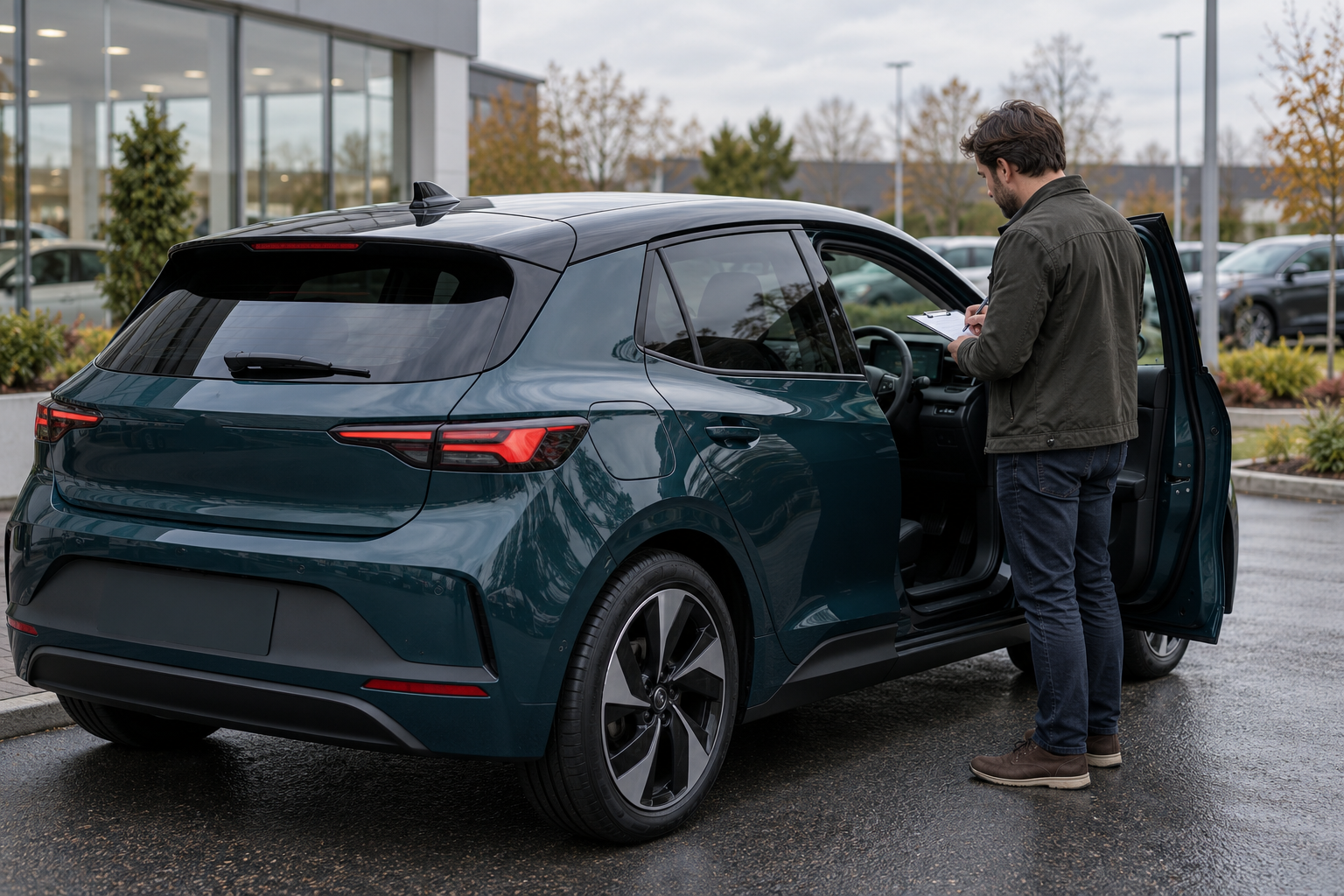
Your driveway is no longer just a local storefront. It's a high-tech node in a global supply chain where export potential can be the difference between a standard sale and a premium windfall. With the national average used car price sitting at approximately $25,600 in 2026, you might feel the pressure of a market that's cooled by 6.1% over the last year. It's natural to worry about leaving money on the table or feeling confused by how AI features and international demand shift your bottom line. If you're asking yourself how to price my used car for sale in this borderless economy, you need a strategy that looks beyond your zip code.
We agree that the traditional way of pricing a vehicle feels outdated and frustratingly opaque. This article promises to help you master the sophisticated logic of modern valuation, ensuring you capture your car's true global worth. You'll gain a clear pricing strategy that accounts for the latest FTC transparency regulations and China's 2026 export rules. We'll preview the exact steps to leverage AI-powered analytics, giving you the confidence to negotiate with both local buyers and international enthusiasts looking for their next high-demand SUV or truck.
Key Takeaways
- Transition from mileage-based metrics to a software-first valuation model that reflects the true technological value of your vehicle.
- Discover how to price my used car for sale by leveraging real-time AI analytics that track shifting global demand.
- Unlock the "Export Premium" by identifying which models fetch up to 20% more in international markets than they do in domestic sales.
- Apply strategic pricing brackets and psychological markers to optimize your vehicle's visibility within global search algorithms.
- Utilize intelligent tools like multilingual chat and distance insights to navigate cross-border transactions with professional precision.
Table of Contents
The Fundamentals of Used Car Valuation in 2026
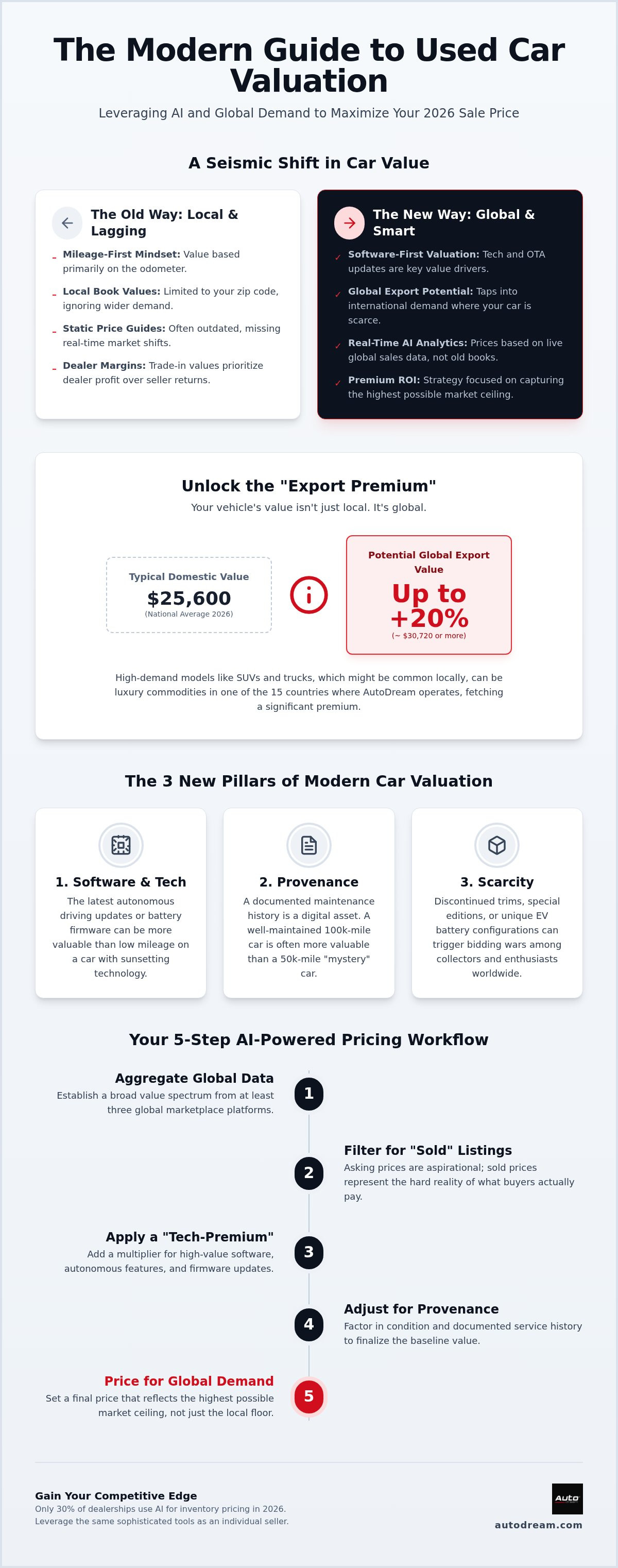
The traditional automotive market is undergoing a seismic shift. If you are researching how to price my used car for sale, you must recognize that mechanical longevity is no longer the sole driver of value. In 2026, the industry has transitioned from a mileage-first mindset to a software-first valuation model. A vehicle with higher mileage but the latest autonomous driving updates or battery management firmware often commands a higher premium than a low-mileage car with sunsetting technology. This shift requires a deeper understanding of the Fundamentals of Car Valuation, specifically how software ecosystems and over-the-air (OTA) capabilities dictate long-term desirability.
While the 6.1% decrease in national average prices from 2025 to 2026 suggests a cooling market, this volatility actually creates opportunities for sellers who understand cross-border demand. Local book values serve as a baseline, but they rarely capture the full picture. Trade-in values prioritize dealer margins, and private party values reflect local supply. However, global export values tap into international demand where specific models are scarce. For instance, an SUV that is common in your city might be a luxury commodity in one of the 15 countries where AutoDream operates. Determining how to price my used car for sale requires balancing these local realities with global potential.
The Core Pillars: Age, Mileage, and Provenance
Modern buyers prioritize provenance. Documented maintenance is no longer just a courtesy; it's a digital asset. In a market where the average vehicle age is 12.8 years, a clear service history proves the hardware can support the latest software updates. You must weigh mileage against service history carefully. A well-maintained vehicle with 100,000 miles and a documented history of battery health or transmission service is often more valuable than a "mystery" car with 50,000 miles. Scarcity also plays a role. Discontinued internal combustion trims or specific EV battery configurations can trigger bidding wars among collectors who view these vehicles as the last of their kind.
Local vs. Global Demand Dynamics
Global demand is fluid and highly reactive to local regulations. Identifying if your vehicle is a "global commodity," like a Tesla Model S or a high-trim Ford F-150, is the first step toward a premium sale. When you evaluate regional interest, use online car shopping tools to see where your specific trim is trending. Currency fluctuations also matter. If the dollar is strong, your car might be expensive for local buyers but a bargain for an international collector looking to hedge against their own local inflation. Understanding these dynamics allows you to set a price that reflects the highest possible market ceiling rather than just the local floor.
Leveraging AI and Real-Time Data for Precision Pricing
Static price guides are becoming relics of a slower era. In 2026, these manuals often lag behind rapid market shifts, failing to account for the sudden spikes in demand that characterize a global economy. If you're trying to figure out how to price my used car for sale, you need the speed and accuracy of live data. Real-Time Valuation is the synthesis of current listings and predictive AI trends. This approach allows you to see the market as it exists this minute, rather than how it looked six months ago. While only about 30% of dealerships use AI for inventory pricing in 2026, individual sellers can now leverage these same sophisticated tools to gain a competitive edge.
AutoDream’s platform utilizes smart logic to analyze cross-border demand across 15 countries. It doesn't just look at what's parked in your neighbor's driveway. It identifies where your specific vehicle is undervalued or in high demand internationally. This is vital because a car that's a "slow mover" in your local city might be a high-priority acquisition for a buyer in a different region. By integrating these insights, you move beyond guesswork and into strategic positioning.
The 5-Step AI-Driven Pricing Workflow
To reach a precision price that attracts serious global interest, follow this data-backed sequence:
- Step 1: Aggregate data from at least three global marketplace platforms to establish a broad value spectrum.
- Step 2: Filter specifically for "Sold" listings. Asking prices are often aspirational; sold prices represent the hard reality of what buyers actually pay.
- Step 3: Apply a "Tech-Premium" multiplier if your vehicle has received recent over-the-air software upgrades or features advanced driver-assistance systems.
- Step 4: Adjust for geographic distance and potential shipping logistics using detailed distance insights to ensure your price remains attractive after transport costs.
Interpreting Market Sentiment and 'Deal Ratings'
Buyers in 2026 rely heavily on AI-generated badges like "Great Deal" or "High Price." If your car is priced just $100 over a specific algorithmic threshold, it might be flagged as "Fair," which significantly reduces your click-through rate. By following expert Tips for Selling Your Car, you can balance these deal ratings with your desired ROI. You can also utilize AI for auto dealers tools to predict upcoming price drops in your category. This foresight prevents you from chasing a falling market and helps you set a price that moves the car quickly. Understanding 'Days on Market' (DOM) data is your final sanity check. If the average DOM for your model is 45 days and you need a sale in two weeks, your price must reflect that urgency. To see how your car stacks up against global demand today, you can start a Standard Vehicle Listing and let the data guide your next move.
Adjusting for Condition, Tech, and Global Export Potential
Traditional condition ratings like "Excellent" or "Good" are becoming obsolete in a market defined by total transparency. When you're determining how to price my used car for sale, you must look beyond physical aesthetics and into the digital soul of the vehicle. In 2026, the standard for valuation includes digital health and regional desirability. For example, a "Battery Health Certificate" can add a specific 5% to 8% value to an EV by providing verifiable data on energy retention. This level of detail is what separates a standard listing from a premium global asset that commands top dollar.
The "Export Premium" is a significant factor for sellers of specific high-demand models. In international markets, certain SUVs and trucks can fetch 15% to 20% more than they would in a saturated local market. This occurs because global buyers prioritize specific utility and reliability factors that might be undervalued at home. While Edmunds' guide to pricing your used car provides an excellent foundation for domestic sales, capturing this international surplus requires a more expansive view of demand. You must also factor in remaining manufacturer warranties and transferable software subscriptions, which act as high-value insurance for distant buyers.
The EV Factor: Battery Health and Charging Tech
State of Health (SOH) is the new mileage. A 2024 EV with 30,000 miles and 98% SOH is worth significantly more than the same model with 92% SOH. You should explicitly price in your SOH percentage to justify a higher ask. Don't forget to factor in charging hardware or adapter bundles in the final price, as these remove logistical friction for the buyer. For those selling high-end electrics, our buy used tesla international guide offers specific nuances on how charging standards vary by region and affect resale value.
Software and Connectivity Value
Hardware versioning is now a primary value driver. A vehicle equipped with Hardware 4 (HW4) will naturally command a higher price than one with HW3, regardless of what the odometer says. You should also consider if "Full Self-Driving" or advanced ADAS features transfer value to the next owner. If the subscription stays with the car, it's an active asset. Price these transferable digital subscriptions and over-the-air (OTA) updates as premium add-ons. This level of technical specificity ensures you aren't leaving money on the table when you finally decide how to price my used car for sale in a tech-driven marketplace.
Strategic Pricing Models: From 'Instant Sale' to 'Premium ROI'
Setting the right number requires more than just looking at a local estimator. It's about understanding how digital platforms process your listing metadata. When you're determining how to price my used car for sale, you must adopt an 'Algorithm-First' strategy. Most global search filters operate on round-number brackets. If your vehicle is worth roughly $30,000, pricing it at $29,990 ensures you appear in the "Under $30k" search results. A price of $30,100 could inadvertently hide your car from thousands of qualified buyers who set strict upper limits on their search parameters.
Psychological pricing remains a powerful tool in the 2026 market. Data suggests that $49,950 consistently outperforms $50,000 in click-through rates. This small adjustment creates a perception of value while keeping your vehicle within a lower search tier. For luxury or rare models, you might choose the 'Anchor Price' method. This involves setting a slightly higher initial ask to provide a buffer for sophisticated negotiation. You'll need to decide between a "Firm Price" to signal uncompromising quality or "Or Best Offer" (OBO) to attract international collectors looking for a starting point for dialogue.
However, not every vehicle is a candidate for the global export market. For those with older, damaged, or high-mileage cars that don't fit the high-tech profile, an "Instant Sale" to a specialized buyer provides a faster alternative. You can explore Cash for Junk Cars to learn more about services that purchase vehicles directly, offering a convenient solution for cars that might not attract international enthusiasts.
Branding Your Price: The Power of Transparency
Transparency is the cornerstone of trust in a borderless marketplace. Modern buyers are wary of hidden fees or sudden price jumps. By listing your "Bottom Line" and providing data-backed justifications in your description, you attract high-quality leads who value efficiency. This clarity is essential for secure cross-border vehicle transactions. When a buyer in another country sees a clear, justified price, they feel more empowered to proceed with a high-value purchase. Using data to justify your ask in the ad description removes friction and positions you as a professional seller.
The 'Featured' Advantage
Visibility is the engine of a premium sale. Utilizing a Featured Listing Placement allows you to push for a higher "Premium ROI" price point. This placement ensures your vehicle stays at the top of search results, where buyers are most active. You should also time your price adjustments strategically. Dropping your price by a small, meaningful increment can trigger "Price Reduced" notifications to everyone watching your car. This automated nudge often serves as the final catalyst for a hesitant buyer to make an offer. When considering how to price my used car for sale, remember that the cost of a premium listing is often dwarfed by the higher final sale price achieved through increased competition.
Navigating the Global Marketplace with AutoDream
Your vehicle is no longer a depreciating local asset. It is a high-demand commodity in a borderless marketplace. When you consider how to price my used car for sale, AutoDream provides the infrastructure to realize the "Export Premium" we've discussed. Our platform acts as a high-tech bridge, connecting your driveway to buyers in 15 countries. By moving beyond local listing sites, you tap into a network where your car’s specific features, software versions, and condition are valued by those who need them most, regardless of where they are located.
Efficiency is the core of our ecosystem. AutoDream’s AI-powered multilingual chat facilitates seamless negotiations, allowing you to discuss pricing and technical specifications with international buyers without language barriers. This technology removes the friction of cross-border communication, ensuring your value proposition is never lost in translation. Additionally, our detailed distance insights empower buyers to calculate the total landed cost of the vehicle. By providing this transparency upfront, you build the trust necessary to maintain a premium price point throughout the negotiation process.
Listing for Global Visibility
Success starts with a sophisticated presentation. To attract serious international interest, you must list a car for sale using high-quality, global-standard photography. Clear, high-resolution images of the undercarriage, battery health screens, and tech interfaces justify your price to a buyer who cannot physically inspect the car. AutoDream’s intelligent search algorithms prioritize listings with complete data sets, ensuring your vehicle reaches the most relevant audience across 15 different countries. This data-driven visibility is the final piece of the puzzle when deciding how to price my used car for sale for maximum ROI.
Closing the Transaction with Confidence
Finalizing a global sale requires a secure, streamlined process. AutoDream’s secure communication tools allow you to move from price agreement to a finalized deal with professional precision. Handling international payments and "sight unseen" agreements becomes a manageable task when backed by a platform designed for global connectivity. Once you reach a price agreement, the transition to a secure handover is handled through our logistical facilitators. This visionary approach transforms the selling experience, allowing you to exit your vehicle with the confidence that you’ve captured its true global worth.
Mastering the Global Value Curve
The automotive landscape has moved beyond local boundaries. You've learned that software health and export desirability now outweigh simple mileage in the 2026 market. By shifting to an algorithm-first mindset, you ensure your vehicle stays visible in critical search brackets while capturing the "Export Premium" that local buyers often overlook. Mastering how to price my used car for sale is no longer about checking a static book; it's about leveraging live data to find the highest bidder on the planet.
AutoDream provides the sophisticated toolkit you need to execute this strategy with precision. With our AI-powered multilingual chat and advanced distance insights, you can confidently negotiate across 15 countries. It's time to stop settling for local trade-in offers and start viewing your car as a global opportunity. List your vehicle on AutoDream and reach buyers across 15 countries today to secure the true worth of your investment. Your car's next owner is waiting, perhaps on the other side of the world. The future of automotive retail is connected, and you're now ready to lead the way.
Frequently Asked Questions
How do I know if my car has export potential for a higher price?
Your vehicle has high export potential if it belongs to a globally recognized category like luxury SUVs, heavy-duty trucks, or specific high-trim electric vehicles. AutoDream analyzes demand across 15 countries to identify "export premiums" where local supply is low but international interest remains high. If your car features advanced tech specifications or belongs to a discontinued but reliable internal combustion line, it likely commands a significant premium abroad.
Should I fix minor scratches and dents before pricing my used car?
You should address minor cosmetic issues if they detract from high-quality photography, as visual trust is paramount for international buyers. While mechanical and software health are the primary drivers of 2026 valuations, a pristine exterior justifies a "Premium ROI" price point. To achieve this, you might discover Nanak Car Wash, as professional detailing and minor dent repair often return twice their cost in the final sale price by signaling meticulous provenance to a distant buyer.
Does a higher mileage always mean a significantly lower price in 2026?
High mileage doesn't automatically trigger a price collapse if the vehicle’s software and battery health are documented and up to date. In the current software-first market, a car with 80,000 miles and the latest autonomous updates often outvalues a 40,000-mile car with obsolete hardware. When researching how to price my used car for sale, prioritize the "State of Health" and digital maintenance records over the odometer.
How much negotiation room should I typically build into my asking price?
You should typically build in a 5% to 8% buffer for negotiation while remaining within strategic search filter brackets. If you want to sell for $28,000, listing at $29,950 keeps you in the "Under $30k" category while leaving room for professional dialogue. This "Anchor Price" method allows you to concede slightly during the negotiation process without dipping below your actual bottom line.
How do software updates and subscriptions affect my car's resale value?
Transferable software updates and active digital subscriptions act as concrete assets that increase your car's resale value. Features like advanced driver-assistance systems or premium connectivity packages are highly sought after in the global marketplace. You must verify which subscriptions are tied to the vehicle hardware rather than the user account to effectively justify your premium ask to potential buyers.
Can AI tools really provide a more accurate price than a physical inspection?
AI tools excel at providing market-driven logic and real-time demand data, whereas physical inspections verify mechanical integrity. An AI-powered dashboard analyzes millions of data points to tell you what the market is willing to pay, but a physical record proves the car deserves that price. Combining both ensures you don't leave money on the table while providing the buyer with absolute certainty about the vehicle's condition.
What is the best time of year to list my car for a premium price?
The best time to list your vehicle is during periods of market stabilization when global inventory levels are lower, typically in the first or second quarter of the year. In 2026, used car sales are projected to reach 38.3 million units, making early-year listings ideal for capturing buyers with fresh budgets. Aligning your sale with these global demand cycles increases the likelihood of a faster transaction at a higher price point.
How do I price my car if it’s a rare model with no local comparisons?
To price a rare model without local comparisons, you must aggregate data from global marketplace platforms to establish a worldwide benchmark. When you decide how to price my used car for sale, look at historical auction data and international listings for similar trims or discontinued editions. AutoDream’s cross-border insights help you identify collectors in other regions who value rarity more than your local market does.
Ready to list your car?
Put your vehicle details and photos together, then start your listing on AutoDream.
Create your listing