
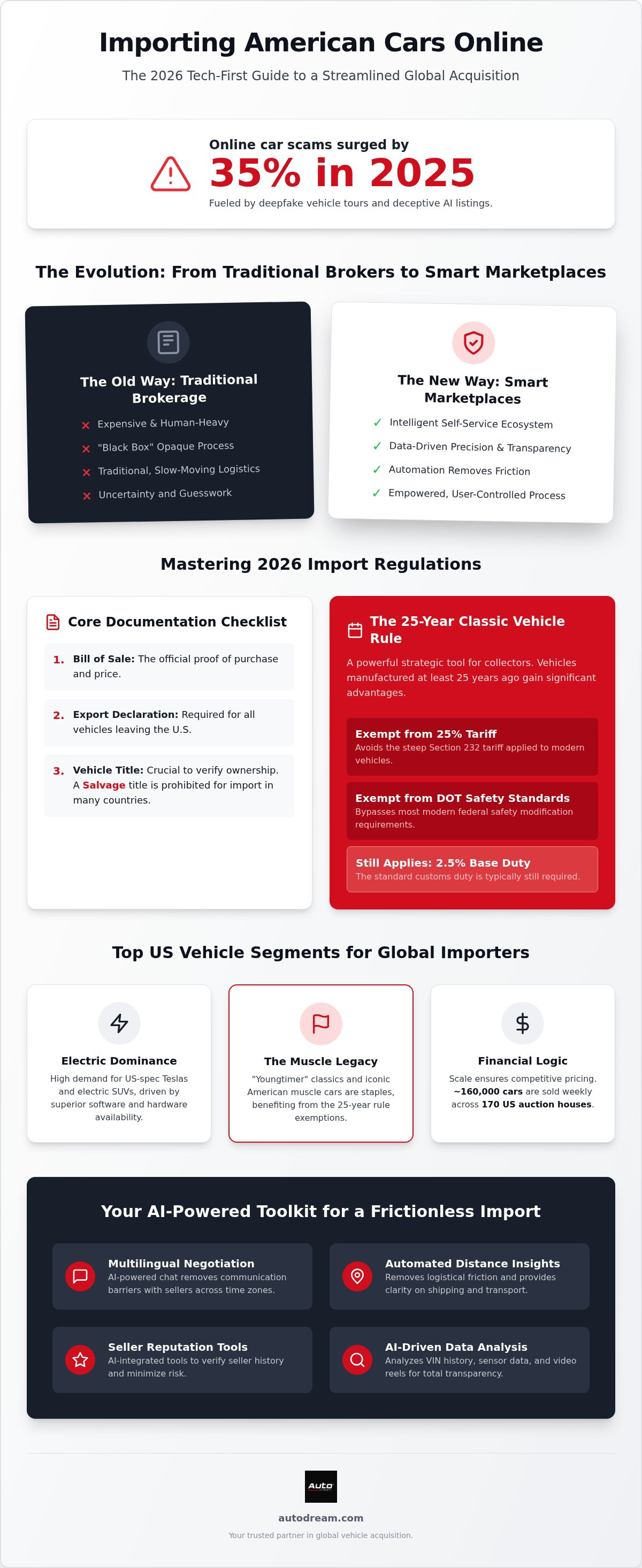
Did you know that online car scams surged by 35% in 2025, fueled by deepfake vehicle tours and deceptive AI listings? You've likely felt the hesitation that comes with these statistics, especially when faced with the intricate 2026 tariff landscape and the daunting task of communicating with sellers across different time zones. It's frustrating to manage cross-border regulations while worrying about the true condition of a vehicle you haven't touched. You want the global inventory, but you don't want the logistical friction that usually follows it.
This guide changes that narrative, showing you exactly how to import american cars online using a sophisticated, tech-first approach. We'll show you how to leverage AI-powered multilingual negotiation and automated distance insights to turn a complex international purchase into a streamlined digital experience. You'll master the 2026 customs requirements, from the 25 percent Section 232 tariffs to the specific exemptions for classic models, ensuring your sourcing process is transparent, verified, and entirely within your control.
Key Takeaways
- Master the shift from traditional brokerage to intelligent, self-service marketplaces that put you in control of the global sourcing process.
- Navigate the complexities of 2026 documentation requirements, including the critical 25-year rule for classic vehicle exemptions.
- Learn how to safely import american cars online by utilizing advanced search filters and AI-integrated seller reputation tools.
- Evaluate the risk-reward dynamics of digital auctions versus specialist smart marketplaces to align with your specific acquisition goals.
- Leverage sophisticated AI tools like multilingual chat and automated distance insights to remove communication barriers and logistical friction.
Table of Contents
The Evolution of Importing American Cars Online in 2026
The landscape of international vehicle sourcing has undergone a fundamental transformation. In the past, buyers relied on expensive, human-heavy brokerage services that often felt like a black box. Today, the ability to import american cars online has shifted toward intelligent, self-service ecosystems. This evolution replaces uncertainty with data-driven precision, allowing individual buyers to bypass traditional gatekeepers. It's a move from a utility-based transaction to a sophisticated, empowered acquisition strategy where the user is the primary architect of their own success.
The Rise of the Smart Marketplace
The distinction between a simple listing site and a smart marketplace lies in integration. Static sites merely display photos; smart marketplaces like AutoDream provide a "platform-as-a-service" experience. Instead of a manual inspection that might miss subtle defects, 2026 technology utilizes AI-driven data points. These tools analyze VIN history, sensor data, and high-fidelity video reels to provide a level of transparency previously impossible. This shift empowers buyers with real-time access to a global inventory, turning the concept of Grey import vehicles into a streamlined, professional transaction rather than a risky gamble. Intelligence replaces guesswork, and automation removes the friction of distance.
US Market Trends: What Global Buyers Want Now
The United States remains the global benchmark for variety and value. While local markets might be limited, the US offers a massive volume of specialized inventory that maintains high residual value abroad. Global interest has converged on a few key segments:
- Electric Dominance: High demand for American-spec Teslas and electric SUVs continues to grow, driven by superior software integration and hardware availability that often outpaces other regions.
- The Muscle Legacy: "Youngtimer" classics and iconic American muscle cars remain staples for 2026 importers, especially as the 25-year rule provides specific tax exemptions from the 25% Section 232 tariff.
- Financial Logic: Sourcing makes sense when the price delta remains significant. With approximately 160,000 cars sold weekly across 170 US auction houses, the sheer scale ensures competitive pricing that often offsets the 2.5% base customs duty.
Global connectivity has removed the "fear of the unknown." Modern buyers aren't just looking for a car; they're looking for a catalyst to achieve a personal goal. By using sophisticated tools like multilingual chat and distance insights, the logistical hurdles of a complex market are solved before the first bid is even placed. The individual buyer is no longer an outsider; they are a sophisticated participant in a borderless trade environment that values efficiency and smart design over traditional, slow-moving logistics.
Navigating Regulatory Frameworks and Documentation
Success in your journey to import american cars online depends on mastering the bureaucratic landscape before the vehicle ever leaves the port. In 2026, the process is defined by digital precision rather than the cumbersome paper trails of the past. You must secure three core documents to ensure a seamless transition: the Bill of Sale, the Export Declaration, and the vehicle Title. The distinction between a Clean and Salvage title is critical; many international jurisdictions strictly prohibit the registration of salvage vehicles regardless of their current repair status. Verifying the official U.S. import requirements ensures you don't overlook CBP Form 7501, which is now processed through integrated digital portals to slash customs clearance times from weeks to days.
The 25-year rule remains a powerful strategic tool for global collectors. Vehicles manufactured at least 25 years ago, calculated by the exact month of production, are exempt from the 25 percent Section 232 tariff and most DOT safety standards. While they still incur the 2.5 percent base customs duty and any applicable reciprocal tariffs, the removal of modern emissions hurdles makes them the most accessible entry point for international enthusiasts. Every vehicle's VIN serves as a digital fingerprint in this process, allowing for real-time verification of its history and global compliance status through sophisticated marketplace tools.
EPA and DOT Compliance for US Vehicles
Modern vehicles must align with Environmental Protection Agency (EPA) emissions standards and Department of Transportation (DOT) safety regulations. You'll generally need to submit EPA Form 3520-1 and DOT Form HS-7 during the entry process to prove the car meets federal requirements. A Letter of Compliance is an official document from the vehicle manufacturer certifying that the specific VIN meets all applicable federal motor vehicle safety and emissions standards. Without this certification, you may face expensive physical modifications to lighting or exhaust systems upon arrival.
Electric Vehicle (EV) Specific Import Nuances
Importing a Tesla or luxury electric SUV requires foresight beyond the mechanical. US-market EVs utilize the CCS1 charging standard, while most of the world has standardized on CCS2. You'll need physical adapters and potentially internal hardware conversions to utilize local fast-charging networks effectively. Additionally, be aware of software region locks; infotainment systems and cellular connectivity features often require a regional firmware update to function outside North America. Battery health certifications are now mandatory for cross-border shipping to ensure thermal stability during transit. You can find vehicles with verified battery data through Standard Vehicle Listings on smart marketplaces that prioritize data transparency.
Evaluating Online Platforms: Auctions vs. Smart Marketplaces
Choosing your acquisition channel is the most critical strategic decision when you plan to import american cars online. The digital landscape of 2026 offers three distinct paths, each with a different balance of risk and technological integration. Traditional online auctions represent the high-stakes end of the spectrum, where professional rebuilders compete for wholesale inventory. While the rewards can be significant, the environment is often unforgiving for individual buyers. On the other end, specialist importers offer a low-involvement experience, though this convenience comes at the cost of high service fees that can erode your profit margins.
Smart marketplaces have emerged as the visionary middle ground. These platforms act as an intelligent facilitator, providing the tools you need to manage the process directly without the "black box" feel of a traditional brokerage. By utilizing features like "automatic distance insights," you can instantly calculate the logistical gap between a seller's location and the nearest exit port. This data is essential for accurate ROI calculations, allowing you to account for domestic transit complexities before you commit to a purchase. Understanding U.S. vehicle import regulations remains a foundational requirement, but a smart marketplace ensures these rules are integrated into the search experience rather than treated as an afterthought.
The Risk Profile of Online Car Auctions
Auctions operate on a strict "As-Is" basis, meaning buyer protection is virtually non-existent once the gavel falls. Professional dealers dominate this space because they have the infrastructure to absorb the risk of hidden mechanical failures or title discrepancies. If you aren't careful, hidden costs like auction storage fees and late payment penalties can accumulate daily, quickly inflating the final price. With approximately 160,000 cars moving through 170 US auction houses every week, the sheer volume makes it easy for individual buyers to feel overwhelmed by the pace of the transaction.
The Smart Marketplace Advantage
Modern marketplaces prioritize transparency and direct communication. Instead of bidding blindly, you can engage in nuanced negotiations with sellers through AI-powered multilingual chat tools. This technology removes the language barrier, allowing you to ask specific questions about vehicle history or maintenance records in real-time. By leveraging secure cross-border vehicle transactions, you ensure that your capital is protected throughout the verification phase. These platforms also use AI to filter for "Export-Ready" listings, highlighting reputable sellers who understand the documentation needs of international buyers. This shift toward smart logic ensures that your sourcing journey is defined by progress and movement rather than logistical friction.
A Step-by-Step Strategy for Remote Vehicle Acquisition
Sourcing a vehicle across borders requires a disciplined, tech-enabled workflow. In 2026, the ability to import american cars online is no longer about luck; it's about the systematic application of smart marketplace tools. You begin by defining your criteria using high-precision filters. Don't just search for a model. Filter by fuel type, specific US port proximity, and certified mileage to ensure the logistics remain manageable. Precision is power. By narrowing your focus early, you eliminate the noise of irrelevant listings and focus on assets with the highest potential for a seamless transfer.
Verifying Vehicle History Sight Unseen
Traditional reports are just the baseline. Modern acquisition strategies utilize AI damage detection tools that analyze high-resolution listing photos for structural inconsistencies the human eye might miss. You should always request a virtual tour or a high-definition video walkthrough to confirm the vehicle's current state. Identifying red flags in US dealer listings is essential. Watch for "Title in transit" or prices that don't align with current market trend analysis. Data removes doubt. If the digital maintenance logs are incomplete or the AI detects anomalies, move on to the next listing immediately.
Negotiating with AI-Powered Multilingual Tools
The US used car market is predominantly English-speaking, creating a significant friction point for global buyers. AI-powered multilingual chat tools bridge this gap instantly. These tools ensure that technical specifications, such as axle ratios or battery degradation percentages, aren't lost in translation. You can maintain a professional, sophisticated tone while haggling across time zones. This ensures your requirements are understood exactly as intended without the need for a human translator. It’s about seamless integration between your intent and the seller’s response, removing the traditional barriers to entry in a foreign market.
Once the price is settled, use verified international payment protocols to secure the transaction. This protects your capital while the seller prepares the documentation discussed earlier in this guide. Finally, coordinate with a third-party logistics provider for inland transport and shipping. While the platform provides distance insights for planning, you'll need a dedicated partner for the physical movement of the asset. Ready to start your search? Explore our Standard Vehicle Listings to find your next acquisition and begin the process with confidence.
Leveraging AutoDream for a Frictionless Import Experience
AutoDream acts as the ultimate catalyst for those ready to import american cars online with professional precision. By connecting users across 15 countries, the platform effectively transcends traditional geographical boundaries. It’s no longer just about finding a vehicle; it’s about accessing a sophisticated ecosystem designed to remove every layer of traditional friction. While previous sections detailed the regulatory and strategic hurdles of the 2026 market, AutoDream provides the technological bridge to clear them. For professional importers, our AI-Powered Dealer Dashboard delivers advanced analytics, allowing high-volume traders to monitor market trends and inventory movement with unprecedented clarity. This is the vision of a truly borderless automotive market where physical distance is reduced to a manageable data point.
The platform’s intelligence ensures that you don't just participate in the market; you dominate your niche within it. By centralizing communication and data, we've created an environment where the global reach of a user is limited only by their ambition. Every tool, from distance insights to multilingual chat, is a component of a larger facilitator designed to put the power of the US market directly into your hands. This isn't a traditional retail experience; it's a platform-as-a-service evolution that values your time and your goals.
Sourcing Luxury and EVs with Precision
Finding high-spec assets requires a toolset that prioritizes data over marketing hype. Whether you are searching for a used Tesla Model S or a rare luxury SUV, AutoDream’s smart filters ensure you see only the most relevant results. These filters prioritize listings with verified mileage and detailed fuel data, ensuring your ROI calculations are based on facts rather than estimates. You aren't just browsing a site; you're connecting with professional US dealers who specifically understand the documentation and logistical needs of international export. This targeted connectivity ensures that your acquisition remains efficient from the first click to the final handshake.
The Future of Global Automotive Retail
The industry is moving toward a frictionless, platform-as-a-service model where the user's goals are met by intelligent automation. AutoDream leads this digital evolution by integrating every necessary insight into a single, cohesive interface. We believe that the complexity of global trade shouldn't be a barrier to individual ambition. By utilizing our Featured Listing Placement or simply browsing the global inventory, you're participating in a new era of automotive retail. It's time to take the next step in your sourcing journey. Registering as a buyer on our global marketplace empowers you to import american cars online with the confidence of a local expert, backed by the intelligence of a world-class facilitator.
Mastering the Borderless Automotive Frontier
The shift toward intelligent, self-service marketplaces has fundamentally redefined how you source vehicles across continents. By moving away from traditional, opaque brokerage models and high-risk auctions, you gain direct control over your acquisition strategy. You've learned to navigate the 2026 regulatory landscape, from the 25-year rule for classics to the specific charging and software requirements for modern electric vehicles. Success in this market is no longer a matter of luck; it's a result of leveraging precise data and sophisticated verification tools.
When you choose to import american cars online through a visionary platform, distance becomes a mere data point. AutoDream serves as your intelligent facilitator, connecting you to inventory across 15 countries with AI-powered multilingual negotiation tools that remove every communication barrier. Our sophisticated distance and logistics insights ensure you have a transparent, end-to-end view of your transaction before it begins.
Explore Global Inventory and Start Your Import Journey with AutoDream. Your next high-performance asset is ready for discovery. Embrace the future of global trade and secure your vehicle with the confidence of a modern innovator.
Frequently Asked Questions
Is it legal to import a car from the USA to my country?
Yes, provided the vehicle meets your local safety and emissions standards or qualifies for age-based exemptions. In 2026, most countries allow imports if the car aligns with regional environmental regulations or is at least 25 years old. You should always consult with a licensed customs broker to confirm specific local restrictions. Verification of the VIN against global compliance databases is a standard step in a sophisticated sourcing strategy.
How much does it cost to ship a car from America internationally?
Shipping costs vary based on the vehicle's dimensions, the departure port, and the destination's logistical complexity. While AutoDream doesn't provide shipping services, our platform offers distance insights to help you plan inland transit to major US ports. You'll typically encounter costs for ocean freight, port handling, and domestic transport. Requesting quotes from multiple international logistics providers ensures you find the most efficient route for your acquisition.
How do I verify if a US car seller is legitimate online?
Use platform-integrated reputation tools and AI-driven history checks to vet sellers before initiating contact. When you import american cars online, look for dealers with high feedback scores and verified VIN-based listings. Requesting a high-definition video walkthrough or a virtual tour is a pragmatic way to confirm the vehicle's physical presence. Avoid sellers who demand untraceable payment methods or refuse to provide digital maintenance logs for verification.
What is the difference between a clean title and a salvage title for export?
A clean title indicates the vehicle has never been declared a total loss, whereas a salvage title means it has suffered significant damage. This distinction is vital for international buyers because many countries prohibit the registration of salvage vehicles. Using a smart marketplace allows you to filter specifically for clean titles, ensuring your investment meets the strict safety standards required for legal operation in your home region.
Do I need to pay US sales tax if I am exporting the vehicle?
You are generally exempt from US sales tax if the vehicle is moved directly from the dealer to a professional export facility. You'll need to provide the seller with a Bill of Lading or an Export Declaration as proof of the car's departure from the United States. It's a highly efficient way to reduce your initial capital outlay, provided the documentation is managed with professional precision.
Can I import a Tesla from the US and use it in Europe or Asia?
Yes, but you must account for hardware and software differences such as charging standards and connectivity. US-spec Teslas use the CCS1 connector, while most other regions utilize CCS2. You'll need to source physical adapters and potentially update the vehicle's firmware to enable local cellular services and navigation features. These technical nuances are easily managed when you approach the acquisition as a sophisticated, tech-enabled project.
How long does the international car import process take in 2026?
The entire process typically spans four to eight weeks, depending on shipping schedules and customs clearance speed. Digital documentation has significantly accelerated this timeline compared to previous years. Once the vehicle arrives at the US port, ocean transit takes approximately 15 to 30 days for most global routes. Efficient planning and real-time tracking of your documentation ensure that the movement of your asset remains constant and progressive.
What documents do I need to clear customs for a US vehicle?
You'll need a specific set of documents to ensure your vehicle clears customs without friction. When you import american cars online, you must secure the following:
- Original vehicle Title or foreign registration
- Official Bill of Sale
- Bill of Lading and Export Declaration
- EPA Form 3520-1 and DOT Form HS-7
- CBP Form 7501
Ready to list your car?
Put your vehicle details and photos together, then start your listing on AutoDream.
Create your listing