
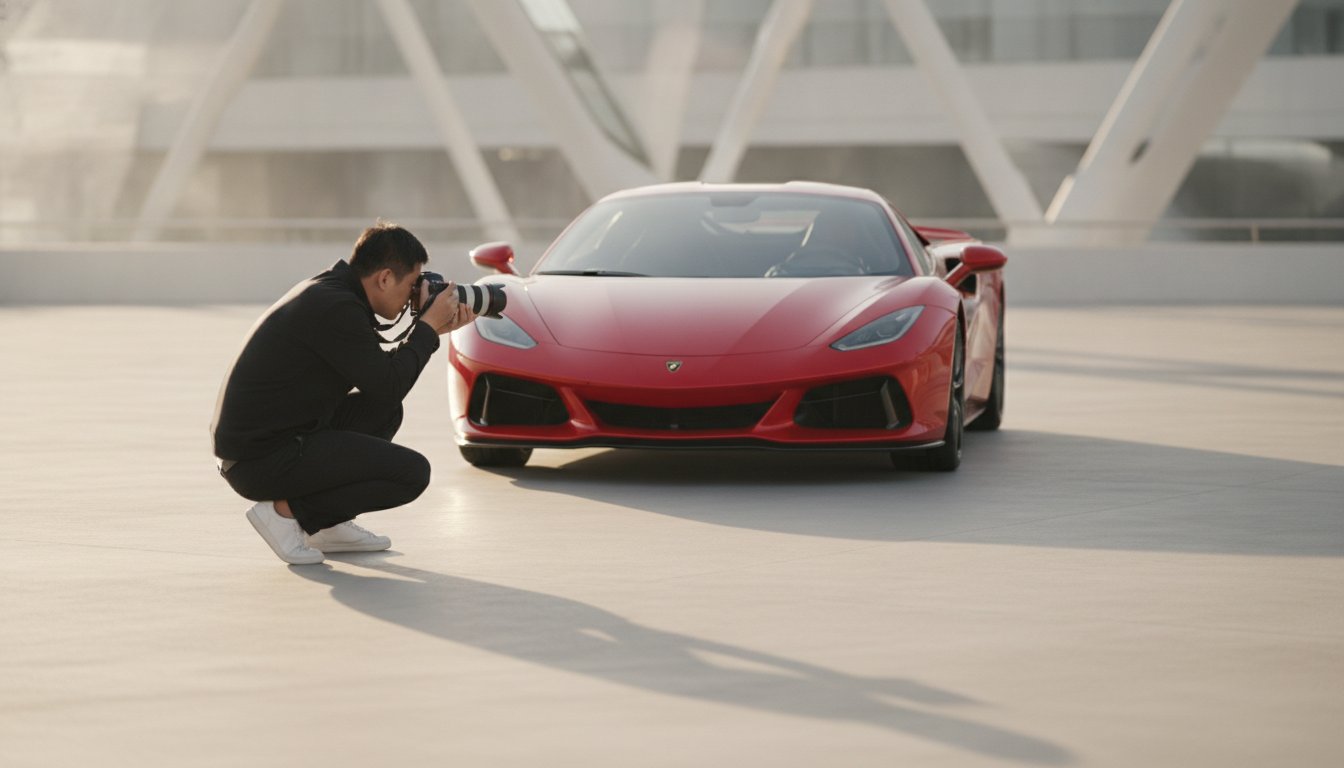
According to Rewarx Studio, 73% of automotive sellers report higher conversion rates after implementing advanced AI photography tools. Mastering how to take photos for car ad success is the primary catalyst for a transaction in our connected marketplace. You've likely felt the frustration of watching a listing stagnate because poorly lit or blurry images failed to spark interest. When buyers can't touch the leather or hear the engine, your photos must bridge that gap by providing absolute transparency.
We've mastered the intersection of aesthetic storytelling and technical precision to help you capture stunning vehicle imagery. You'll learn the professional techniques required to build immediate trust and accelerate sales on a global scale. We'll walk through the specific angles that drive buyer confidence, the lighting setups that highlight premium details, and the smart editing workflows that ensure your vehicle stands out. By the end of this guide, you'll have the roadmap to create a professional-looking gallery that secures a faster sale and a higher final price.
Key Takeaways
- Understand why high-resolution imagery is the primary currency of trust, effectively bridging the physical distance for international buyers in a digital marketplace.
- Master the "Golden Circle" of exterior angles and detailed cockpit sequences to learn exactly how to take photos for car ad listings that drive engagement.
- Leverage optimal lighting conditions, such as the Golden Hour and overcast skies, to highlight premium vehicle contours while eliminating distracting shadows.
- Build radical transparency by documenting maintenance records and mechanical integrity through strategic service book and underside photography.
- Discover how to integrate your professional gallery with AutoDream’s AI-Powered Dealer Dashboard to optimize buyer matching and maximize your listing's global reach.
Table of Contents
The Psychology of Visual Trust in Automotive Sales
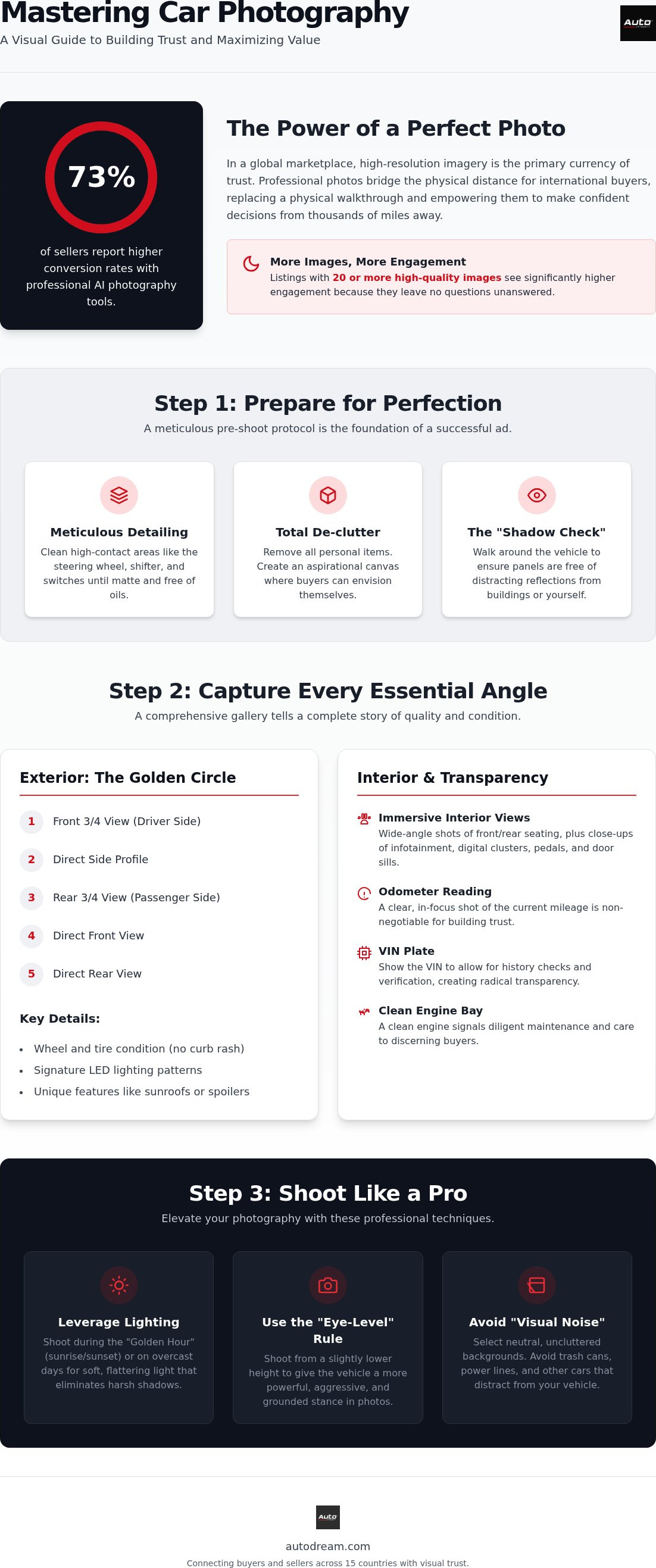
In a digital marketplace that spans 15 countries, your vehicle’s imagery serves as its digital twin. High-resolution photography isn't just about aesthetics; it's the primary mechanism for establishing trust. When a buyer in another region views your listing, they face a significant "sight-unseen" barrier. Professional imagery bridges this physical distance by providing a comprehensive sensory experience that replaces a physical walkthrough. By removing ambiguity, you empower the buyer to make a confident decision from thousands of miles away.
Visual transparency is a strategic asset. It transforms your listing from a mere advertisement into a reliable data set. While the enthusiast culture of car spotting highlights the beauty of automotive design, your goal is to document condition and authenticity. There is a direct correlation between gallery depth and click-through rates. Listings with 20 or more high-quality images see significantly higher engagement because they leave no questions unanswered. This level of detail feeds directly into AutoDream’s AI-powered buyer matching, ensuring your vehicle finds the most qualified lead based on visual data points.
The Pre-Shoot Protocol: More Than a Car Wash
Professional presentation starts with a meticulous detailing protocol that goes beyond a standard wash. You must focus on high-contact areas that the lens often magnifies. Clean the steering wheel, gear shifter, and window switches until they're matte and free of oils. Remove every personal item, from charging cables to air fresheners, to create an aspirational canvas where the buyer can envision themselves as the owner. Finally, perform a "Shadow Check." Walk around the vehicle to ensure the panels are free of distracting reflections from nearby buildings or your own silhouette. This preparation is the first step in learning how to take photos for car ad success.
Choosing the Visionary Setting
The environment surrounding the vehicle should elevate its presence, not compete with it. Select a neutral, uncluttered background that emphasizes the car's silhouette and paint depth. For luxury models or high-demand EVs like Tesla and BYD, industrial or modern architectural backdrops provide a sophisticated context that resonates with the target audience. You must actively avoid "Visual Noise." Elements like overflowing trash cans, power lines, or other parked vehicles introduce friction into the buyer's visual journey. By isolating the subject in a clean environment, you ensure that your Featured Listing Placement captures and holds the viewer's attention immediately. This clarity is essential when considering how to take photos for car ad listings that convert at a professional level.
The Essential Shot List for a Professional Car Ad
Success in a global digital marketplace depends on a narrative of quality. When you're determining how to take photos for car ad listings that actually convert, you must move beyond basic snapshots to create a comprehensive digital dossier. This begins with the "Golden Circle" of exterior angles: the front, both front 3/4 views, a direct side profile, and the rear. These shots establish the vehicle's presence and overall condition immediately, providing the foundational data points every buyer requires.
Exterior Angles: Capturing the Silhouette
Perspective is everything. Follow the "Eye-Level" Rule by shooting from a slightly lower height. This adds a sense of authority and power to the vehicle's stance, making it look more grounded and aggressive. You should also capture the wheel and tire condition in detail. Clean, curb-rash-free rims and healthy tread depth signal maintenance diligence to a discerning buyer. Don't forget to highlight unique signatures like LED lighting patterns, sunroofs, or spoilers. These features often serve as the final hook for a specific buyer profile seeking a particular aesthetic.
Interior Immersion: The Driver's Perspective
The interior is where the buyer will spend their time, so your imagery must feel immersive and tactile. Use wide-angle shots for the front and rear seating areas to provide an accurate sense of space perception. Focus heavily on technology interfaces, including infotainment screens and digital clusters. For high-demand EVs, these tech close-ups are often the most scrutinized images in the gallery. You should also document the "newness" factor. Crisp shots of the pedals, door sills, and the headliner prove the car has been treated with respect rather than just used as a utility.
Transparency is the ultimate currency for international transactions. You must include technical shots of the VIN plate, the current odometer reading, and a clean engine bay. While it might feel counterintuitive, you should also document minor imperfections like small paint chips or slight upholstery wear. This honesty prevents future transaction friction and builds radical trust with remote buyers. Once your shot list is complete, uploading your gallery to a Standard Vehicle Listing ensures your professional presentation reaches our network across 15 countries. Mastering how to take photos for car ad success is the first step toward a frictionless sale and a premium final price.
Technical Mastery: Lighting and Composition
Lighting is the fundamental language of premium presentation. To elevate your vehicle’s perceived value, you must leverage the "Golden Hour," which is the period shortly after sunrise or before sunset. During these windows, the sun sits low on the horizon, casting a warm, directional glow that accentuates the vehicle's body lines while avoiding the harsh, vertical shadows of midday. If your schedule doesn't align with these times, overcast days are a car photographer’s best friend. The cloud cover acts as a massive natural softbox, distributing light evenly across the paintwork and ensuring that details in the wheel wells or undercarriage remain visible.
Composition transforms a simple record into a persuasive narrative. Apply the Rule of Thirds by aligning the vehicle along the intersections of a 3x3 grid to create a more dynamic and balanced frame. You can also use the road’s geometry or architectural edges as leading lines to guide the buyer’s eye directly toward the car’s silhouette. One critical error to avoid is the "Portrait Mode" trap found on many modern smartphones. While this feature creates a pleasant background blur for human subjects, the AI often struggles with the sharp, complex edges of a vehicle. This results in a messy "halo" effect that immediately signals an amateur effort. Professional credibility requires sharp, consistent focus from the front bumper to the rear spoiler.
Smartphone Optimization for Sellers
Modern mobile devices are sophisticated tools when used with foresight. Always enable High Dynamic Range (HDR) to balance the exposure between a bright sky and a dark cabin. This ensures that interior textures remain visible even when shooting toward a light source. When framing your shot, choose physical movement over digital zoom. Walking toward or away from the vehicle preserves the integrity of the sensor's data, whereas pinching the screen introduces digital noise and artifacts. Finally, perform the most neglected step in the process: wipe your lens with a microfiber cloth. A single fingerprint smudge can turn a sharp 4K image into a hazy, unappealing mess that obscures the car's true condition.
Advanced Editing: Polishing the Vision
The objective of post-processing is enhancement, not deception. Use subtle color correction to ensure the paintwork appears exactly as it does in real life, which is especially important for complex metallic or pearl finishes. For privacy, use a clean, solid-color overlay to hide license plate identifiers rather than a distracting blur tool that breaks the visual flow. Standardizing your aspect ratios ensures a seamless online car listing experience, allowing buyers to navigate your gallery without jarring shifts in image size. Mastering these technical nuances is the secret to how to take photos for car ad campaigns that command attention and drive premium offers.
Strategic Documentation for International Buyers
International buyers face a unique set of anxieties when purchasing a vehicle they cannot physically touch. To succeed in a global market, your imagery must act as a comprehensive remote inspection. This is where strategic documentation separates a standard listing from a high-converting asset. Beyond the silhouette and the interior, you must provide visual evidence of the vehicle's history and mechanical health. High-resolution photos of service books with clear dealer stamps, recent maintenance receipts, and original manuals serve as the vehicle's professional resume. These details provide the concrete assurance that a buyer in another country needs to move forward with a high-value transaction.
One of the most powerful tools in your arsenal is the "Underside Shot." For buyers in regions prone to heavy snow or coastal salt, rust is a primary concern that static exterior photos don't address. By capturing clear images of the chassis, suspension components, and floor pans, you demonstrate mechanical integrity and radical honesty. Don't forget the logistical essentials. Include photos of both spare keys, the original tool kit, and, for EV owners, all included charging cables and adapters. These small details confirm the vehicle is complete and ready for immediate use upon arrival.
Building Trust Sight-Unseen
Radical transparency is the only way to eliminate the friction of distance. When you are mastering how to take photos for car ad success, you must photograph minor damage with the same precision as the car's best features. Close-ups of a small wheel scuff or a stone chip on the hood build immense credibility; they prove you aren't hiding flaws. You should also highlight regional compliance markers, such as emission stickers or specific lighting types, which are critical for a secure cross-border vehicle transaction. This level of detail ensures the buyer understands exactly what will arrive at their port.
The Virtual Vehicle Tour
Static imagery is the foundation, but a virtual tour provides the soul of the vehicle. Capture a "Cold Start" video where the camera shows the dashboard lighting up and the exhaust note from a dead stop. This proves the engine's health and battery strength in real-time. Use steady-cam techniques for a fluid 360-degree walkthrough, allowing the buyer to experience the car's proportions and "voice" through engine and exhaust sound clips. To ensure these high-impact visual assets reach the right audience, consider upgrading to a Featured Listing Placement. This ensures your commitment to transparency is the first thing global buyers see when they begin their search. Mastering how to take photos for car ad listings that include these strategic elements will drastically reduce your time-to-sale.
Maximizing Impact with AutoDream’s Ecosystem
AutoDream’s ecosystem transforms your static images into an intelligent sales funnel. Our AI-Powered Dealer Dashboard doesn't just host your files; it analyzes and optimizes the image sequence to maximize buyer engagement. By understanding which angles trigger the highest retention, the platform ensures your most compelling shots are presented first. This strategic alignment is a core component of AI for auto dealers, moving beyond simple storage to active conversion optimization. When you've learned how to take photos for car ad excellence, our platform ensures that effort translates into measurable leads.
AI-Enhanced Listing Tools
The intelligence of our platform extends to contextual data that supports your visual storytelling. Automated distance insights complement your location-based photos, providing remote buyers with immediate logistical clarity. You can use the AI-Powered Dealer Dashboard to track exactly which photos in your gallery perform best with active users. If a specific interior shot is generating more "zoom-in" events, you can pivot your presentation strategy in real-time. Our multilingual chat tools also allow you to answer complex questions sparked by your detailed photography, bridging the communication gap in any of the 15 countries we serve.
The Path to a Global Sale
The journey of buying a used Tesla internationally or sourcing a premium Mercedes-Benz begins with the visual trust established in your gallery. Once you've mastered how to take photos for car ad success, the final step is ensuring that quality meets the right eyes. Leveraging a Featured Listing Placement ensures your high-resolution assets bypass the noise and appear at the top of search results, where our AI-powered buyer matching can do its best work. This synergy between professional imagery and sophisticated technology creates a frictionless path from the first click to the final transaction.
Before you hit publish, run through this final checklist to ensure your listing is optimized for a global audience:
- Lens Integrity: Was the lens wiped clean before the shoot?
- Angle Depth: Does the gallery include the full "Golden Circle" and the underside?
- Radical Transparency: Are service stamps and minor imperfections documented?
- Dynamic Content: Is a "Cold Start" or 360-degree walkthrough included?
- Visibility: Is the listing promoted via Featured Listing Placement?
Ready to showcase your vehicle to a global audience and accelerate your sales cycle? List your car on AutoDream today and experience the power of a visionary automotive marketplace.
Accelerate Your Global Sales Potential
Visual excellence is no longer an optional upgrade; it's the foundational currency of the global digital marketplace. You've learned that mastering how to take photos for car ad listings requires a sophisticated blend of technical precision and radical transparency. By leveraging the Golden Hour and documenting every detail from the chassis to the service stamps, you remove the friction of distance for remote buyers. These high-quality assets serve as a silent salesperson, building immediate confidence across borders and ensuring your vehicle stands out in a crowded inventory.
Your professional imagery deserves a platform that matches its sophistication. With listings viewed in 15+ countries and AI-powered multilingual support, our ecosystem ensures your vehicle resonates with a worldwide audience. You can track engagement in real-time through our AI-Powered Dealer Dashboard, turning visual data into actionable sales insights through advanced analytics. It's time to transform your presentation into a high-velocity transaction tool. Elevate your vehicle listing and reach global buyers on AutoDream. The future of automotive retail is visual, and your next sale is just one stunning gallery away.
Frequently Asked Questions
How many photos should I include in a car ad for the best results?
You should aim for a gallery of 20 to 40 high-resolution images to achieve the best engagement. While basic listings often settle for ten, international buyers require a deeper level of visual data to overcome the distance barrier. A comprehensive set includes the full exterior "Golden Circle," detailed interior textures, and mechanical documentation. Mastering how to take photos for car ad success means providing enough depth to replace a physical inspection for remote leads.
Can I take professional car photos with just a smartphone?
You can absolutely capture professional-grade imagery using a modern smartphone. High-end mobile sensors now feature advanced HDR capabilities that balance complex lighting between bright skies and dark cabins. To ensure the best results, always clean your lens and avoid using digital zoom, which introduces noise. Once captured, you can upload these assets directly to your AI-Powered Dealer Dashboard to track performance and optimize your listing's global reach across our 15-country network.
What is the best time of day to take photos of my car?
The Golden Hour, which occurs shortly after sunrise or before sunset, provides the most sophisticated lighting for automotive subjects. This directional light accentuates the vehicle's body lines without creating the harsh shadows associated with midday sun. Alternatively, overcast days offer a natural softbox effect that distributes light evenly across the paintwork. Choosing the right environment is a critical step in learning how to take photos for car ad listings that command premium prices.
Should I hide the license plate in my car advertisement photos?
You should obscure your license plate to protect your privacy and prevent cloning, but avoid using messy digital blurs. Instead, use a clean, solid-color overlay that matches the car's aesthetic or the platform's professional tone. This small detail maintains the visual integrity of your gallery and signals to buyers that you are a meticulous seller. High-quality presentation is essential when your vehicle is competing for attention in a visionary global marketplace.
How do I photograph a car interior without it looking dark or cramped?
To avoid a cramped appearance, use your smartphone's wide-angle lens and shoot from the opposite side of the cabin through an open door or window. Enable HDR mode to ensure the shadows in the footwells are visible without blowing out the highlights on the dashboard. Removing personal items and ensuring the seats are properly aligned creates a spacious, aspirational environment. This technique ensures your interior photos look as sophisticated as the exterior silhouette.
What is the most important photo in a car listing?
The front 3/4 "hero shot" is arguably the most critical image in your entire listing. It serves as the primary thumbnail that buyers encounter during their initial search. This angle captures the car's face, its profile, and its stance in a single frame, providing an immediate sense of character and condition. To maximize the impact of this shot, consider using a Featured Listing Placement to ensure your vehicle is the first thing buyers see.
How do I document car damage without scaring away buyers?
You build trust by documenting minor damage with radical transparency rather than hiding it. Use clear, close-up shots of stone chips or wheel scuffs alongside your wider beauty shots. This honesty proves to remote buyers that they can rely on your description, which is vital for cross-border transactions. When a buyer knows exactly what to expect, they are much more likely to commit to a purchase without the need for a physical inspection.
Do I need to edit my car photos before uploading them?
You don't need extensive retouching, but subtle edits for color accuracy and plate removal are highly recommended. The goal is to ensure the paintwork looks exactly as it does in real life, especially for complex finishes on brands like Tesla or Mercedes-Benz. Avoid using deceptive filters or the "Portrait Mode" trap that blurs the car's edges. Instead, focus on clarity and consistency, ensuring your gallery integrates seamlessly with our advanced AI management tools.
Ready to list your car?
Put your vehicle details and photos together, then start your listing on AutoDream.
Create your listing

