
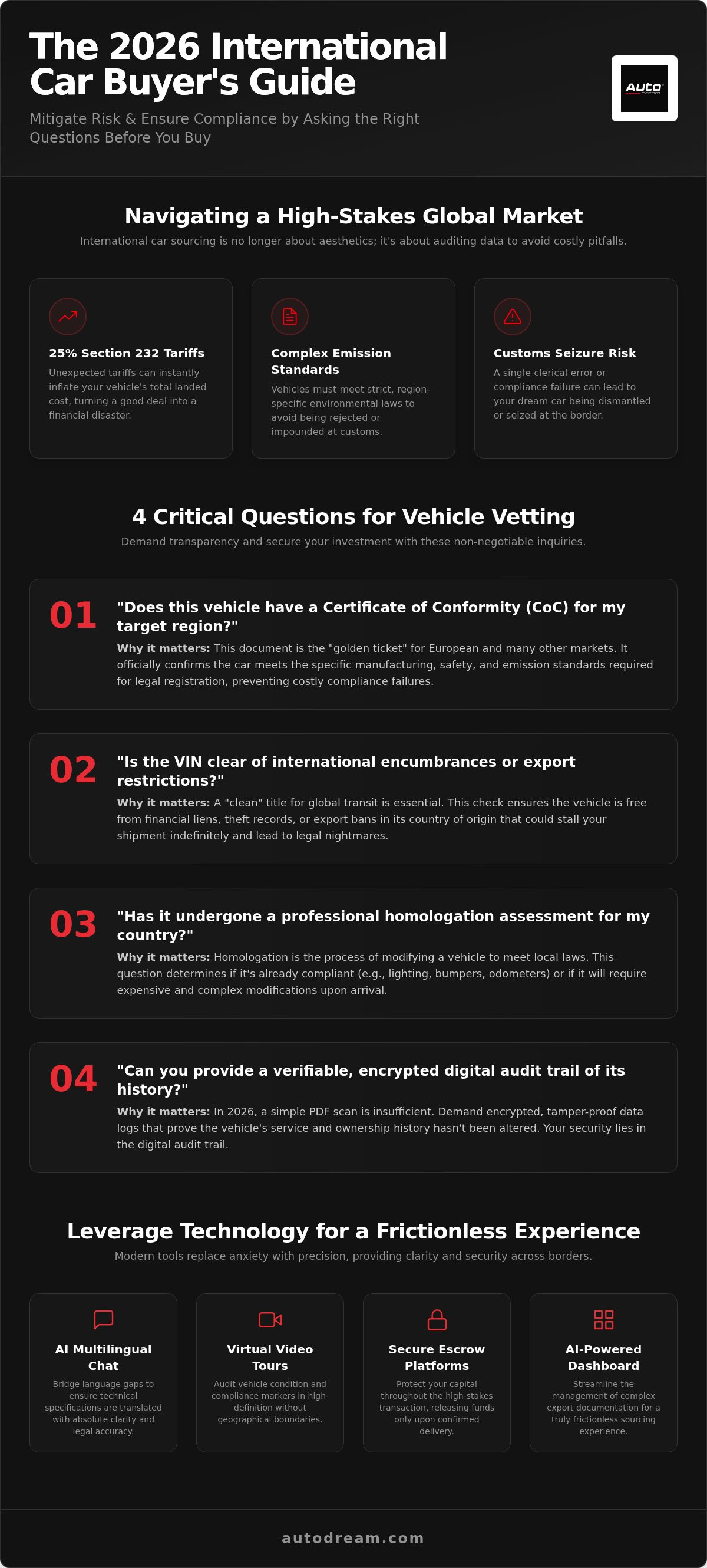
What if the dream car you just purchased is dismantled at the border because of a single clerical error? In 2026, the global automotive market is defined by rapid regulatory shifts, including the 25% Section 232 tariffs that can instantly inflate your total landed cost. Many buyers feel overwhelmed by the complexity of regional emission standards and the inherent risks of "sight unseen" transactions. Identifying the right questions to ask when buying a car internationally is no longer just a courtesy; it's a vital survival strategy for your investment.
You deserve a sourcing process that feels as modern and connected as the vehicle you're importing. We understand the hesitation that comes with navigating diverse customs landscapes from the U.S. to the E.U. This guide provides a sophisticated framework designed to replace anxiety with precision. By mastering these seven critical inquiries, you'll gain the confidence to use digital verification tools effectively and ensure a frictionless import experience. We'll explore everything from verifying precise manufacture dates for the 25-year rule to auditing the digital data trail that secures your vehicle's passage.
Key Takeaways
- Identify the seven essential questions to ask when buying a car internationally to mitigate financial risk and ensure legal entry at customs.
- Learn how to verify regional compatibility by requesting a Certificate of Conformity and ensuring the VIN is free of international encumbrances.
- Master the technicalities of Incoterms and secure escrow platforms to protect your capital throughout the high-stakes global transaction.
- Discover how to leverage AI-powered multilingual chat and virtual video tours to audit vehicle condition and compliance markers without geographical boundaries.
- Explore how the AI-Powered Dealer Dashboard streamlines the management of complex export documentation for a truly frictionless sourcing experience.
Table of Contents
Navigating the 2026 Global Sourcing Landscape: Why Questions Matter
Transacting across 15 global markets in 2026 is a sophisticated, data-driven exercise. The modern buyer doesn't just look for a vehicle; they audit a comprehensive digital history. While traditional marketplaces focus on local aesthetics, the global economy demands a rigorous focus on technical compatibility. Mastering the specific questions to ask when buying a car internationally is the only way to de-risk a purchase that spans continents. Sourcing a vehicle is no longer about the physical object alone. It's about the data that travels with it.
Standard inquiries about mileage or service history are insufficient for cross-border trade. You must pivot your focus toward "Regulatory Compatibility." This concept represents the primary hurdle for any importer. If a vehicle doesn't align with your region’s specific safety and emission standards, it becomes an expensive liability at the port. For those seeking a broad perspective on these logistical layers, our international car buying guide offers a foundational look at the global sourcing ecosystem. Without this context, you're merely guessing in a high-stakes environment.
The Shift Toward Digital Compliance
By 2026, digital documentation has completely superseded physical paperwork. Unified global databases allow for instant verification of vehicle eligibility, reducing the friction that once plagued international trade. Sophisticated buyers now gravitate toward "Global Models" designed to meet multiple regional standards simultaneously. These vehicles offer a smoother path through customs because their specifications are pre-verified within digital clearinghouses. Relying on paper titles alone is a relic of the past. Your security lies in the digital audit trail provided by modern platforms.
The Cost of Miscommunication
Ignoring the nuances of regional safety modifications can lead to total vehicle seizure. This process, known as homologation, requires specific technical knowledge that varies by country. This risk is particularly high for grey market vehicle imports. Language barriers often obscure critical legal details, turning a perceived bargain into a financial disaster. Using AI-facilitated platforms to bridge these gaps is essential. These tools ensure that technical specifications are translated accurately and that the questions to ask when buying a car internationally are answered with absolute clarity. Precision in dialogue is your ultimate safeguard.
Questions Regarding Vehicle Pedigree and Compliance
Securing a vehicle from an overseas market requires more than a casual glance at a digital listing. You need a rigorous vetting process that prioritizes regulatory data over surface-level aesthetics. When refining your list of questions to ask when buying a car internationally, focus on the document trail that proves a car can legally exist in your driveway. A vehicle without a verifiable pedigree is simply a collection of parts waiting for a customs seizure. In the 2026 economy, your leverage as a buyer depends on your ability to demand transparency before funds ever leave your account.
- "Does this vehicle possess a Certificate of Conformity (CoC) for my target region?" This document is the golden ticket for European and many Asian markets. It confirms the car meets specific manufacturing standards required for registration.
- "Is the VIN clear of any international encumbrances or export restrictions?" Financial liens or export bans in the country of origin can stall your shipment indefinitely. You need confirmation that the title is "clean" for global transit.
- "Has the vehicle undergone a professional homologation assessment for [Target Country]?" Knowing if a car is already compliant or needs expensive modifications is critical for your total landed cost.
- "Can you provide a digital audit trail of the vehicle’s service history and ownership?" In 2026, a simple PDF scan isn't enough. You want encrypted, verifiable data logs that prove the car's history hasn't been tampered with.
Understanding Homologation Requirements
Homologation is the technical bridge between a "foreign" car and a "legal" car. You must ask the seller about specific physical modifications like lighting configurations, bumper impact ratings, and whether the odometer units match your local laws. It's vital to determine if a car was built to "Global Specification" or a strictly "Local Specification." This distinction often dictates the complexity of meeting official import requirements for safety and emissions. For instance, sourcing certain modern vehicles with advanced digital architecture is often simpler because their integrated systems allow for remote verification of regional software and hardware compatibility through a single data audit.
Verifying the VIN and Title
Transparency starts with the Vehicle Identification Number. Don't settle for a typed number in an email. Request a high-resolution photo of the physical VIN plate and the original title document. You should also confirm the availability of a "De-registration Certificate." This document proves the vehicle has been legally removed from its home country's registry, which is a non-negotiable step for export. Modern buyers often use intelligent marketplace tools to cross-reference this data against global theft and salvage databases instantly. This level of foresight ensures that the questions to ask when buying a car internationally lead to concrete, de-risked answers rather than vague promises.
Logistics and Financial Transparency: Vetting the Transaction
Once you have verified the vehicle's pedigree, the focus must shift to the financial architecture of the deal. In the 2026 global market, the purchase price is merely a starting point. The complexity of moving an asset across borders requires a deep understanding of logistical responsibilities and capital protection. Knowing the specific questions to ask when buying a car internationally regarding shipping and payments ensures your investment doesn't disappear into a regulatory or fraudulent void. Precision at this stage separates successful importers from those caught in expensive port delays.
- "What is the Incoterm for this sale?" This question determines exactly where the seller's responsibility ends and yours begins. Whether it is FOB (Free on Board), CIF (Cost, Insurance, and Freight), or DAP (Delivered at Place), you need to know who is liable if the vehicle is damaged during transit.
- "Which escrow or secure payment platform will be used to hold funds until customs clearance?" In 2026, sophisticated buyers avoid direct wire transfers. Utilizing secure cross-border vehicle transactions through verified digital intermediaries is the only way to prevent fraud in "sight unseen" deals.
- "What is the estimated ‘Landed Cost’ including duties, taxes, and port fees?" You must factor in the 2.5% U.S. import duty for cars (or the 25% "Section 232" tariff for certain regions) and local handling fees to understand your true total investment.
Incoterms and Shipping Responsibilities
Clarifying shipping terms is about more than just cost. It's about control. You should ask the seller if they recommend "Roll-on/Roll-off" (RoRo) shipping, which is generally more affordable at $900 to $2,000, or a "Sole-Use Container" for maximum protection. Each choice impacts the "Bill of Lading," which serves as your primary digital receipt and title of carriage. This document is the cornerstone of your digital audit trail. Without it, you cannot prove ownership to customs authorities upon the vehicle's arrival.
Taxation and Dutiable Value
Transparency in the "Commercial Invoice" is non-negotiable. You must ensure the declared value reflects the true market price to avoid penalties for under-valuation. Ask the seller about VAT or GST exemptions; for example, a vehicle exported from the UK may qualify for a 20% VAT refund if handled correctly. Taxes are also increasingly tied to technical specifications. Engine displacement or battery capacity can trigger different tax brackets, and you must verify that the car meets local vehicle emission standards to avoid being taxed on a vehicle that cannot be registered. Mastering these questions to ask when buying a car internationally allows you to calculate the impact of these variables before you commit your capital.
A Visionary Framework for Verifying Seller Responses
Verification is the ultimate differentiator in a globalized market. You must move beyond passive inquiry and adopt a structured framework to validate every claim a seller makes. While identifying the right questions to ask when buying a car internationally is a prerequisite, the true value lies in your ability to audit the responses with technological precision. This framework ensures that your cross-border acquisition remains secure, compliant, and transparent. Trust is no longer a sentiment; it is a data-driven conclusion.
- Step 1: Deploy AI-Powered Communication. Use multilingual chat tools to confirm technical specifications in the seller’s native language. This eliminates the risk of "lost in translation" errors that often plague technical regulatory discussions.
- Step 2: Mandate a High-Definition Virtual Tour. Request a live or recorded video focusing specifically on the physical VIN plate and regional compliance markers, such as EPA or E-mark labels.
- Step 3: Audit the Documentation. Cross-reference all provided titles and service logs against essential online car shopping tools to ensure the data is consistent with global databases.
- Step 4: Consult a Registered Importer (RI). If your inquiry reveals that the vehicle requires physical modifications for legal entry, engage an RI early to estimate homologation costs.
Leveraging AI for Due Diligence
In 2026, automation is your most reliable ally. Automated translation tools do more than just convert words; they preserve the legal intent of contracts and technical manuals. Sophisticated platforms now integrate distance insights to verify that the seller’s physical location aligns with the nearest logistical hub, reducing the risk of phantom listings. You should also analyze seller response patterns. A professional, timely response is often a reliable proxy for the seller's operational efficiency and trustworthiness in a complex market. To begin vetting your next purchase with these intelligent tools, explore our AI-powered marketplace today.
The Virtual Inspection Standard
The 2026 standard for "sight unseen" transactions is the high-definition, 360-degree virtual tour. This technology allows you to inspect the vehicle's integrity from thousands of miles away. Direct your attention to the undercarriage for corrosion, check battery seals on electric models, and verify the legibility of all emission control labels. A "Condition Report" from an independent, third-party agency is a non-negotiable requirement. This report provides an unbiased assessment of the vehicle's state, ensuring that the questions to ask when buying a car internationally result in verifiable facts rather than subjective descriptions. This level of scrutiny is what defines a visionary buyer.
How AutoDream Simplifies the International Vetting Process
AutoDream acts as the intelligent bridge between your ambition and a successful global acquisition. By centralizing the complex variables of cross-border trade, the platform transforms a high-risk endeavor into a streamlined, predictable process. We provide the tools that allow you to verify every detail, ensuring that the questions to ask when buying a car internationally are answered with verifiable data rather than hearsay. Our presence in 15 global markets provides a robust infrastructure for buyers seeking high-value assets across diverse regulatory zones. Transparency is no longer a luxury; it is a technological standard we uphold for every transaction.
The AI-Powered Dealer Dashboard serves as the engine for this transparency. It empowers sellers to provide comprehensive digital audit trails, from service histories to export-ready documentation. This technological shift, detailed in our analysis of AI for auto dealers, ensures that every listing on our platform is built on a foundation of trust and technical accuracy. When dealers use intelligent tools to manage their inventory, you receive a higher level of clarity and responsiveness during the vetting process.
Removing the Friction of Cross-Border Trade
Our multilingual chat interface handles the nuances of technical regulatory discussions automatically. It removes the linguistic barriers that often obscure critical compliance details, allowing for precise negotiation in the seller's native tongue. The platform also integrates real-time logistics and distance insights directly into each vehicle listing. You're not just looking at a car; you're looking at a complete import roadmap. Whether you're sourcing a Tesla from the U.S. or a Mercedes-Benz from Germany, our managed marketplace provides the security and oversight necessary for high-value transactions. We've solved the logistical hurdles so you can focus on the vehicle.
The Visionary Future of AutoDream
We're moving toward a "one-click" import experience where AI handles the heavy lifting of customs declarations and homologation checks. This evolution is central to our role in shaping the European used car market and other global trade hubs. By automating the verification of the questions to ask when buying a car internationally, we empower you to focus on the vehicle itself rather than the logistical hurdles. The future of automotive sourcing is connected, efficient, and borderless. It's a world where geographic limits no longer define your choices.
Start your global sourcing journey today with a platform engineered for the 2026 economy. Explore our featured listings and experience a frictionless path to your next international vehicle acquisition.
Mastering the Future of Global Automotive Sourcing
The shift toward a borderless car market requires a blend of regulatory foresight and technological precision. By focusing on digital compliance and financial transparency, you transform a complex logistical challenge into a predictable path toward ownership. Mastering the specific questions to ask when buying a car internationally ensures that your capital is protected and your vehicle arrives ready for the road.
AutoDream acts as your intelligent facilitator in this journey. We provide verified listings across 15 international markets and AI-powered multilingual negotiation support to remove the friction of technical dialogue. With integrated distance and logistics insights for every vehicle, you can make decisions based on real-time data rather than estimates. It's time to replace the anxiety of cross-border trade with the empowerment of a connected marketplace.
Explore our global inventory and start your visionary car buying journey today. Your next vehicle is waiting on the global stage. Step into the future of automotive retail with the confidence that only a data-driven framework can provide.
Frequently Asked Questions
What is the most important question to ask an overseas car seller?
The most critical inquiry is asking for a verifiable digital audit trail of the vehicle's pedigree and its specific Certificate of Conformity (CoC). This data confirms the car meets your region’s legal standards before you commit capital. Without this proof, you risk total vehicle seizure at the border. You must ensure the seller can provide high-resolution documentation that matches the physical VIN plate on the chassis.
How do I verify if a car is eligible for import under the 25-year rule?
You must verify the exact month and year of manufacture, not just the model year, to qualify for this critical exemption. For 2026, the 25-year rule applies to vehicles manufactured in 2001 or earlier. Checking the physical manufacture plate located on the door jamb or in the engine bay is the only way to ensure the car is exempt from modern safety and emission standards.
Do I need a customs broker if I am buying through AutoDream?
Yes, you typically need a licensed customs broker to manage the legal entry of your vehicle. AutoDream acts as an intelligent marketplace facilitator, providing the AI-powered negotiation tools and documentation you need, but we don't provide direct logistics or brokerage services. A professional broker ensures all duties, such as the 2.5% U.S. import duty for cars, are paid correctly to avoid port delays.
What happens if a seller provides false information about a car’s compliance?
If a vehicle fails to meet declared compliance standards upon arrival, it can be seized by customs or forced into an expensive re-export at your expense. This is why identifying the right questions to ask when buying a car internationally is vital for your due diligence. Using secure escrow platforms helps mitigate this risk by holding your funds until the vehicle's documentation is verified by authorities.
Are electric vehicles like BYD and Tesla easier to import than gas cars?
Electric vehicles are often easier to verify digitally due to their software-driven architecture, but they face unique hurdles regarding regional charging standards and battery safety certifications. A Tesla Model S, for example, allows for remote auditing of regional software compatibility through a single data log. However, you must still confirm the specific model meets your local voltage and connector requirements to ensure it's functional in your home country.
What are Incoterms and why should I care about them?
Incoterms are standardized international rules that define exactly when the risk and cost of transport shift from the seller to the buyer. Terms like FOB (Free on Board) or CIF (Cost, Insurance, and Freight) determine who is liable if a car is damaged during its journey. Understanding these terms is essential for calculating your true total landed cost and ensuring you have adequate insurance coverage during transit.
How can I safely pay for a car in another country?
You should only use verified escrow services or secure digital payment platforms that hold your funds until the vehicle’s title and export documents are confirmed. Direct wire transfers offer no protection and are a primary target for international fraud in "sight unseen" transactions. Sophisticated marketplaces now integrate these secure transaction layers to protect your capital throughout the entire cross-border sourcing process.
Can I import a car that does not meet my country’s current emission standards?
You can only import such a vehicle if it qualifies for a specific exemption, like the 25-year rule, or if you hire a Registered Importer to physically modify it. For most buyers, importing a non-compliant modern car is financially prohibitive due to the high cost of homologation. Always verify that the vehicle has the correct emission labels before finalizing any international purchase to avoid a costly legal mistake.
Ready to list your car?
Put your vehicle details and photos together, then start your listing on AutoDream.
Create your listing