

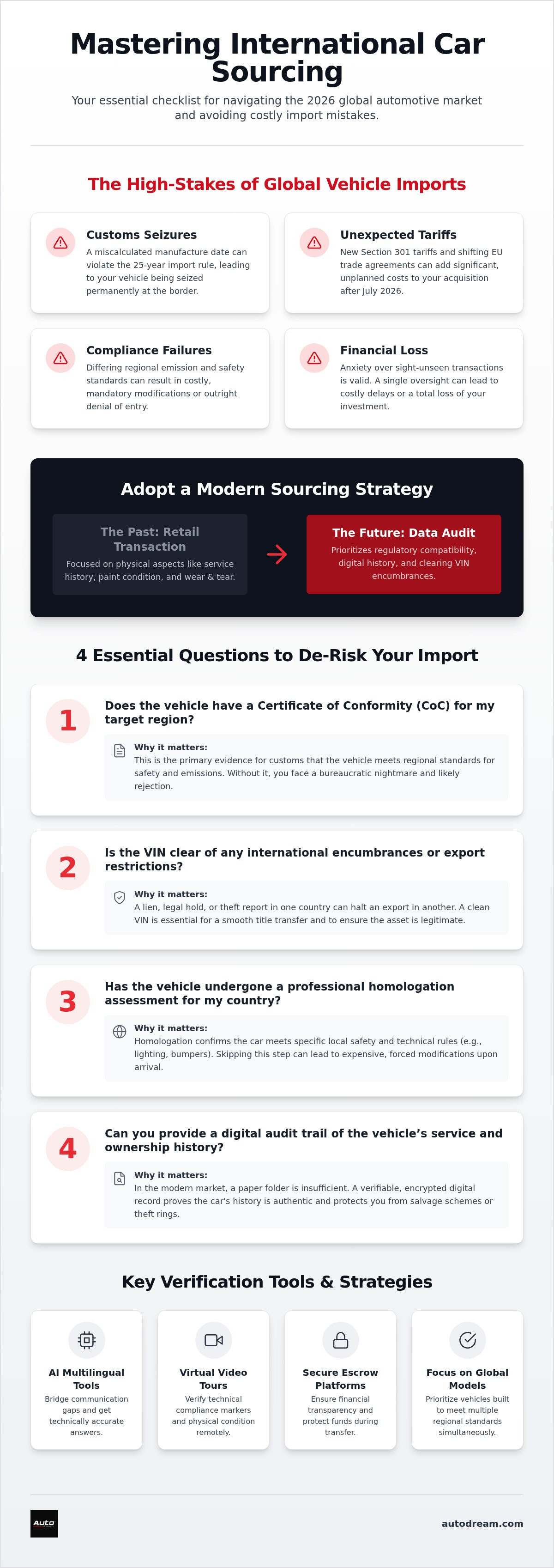
Did you know that a miscalculated manufacture date could lead to your dream car being seized at customs? With the 25 year rule requiring precision down to the month of production and new Section 301 tariffs hitting on July 24, 2026, knowing the right questions to ask when buying a car internationally is no longer optional. You likely feel the weight of these risks every time you browse a foreign listing. The anxiety of sight unseen transactions and the confusion of differing regional emission standards can make even a seasoned collector hesitate. It's a high stakes environment where a single oversight results in costly delays or permanent loss.
We're here to help you master the sophisticated art of cross border vehicle sourcing. This guide provides an expert framework for de risking your investment, whether you're navigating the standard 2.5 percent duty for passenger cars or complex EU trade shifts. You'll gain the confidence to use advanced digital verification tools and ensure your next import is entirely frictionless. By focusing on smart logic and data audit trails, we move past traditional retail hurdles into a future of intelligent, global connectivity. We'll preview the seven essential inquiries that bridge the gap between a distant listing and your driveway, ensuring your purchase is legal, safe, and cost effective in a volatile trade climate.
Key Takeaways
- Modernize your sourcing strategy by treating cross border acquisition as a sophisticated data audit rather than a simple retail transaction.
- Identify the essential questions to ask when buying a car internationally to confirm regional Certificate of Conformity status and clear VIN encumbrances.
- Master financial transparency by vetting specific Incoterms and secure escrow platforms before initiating any global funds transfer.
- Utilize AI powered multilingual tools and virtual video tours to verify technical compliance markers in the seller's native tongue.
- Streamline your vetting process using an AI Powered Dealer Dashboard to manage complex export documentation and ensure global visibility.
Table of Contents
Navigating the 2026 Global Sourcing Landscape: Why Questions Matter
In the 2026 economy, sourcing a vehicle across borders has evolved from a mechanical inspection into a rigorous data audit. You aren't just buying a machine. You're acquiring a digital history that must align with strict international standards. While local buyers focus on wear and tear, global purchasers must prioritize Regulatory Compatibility. This concept defines whether a vehicle can legally cross a border without being seized or requiring prohibitive modifications. For a broader look at this ecosystem, see our international car buying guide. It's the foundation for any successful cross border acquisition.
Traditional inquiries about service history or paint condition are insufficient. The most critical questions to ask when buying a car internationally now center on the vehicle's ability to clear customs and meet regional emission targets. Failing to verify these details leads to the risk of understanding grey market vehicles, which often lack the necessary compliance for legal operation in specific territories. You need to know if the asset you're buying is a global citizen or a regional prisoner. In a market defined by volatility, precision is your only protection.
The Shift Toward Digital Compliance
By 2026, standards have shifted to prioritize digital documentation over physical logbooks. Unified global databases now allow for instant verification of a vehicle's eligibility. Sophisticated buyers often focus on Global Models. These vehicles are manufactured to meet multiple regional standards simultaneously, which significantly reduces the friction of import. Automation ensures that every data point, from the VIN to the carbon footprint, is accessible and verifiable before the transaction begins. This digital first approach removes the traditional lag associated with international trade and replaces it with real time certainty.
The Cost of Miscommunication
Misinterpreting a single technical term can lead to a total loss. Language barriers often mask critical nuances, such as whether a car requires expensive homologation to meet local safety rules. This is why using AI facilitated platforms is vital. In the 15 global markets where AutoDream operates, we see how these tools bridge the communication gap. You can pose the right questions to ask when buying a car internationally and receive answers that are technically accurate and culturally translated. It removes the guesswork from cross border negotiation. This high tech bridge turns a complex logistical puzzle into a streamlined, visionary experience that empowers your personal goals.
Questions Regarding Vehicle Pedigree and Compliance
Moving from theory to practice requires a precise checklist. You must demand documentation that proves a vehicle's legal status before any funds change hands. The most critical questions to ask when buying a car internationally involve the vehicle's pedigree and its alignment with your local laws. In a globalized market, a car's digital footprint is just as important as its physical condition. Mastering these inquiries prevents your investment from being stalled at a port of entry.
Start by asking: "Does this vehicle possess a Certificate of Conformity (CoC) for my target region?" This document is the primary evidence for customs that the vehicle meets regional standards. Without it, you're looking at a bureaucratic nightmare. Second, inquire: "Is the VIN clear of any international encumbrances or export restrictions?" A lien or legal hold in one country can halt an export in another. You need a clean break from the previous jurisdiction to ensure a smooth title transfer.
Next, verify the physical reality by asking: "Has the vehicle undergone a professional homologation assessment for my country?" This ensures the car meets safety standards like those outlined in the official U.S. import requirements. Finally, demand transparency: "Can you provide a digital audit trail of the vehicle’s service history and ownership?" In 2026, a paper folder isn't enough. You need a verifiable, encrypted record that proves the car hasn't been part of a salvage scheme or theft ring. You can browse our intelligent marketplace to see how these compliance markers are pre-verified for your convenience.
Understanding Homologation Requirements
Homologation requires specific physical modifications to meet local safety codes. You need to confirm lighting configurations, bumper impact ratings, and odometer units align with your destination. Some vehicles are manufactured to a "Global Specification," making them easier to move between markets. For instance, verifying a used Tesla Model S is often simpler. Its software driven nature allows for digital compliance checks that traditional internal combustion vehicles lack. Always ask if the car was originally built for your specific region or if it requires hardware swaps.
Verifying the VIN and Title
Visual proof is mandatory for every transaction. Request a high resolution photo of the VIN plate and the original title. You also need to see the De-registration Certificate from the origin country. This document confirms the car is legally allowed to leave its current home. AutoDream’s AI tools allow you to cross reference this VIN data against global theft and salvage databases instantly. This creates a fortress of data around your purchase, ensuring you never buy a car with a clouded history. These questions to ask when buying a car internationally turn a risky gamble into a calculated, visionary acquisition.
Logistics and Financial Transparency: Vetting the Transaction
Once you've verified the vehicle's pedigree, you must pivot to the logistical and financial architecture of the deal. Transparency is the only way to de-risk these high-value movements. The questions to ask when buying a car internationally must now target the mechanics of delivery and the finality of the price tag. You aren't just paying for a car; you're funding a complex global operation that requires absolute clarity on who bears the risk at every nautical mile. Precision here prevents the "sight unseen" anxiety from turning into a financial reality.
Start by asking: "What is the Incoterm for this sale?" Whether the agreement is Free on Board (FOB), Cost, Insurance, and Freight (CIF), or Delivered at Place (DAP) determines your legal responsibility for the vehicle during transit. Next, confirm the security of the funds by asking: "Which escrow or secure payment platform will be used to hold funds until customs clearance?" Relying on unverified wire transfers is a relic of a less secure era. For a deeper look at protecting your capital, consult our framework for secure cross-border vehicle transactions. Finally, demand a total figure: "What is the estimated Landed Cost including duties, taxes, and port fees?" In 2026, with carrier pay rising by 22.8 percent and new Section 301 tariffs taking effect on July 24, 2026, an estimated price is no longer sufficient.
Incoterms and Shipping Responsibilities
You need to know exactly where the seller's liability ends and yours begins. Ask if the quote includes insurance and freight to your specific destination port. You should also compare "Roll-on/Roll-off" (RoRo) shipping, which is often more cost-effective, against container shipping for maximum protection. Regardless of the method, the Bill of Lading is your essential digital audit trail. It acts as the definitive receipt of cargo, and you can find more about these logistical milestones in a guide to the import process. This document is the cornerstone of your claims if the vehicle arrives in a condition other than what was promised.
Taxation and Dutiable Value
Request a "Commercial Invoice" that reflects the true market value to avoid issues with customs audits. If you're importing a passenger car into the U.S., you'll likely face a 2.5 percent duty, but this changes significantly for light trucks, which carry a 25 percent "Chicken Tax." Questions to ask when buying a car internationally should also cover VAT or GST exemptions in the origin country. Some jurisdictions offer rebates for vehicles destined for export, which can significantly offset your shipping costs. Remember that technical specs like engine size or battery capacity often trigger different tax brackets, making precise data entry on your import paperwork a non-negotiable requirement for a frictionless experience.
A Visionary Framework for Verifying Seller Responses
Receiving answers is only half the battle. In a high tech global market, you must have a systematic way to validate every claim a seller makes. This framework transforms the questions to ask when buying a car internationally from simple inquiries into a robust verification protocol. By using intelligent tools, you remove the guesswork and replace it with empirical data. This ensures your purchase isn't just a transaction, but a secure leap toward your personal goals.
Your first step involves using AI powered multilingual chat to confirm technical details in the seller’s native tongue. This eliminates the ambiguity that often plagues cross border contracts. Next, request a virtual video tour that focuses specifically on the VIN plate and regional compliance markers, such as the EPA or Euro 6 labels. You should then cross verify all provided documents against essential online car shopping tools to ensure authenticity. Finally, if the vehicle requires physical modifications to meet local standards, engage a third party Registered Importer (RI) to oversee the process. You can leverage our AI Powered Dealer Dashboard to manage these complex interactions with ease.
Leveraging AI for Due Diligence
Automation is your greatest ally in preventing "lost in translation" errors. In legal contracts, a single mistranslated word regarding "dutiable value" or "homologation" can lead to massive financial penalties. Sophisticated platforms now offer distance insights to verify the seller’s physical location relative to the nearest shipping hub. You can also analyze seller response times as a proxy for reliability. A seller who provides prompt, data backed answers is far more likely to be a professional partner than one who hesitates on technical specifics. This level of foresight is what separates visionary buyers from those caught in logistical traps.
The Virtual Inspection Standard
The 2026 standard for "Sight Unseen" buying has moved beyond static photos. You should demand high definition 360 degree tours as a baseline. Use these videos to inspect the undercarriage for corrosion and check battery seals if you're sourcing an electric vehicle. Emission labels are equally critical; they must be clearly visible to satisfy customs inspectors. A "Condition Report" from an independent agency is a non negotiable request that provides an objective baseline for the vehicle’s state. When you integrate these questions to ask when buying a car internationally with a visual audit, the risk of a fraudulent transaction drops to near zero.
How AutoDream Simplifies the International Vetting Process
AutoDream operates as the high tech bridge between your current state and your desired global acquisition. We don't just list vehicles; we provide a visionary ecosystem that pre vets every listing for global visibility. By centralizing the complex variables of cross border trade, we act as an intelligent facilitator that removes traditional logistical hurdles. Our platform integrates advanced logic to ensure that the questions to ask when buying a car internationally are answered before you even pose them. This proactive approach turns a manual, error prone process into a streamlined digital experience that empowers your sourcing strategy.
The AI Powered Dealer Dashboard is the core of this efficiency. It allows sellers to manage complex export documentation with surgical precision, ensuring that compliance markers are always met. This level of transparency is essential for building trust in a "sight unseen" market. You can explore how we're redefining these standards in our guide on AI for auto dealers. By empowering sellers with smart tools, we provide buyers with the clarity they need to commit to high value assets like Teslas or Mercedes-Benz models across 15 global markets. We've removed the friction of traditional retail, replacing it with a platform as a service feel that prioritizes your convenience.
Removing the Friction of Cross-Border Trade
Our multilingual chat doesn't just translate words; it handles technical regulatory discussions automatically. It ensures that the nuances of homologation and regional standards are never lost in translation. We've also integrated real time logistics data directly into the vehicle listing page. This provides instant distance insights and automatic shipping estimates, removing the guesswork from your landed cost calculations. In a managed marketplace, security isn't an afterthought. It's a foundational feature that protects your investment from the moment you first consider the questions to ask when buying a car internationally until the vehicle arrives at your destination port.
The Visionary Future of AutoDream
We're moving toward a future where the import experience is as simple as a one click transaction. Through advanced AI integration, we're automating the final barriers of customs clearance and title de registration. Our influence is already visible in the European used car market, where we're setting the pace for digital evolution. This forward thinking approach ensures that you aren't just reacting to the market, but leading it. Start your global sourcing journey today with a platform built for the complexities of 2026. Your dream car is no longer limited by geography; it's waiting for you in a frictionless global marketplace designed for the modern world.
Secure Your Global Automotive Future
Master the art of cross border vehicle sourcing by shifting your focus from mechanical checks to a rigorous data audit. You've learned that the most vital questions to ask when buying a car internationally revolve around regulatory compatibility, such as Certificate of Conformity status and precise Incoterm definitions. By prioritizing digital compliance and high definition virtual inspections, you de risk your investment and remove the friction of sight unseen transactions. This data driven approach ensures your acquisition is legal, safe, and cost effective in a volatile trade climate.
AutoDream stands as your intelligent facilitator in this evolving landscape. We provide verified listings across 15 international markets, supported by AI powered multilingual negotiation tools that bridge every technical gap. With integrated distance and logistics insights for every vehicle, we transform complex global trade into a streamlined, visionary experience. Explore our global inventory and start your visionary car buying journey today. The world is no longer a barrier; it's your showroom. Your next automotive milestone is waiting just beyond the horizon.
Frequently Asked Questions
What is the most important question to ask an overseas car seller?
The most critical inquiry is whether the vehicle meets the specific regulatory standards of your destination country. You must ask for a Certificate of Conformity or equivalent compliance data to ensure the car isn't seized at the border. This question addresses the fundamental risk of international sourcing. It's a key part of the essential questions to ask when buying a car internationally to prevent your investment from becoming a total loss due to legal incompatibility.
How do I verify if a car is eligible for import under the 25-year rule?
Eligibility under the 25 year rule is determined by the exact month and year of manufacture, not just the model year. You must request a high resolution photo of the manufacturer’s plate or the original title to confirm this date. If the car is even one month shy of the 25 year mark, it remains subject to modern safety standards. Using precise data ensures you don't face unexpected rejection at the port of entry.
Do I need a customs broker if I am buying through AutoDream?
Yes, you should engage a professional customs broker to manage the legal entry of your vehicle. While AutoDream acts as an intelligent facilitator with tools like the AI Powered Dealer Dashboard, we don't provide direct shipping or logistics services. A broker ensures your paperwork complies with current trade policies, such as the Section 301 tariffs effective July 24, 2026. This partnership complements our platform’s data insights to create a truly frictionless import experience.
What happens if a seller provides false information about a car’s compliance?
Providing false compliance data can lead to your vehicle being denied entry or permanently seized by customs authorities. In some cases, you may be forced to pay for expensive homologation modifications or export the car back to its origin at your own cost. This is why vetting seller responses through a managed marketplace like AutoDream is vital. Our platform uses AI powered tools to help you verify technical claims before any funds are transferred.
Are electric vehicles like BYD and Tesla easier to import than gas cars?
Electric vehicles often provide a more transparent digital audit trail, making them easier to verify for certain standards. However, they face specific hurdles like battery safety certifications and evolving trade tariffs. For example, new duties on vehicles from certain regions may impact brands like BYD more than others. While the software driven nature of a Tesla simplifies some compliance checks, you must still ask the right questions to ask when buying a car internationally regarding regional charging hardware compatibility.
What are Incoterms and why should I care about them?
Incoterms are standardized international rules that define exactly when the risk and cost of a vehicle transfer from the seller to the buyer. You should care because terms like FOB (Free on Board) or CIF (Cost, Insurance, and Freight) determine who pays for shipping and insurance. Understanding these terms is essential for calculating your true landed cost. They prevent disputes by providing a clear legal framework for the entire cross border logistical journey.
How can I safely pay for a car in another country?
You should always use a secure escrow service or a verified payment platform that holds your funds until the vehicle clears customs or reaches a specific milestone. Avoid direct wire transfers to individual accounts, as these offer zero protection against fraud. Our smart marketplace facilitates these high stakes conversations, ensuring that technical details are confirmed before you commit capital. This approach de risks the transaction and aligns with the sophisticated standards of 2026 global trade.
Can I import a car that does not meet my country’s current emission standards?
Generally, you can't import a newer vehicle that fails to meet local emission standards without performing costly modifications. However, exemptions exist for older vehicles. In the U.S., cars that are at least 21 years old are often exempt from EPA emissions requirements. For vehicles newer than this, you must confirm that the engine is certified to meet regional targets. Always verify this through a professional homologation assessment before proceeding with any international purchase.
Ready to list your car?
Put your vehicle details and photos together, then start your listing on AutoDream.
Create your listing

