
A dealership can have accurate source records and still publish inconsistent vehicle descriptions. One writer leads with equipment, another begins with condition, a third omits what is unknown, and a fourth copies language from a similar unit. The result is harder for buyers to compare and harder for staff to review.
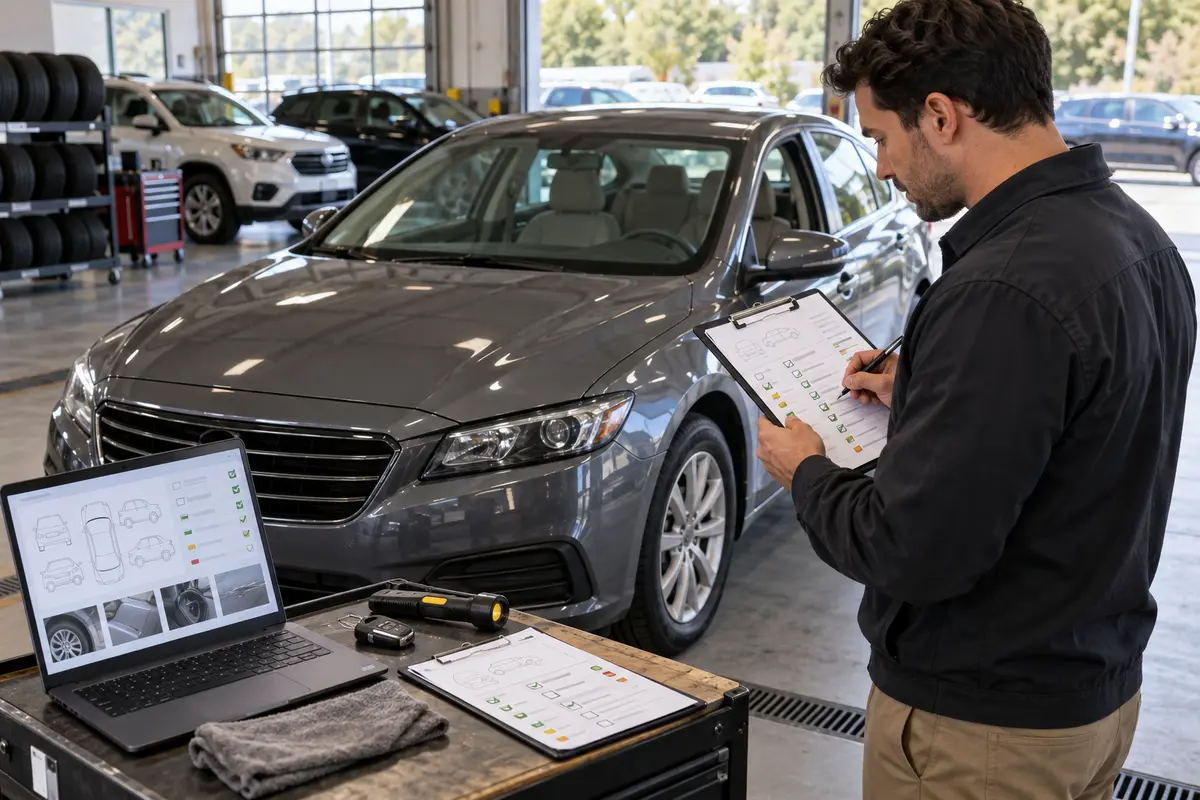
A fixed description template solves a writing-process problem: it gives every unit the same order, evidence labels and review questions. It does not prove ownership, condition, safety, recall completion, warranty coverage or legal compliance. Those conclusions still depend on current documents, direct observations and qualified professionals. The illustration above is fictional and is not evidence of a real vehicle, inspection or dealership process.
1. Build the source record before writing
Do not draft from memory, an auction headline or another listing. Put the evidence for the exact vehicle in one internal record first. At minimum, capture the VIN from the vehicle, the current odometer reading and unit, stock reference, acquisition documents, equipment evidence, current photographs, condition notes, service records, inspection reports, included items, pricing approval and current warranty or Buyers Guide information.
NHTSA's VIN decoder can identify information encoded in a VIN using manufacturer-reported data. Use it as an identity cross-check, not as proof of ownership, current mileage, condition or every installed option. When the VIN plate, documents and decoded identity disagree, hold the description for review instead of choosing the most convenient version.
Assign an owner and a checked-on date to each source. A description that was correct when the vehicle arrived can become wrong after mileage changes, a repair, an accessory removal or a pricing update.
2. Use five evidence labels
A consistent template works better when the writer labels how each fact is known. Use an internal label before turning the fact into public copy:
| Label | Use it when | Example source | Public wording |
|---|---|---|---|
| Verified | The fact matches current primary evidence for this unit | VIN plate, current document, direct measurement | “Odometer shows 48,216 miles as of September 28.” |
| Observed | Staff can see or operate something, but have not diagnosed it | Dated photo, walk-around note, feature check | “One visible scuff on the right-rear door.” |
| Documented | A record states an event or specification | Invoice, build record, inspection report | “Invoice dated May 2026 records front-brake service.” |
| Reported | A prior owner or other party stated it, but the dealership has not independently verified it | Signed intake note | “Previous owner reported two prior keys; one key is currently present.” |
| Unknown / not tested | The dealership lacks reliable evidence or has not completed the check | No record, inaccessible item, pending inspection | “Roof-rack load history is unknown.” |
Do not publish the labels mechanically if they make the copy unreadable. Use them during review so that the final sentence stays within the evidence. The FTC's advertising guidance says advertising claims must be truthful, nondeceptive and evidence-based. A consistent template should narrow claims to what the dealership can support, not make weak evidence sound stronger.
3. Keep the public sections in a fixed order
Use the same sequence for every vehicle. Buyers can scan faster, and reviewers know where to find a missing fact.
- Exact vehicle identity: year, make, model and verified trim, plus a dealership stock reference.
- Mileage and location: current odometer reading, miles or kilometers, checked-on date and physical location.
- Verified equipment: important factory, dealer-installed and aftermarket items, kept in separate groups.
- Current visible condition: material exterior, interior, glass, wheel, tire and cargo-area observations.
- Records and checks: available service records, inspection date, history-report date and recall lookup date, each with its limits.
- Warranty and sale status: the current Buyers Guide or other approved warranty language, without paraphrasing beyond the document.
- Price terms: approved price, currency and any applicable conditions or exclusions that must be disclosed under the dealership's current process and local law.
- Included items: keys, manuals, mats, charging cable, cargo cover, wheel-lock key or other items physically present and approved for the sale.
- Known unknowns: unanswered questions and the next reasonable verification step.
Do not use “fully loaded,” “perfect,” “like new,” “accident free,” “one owner,” “needs nothing” or similar broad claims unless the dealership has a defined, current basis for the exact meaning and sufficient evidence for this vehicle. A checklist is more defensible than a superlative.
4. Write identity and mileage precisely
Start with the exact unit, not a general model description. Verify the trim rather than inferring it from a badge, wheel style or a feature that could have been added later. Keep a dealership's private VIN-handling policy separate from the public description; the internal record should still use the full VIN to prevent unit mix-ups.
Read the odometer directly and include the unit. If the vehicle may be driven while listed, state the reading date and update it when the change becomes material under the dealership's policy. Avoid “low mileage” unless the dealership has a documented comparison and the phrase is appropriate under applicable law.
For a changed odometer or condition fact, follow the workflow in our guide to updating a car ad when mileage or condition changes. Replace the old value everywhere rather than adding a contradictory note at the bottom.
5. Separate factory equipment, added equipment and operation
A feature can be present without being factory-installed, and it can be factory-installed without currently working. Keep three questions separate:
- What evidence identifies the equipment or package?
- Is the item physically present on this vehicle?
- Was its current operation tested, and when?
Use manufacturer records, the vehicle itself and dealership documents appropriate to the unit. Do not copy an equipment list from the same model year or a similar trim. If a subscription, paired account, removable accessory or software-enabled feature is involved, state only what is currently transferable and verified. “Screen powers on during a September 28 check” is not the same as “all connected services included.”
Record aftermarket changes in their own subsection. Identify the visible component and available documentation without claiming compatibility, legal status, safety or performance that has not been verified.
6. Describe condition as observation, not diagnosis
Condition notes should answer three questions: where is the issue, what is visible, and when was it observed? “Approximately 3-inch horizontal scratch on the lower right-rear door, visible in the dated close-up” is more useful than “minor cosmetic wear.”
Separate what staff observed from what a technician diagnosed and from what a repair invoice documents. A dashboard light can be photographed and identified by location without guessing its cause. A clean engine bay does not establish the absence of a leak. New tires on one axle do not establish tire condition on the other axle.
Use current photographs that show the same condition described in the text. If the vehicle changes after photography, update both. Our condition-description guide provides a wide/context/close photo method and neutral wording.
7. Keep records, inspection and recall checks separate
List what is available and the date range it covers. Do not turn partial records into “full service history.” A service invoice documents the work written on that invoice; it does not prove that every recommended task was completed or that the vehicle has no current issue.
State who performed an inspection, the inspection date and the scope if the dealership can accurately disclose it. Do not call a visual intake check a comprehensive mechanical inspection. A vehicle-history report, service file and mechanical inspection answer different questions.
NHTSA's recall lookup lets users check a VIN for open safety recalls. Record the VIN lookup date and result carefully. A lookup can change, and it does not certify overall safety, mechanical condition or completed repairs that are outside the reported recall data.
8. Copy warranty status from the current approved document
For covered U.S. dealer sales, the FTC's Dealer's Guide to the Used Car Rule explains the Buyers Guide requirements and notes that state law can add or change obligations. The FTC also explains that dealers must identify whether a vehicle is offered “as is” or with a warranty and describe applicable warranty information on the Buyers Guide.
Use the dealership's current, approved Buyers Guide and legal process for the exact vehicle. Do not improvise warranty language in the marketing description, and do not use “certified” unless the applicable program, inspection and disclosure requirements have actually been met. If the public copy and Buyers Guide disagree, hold publication until the conflict is resolved.
9. State price terms and included items without ambiguity
Use the approved price and currency. If taxes, title, registration, dealer fees, required products, conditional discounts or financing terms must be disclosed, follow the dealership's current jurisdiction-specific process. This template is not a substitute for legal review, and it should not be used to hide mandatory charges in a later step.
List the physical items included with the vehicle. Count keys and remotes rather than writing “keyless entry.” Verify that the charging cable, wheel-lock key, cargo cover, spare tire or repair kit shown in photographs will actually transfer with the sale. If an item is pictured but excluded, correct the image or disclose the exclusion prominently.
10. Publish known unknowns instead of filling gaps
Unknown is a useful answer when it is accurate. It tells the buyer what still needs evidence and prevents the writer from converting assumption into fact.
Use a short format: question — current status — next step. For example: “Previous paintwork on the left rear quarter: unknown from current records; buyer may arrange an independent body inspection.” Or: “Second key: not present at intake; listing includes one key unless the inventory record is updated.”
Do not let the next step become a guarantee. Offering an inspection opportunity is not the same as promising the vehicle will pass.
Copy-and-paste vehicle description template
[Year] [Make] [Model] [verified trim]
Stock reference: [stock ID]
Location: [city/state or dealership location]
Odometer: [reading] [miles/kilometers], checked [date]Verified identity and equipment
[VIN-verified identity facts]
[Factory equipment supported by current evidence]
[Dealer-installed equipment]
[Aftermarket equipment, labeled separately]
[Feature operation checked on date, or “not tested”]Current visible condition
Exterior: [specific dated observations]
Interior: [specific dated observations]
Wheels/tires: [position-specific observations and measurements, if taken]
Glass/cargo area: [specific observations]
See [photo references] for the areas described.Records and checks
Service records available: [date range and categories]
Inspection: [provider, date and scope, or not completed]
History report: [provider/date, if available; no broader claim]
NHTSA recall lookup: [date and result, with limits]Warranty and sale information
[Copy only approved status consistent with the current Buyers Guide and applicable process]
Price: [amount and currency]
[Required price conditions, fees or exclusions under current approved process]Included items
[number of keys/remotes, manuals, mats, charging cable, cargo cover, wheel-lock key and other approved items]Known unknowns
[unverified fact — current status — next verification step]
Delete every bracketed instruction before publishing. If a section does not apply, use a clear “not available,” “not tested” or “unknown” statement when that information matters; do not leave a blank that suggests the review was completed.
A complete fictional example
2018 fictional Northline Crossover LX
Stock reference: NC-184
Location: Example City, California
Odometer: 64,218 miles, read directly September 28Verified identity and equipment: VIN decode and intake documents identify a 2018 Northline Crossover LX. Present equipment includes all-wheel drive, cloth seating and a dealer-installed cargo liner. Heated-seat operation was not tested at intake.
Current visible condition: one visible paint chip on the front edge of the hood; light creasing on the outer driver-seat bolster; approximately 2-inch scuff on the right-rear wheel face. Dated wide and close photographs show each area. These are visual observations, not a structural or mechanical diagnosis.
Records and checks: privacy-reviewed service invoices are available for 2024–2026 and include oil service and a front-brake invoice. An independent mechanical inspection has not been completed. A NHTSA VIN recall lookup was checked September 28; buyers should recheck the VIN because recall information can change.
Warranty and sale information: see the current Buyers Guide and written sale documents for the exact coverage and terms. Fictional example price: $18,900 USD, subject to the dealership's current written disclosures.
Included items: one key with remote, cargo liner and owner's manual. A second key is not present.
Known unknown: earlier paintwork on the left-rear quarter is not established by the available records. A buyer may arrange an independent inspection.
Every vehicle, identifier, place and price placeholder in this example is fictional. The example demonstrates evidence boundaries; it does not certify a real vehicle or predict a transaction.
Pre-publish description checklist
- Match the VIN on the vehicle to the source record.
- Verify year, make, model and trim for the exact unit.
- Read the odometer directly and record the unit and date.
- Confirm the vehicle's current physical location and availability status.
- Separate factory, dealer-installed and aftermarket equipment.
- Separate feature presence from current operation.
- Support every objective claim with current evidence.
- Replace vague condition adjectives with location-specific observations.
- Match condition notes to current photographs.
- Keep records, history reports, inspections and recall checks distinct.
- Use the current recall lookup date and state its limits.
- Match warranty wording to the current approved Buyers Guide and process.
- Check price, currency and required written terms.
- Count the keys and verify every included accessory.
- Identify material unknowns and the next verification step.
- Remove placeholders, copied text and claims belonging to another unit.
- Have a named reviewer approve or hold the description.
- Save the final text, evidence references and review date together.
A consistent description is not identical marketing for every car. It is a repeatable order for presenting the exact facts of each car. The template makes omissions visible, keeps unsupported claims out of the copy and gives the next reviewer a reliable place to check every material statement.
Ready to list your car?
Put your vehicle details and photos together, then start your listing on AutoDream.
Create your listing

