
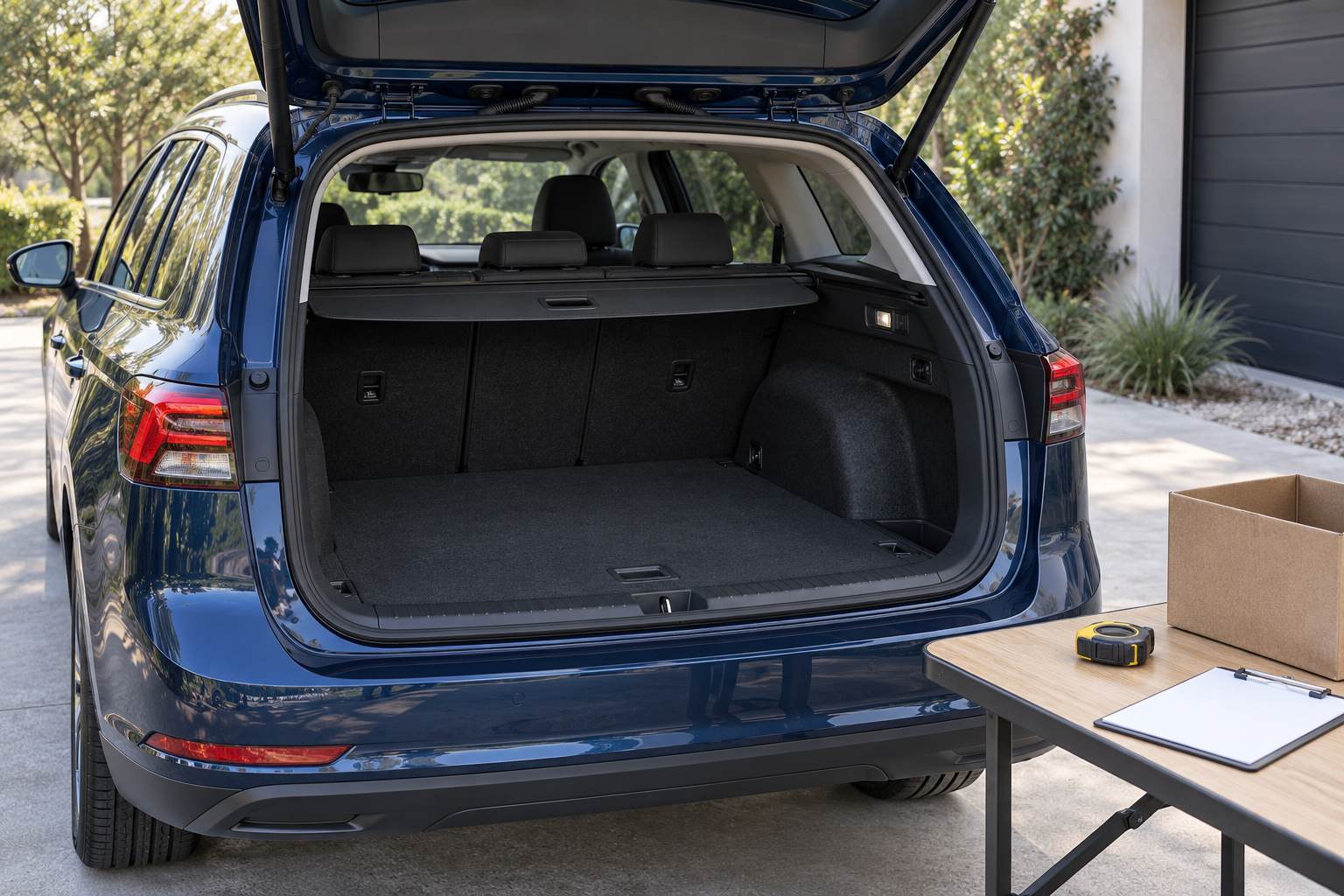
“Will my stroller fit?” is a different question from “How many cubic feet does this model have?” A seller can help by documenting the actual opening, floor and seating arrangement rather than guessing from a wide-angle photograph.
This guide gives private sellers and dealership staff a repeatable way to answer cargo-fit questions. The measurement and photo workflow is an editorial suggestion, not a manufacturer test or a certification. Official advertising and loading references were checked on October 17, 2026.
1. Separate space, access and weight
| Question | Useful evidence | What it does not establish |
|---|---|---|
| How much space does the model have? | Applicable manufacturer specification, with seating configuration and units. | That a particular rigid object will pass through the opening. |
| Will this object go inside? | Actual clearances, photographs and a careful stationary fit check. | That it can be carried safely while driving. |
| How much weight can the vehicle carry? | The vehicle’s applicable loading labels and manufacturer instructions. | That everything fitting inside is within those limits. |
A large-looking compartment is not a load rating. NHTSA’s explanation of vehicle placard terminology distinguishes the combined occupant-and-cargo weight limit from cargo alone. That interpretation dates from 2004; use the labels and instructions applicable to the actual vehicle, not a number copied from an example or a different trim.
If the car has been modified, or a label is missing or unclear, do not improvise a capacity claim. Ask the manufacturer or an appropriately qualified professional to resolve it. This guide does not calculate towing, roof-rack or modified-vehicle ratings.
2. Define the configuration before measuring
Park safely on level ground, switch the vehicle off and follow its instructions for opening the hatch and moving seats. Keep fingers, tools and other people clear of powered closures. Do not work beneath a hatch that will not stay securely open.
Start with the configuration a buyer will actually use. Record:
- The vehicle reference and measurement date.
- Which seat rows are upright, folded or removed using the permitted procedure.
- The position of any sliding or reclining rear seats.
- The cargo-floor setting and whether the cover or parcel shelf is installed.
- Any mat, organizer, subwoofer or accessory occupying space.
- Which pictured accessories are included in the sale.
Make a separate record for each arrangement. Do not photograph the seats folded and describe the result as space available with all seats in use. Do not move the driver’s seat into an unusable position merely to create a longer measurement.
Our included-items checklist helps distinguish the equipment being sold from props used during photography.
3. Measure the limiting points—not just the biggest span
Use a tape measure, keep its line straight and record units on every entry. Identify both endpoints in a photo or note. Repeat a measurement if the tape moves or an endpoint is ambiguous; label the results approximate rather than implying workshop precision.
| Measurement | What to record |
|---|---|
| Opening width | The narrowest usable width at the height where the item must pass, including trim intrusions. |
| Opening height | The clearance from the loading sill to the upper opening at the relevant point. |
| Floor width | The narrow section between wheel housings or other fixed obstructions, plus where it was measured. |
| Usable floor depth | The distance from the rear seatback to the inside boundary of the closed hatch or trunk, without compressing trim. |
| Interior height | The clearance above the intended load position, noting a fitted cover or sloping roof. |
| Loading step | The sill, raised lip or floor step that affects how an object enters and rests. |
Where a closed-hatch boundary is inaccessible, say it was not measured; do not close a powered hatch against a tape or object. An opening may narrow above floor level, and a sloping hatch can reduce usable depth for a tall item. Photograph those restrictions rather than reporting only the largest dimensions.
Do not multiply three rough spans and advertise the result as the manufacturer’s cargo volume. A rectangular calculation ignores curves, intrusions and the measurement method. If quoting an official volume, name its source and the exact configuration separately from your own measurements.
4. Build a short, honest photo set
- Show the entire open cargo area with the seating arrangement visible.
- Show the opening straight on, without an extreme wide-angle view.
- Photograph the width measurement with both endpoints visible.
- Show depth and the relevant seatback or floor boundary.
- Show the height restriction, cover and any inward slope.
- Add a side view of the loading lip and obstructions.
Keep the original files. A close-up of a tape number without its endpoints is weak evidence. Do not stretch an image, remove an obstruction digitally or substitute a photo from another vehicle. For surface condition rather than dimensions, use our separate interior-wear photo guide.
5. Ask about the exact object
Request the object’s outside dimensions in its transport configuration, including handles, wheels, packaging and parts that cannot fold. “Standard stroller” or “medium suitcase” is not an exact size. Ask whether the buyer needs the rear seats in use at the same time.
A light, empty box can help illustrate space, but identify its dimensions and do not call it proof that a heavier or differently shaped item is suitable. If fit is decisive, offer a safe stationary check with the buyer’s actual item and permission before lifting anything into the car. Avoid heavy or awkward lifting just to obtain an advertising photograph.
Check entry, turning clearance, resting position and normal closure separately. Do not force the hatch, compress the item against glass, or bypass a latch. Even a successful stationary fit does not establish safe restraint, visibility or loading compliance.
6. A fictional buyer reply
These numbers illustrate documentation only; they are not specifications for the pictured vehicle or any AutoDream listing.
Measured October 17 with the rear seats upright, cargo floor in its upper position and cover installed: approximately 98 cm between the wheel housings, 79 cm floor depth at the marked centerline and 42 cm clearance beneath the cover. The opening narrows higher up; see photos 2–4. Your folded item measures 94 × 76 × 40 cm, but these approximate measurements do not confirm entry or turning clearance. We can arrange a stationary fit check. Its weight and safe restraint still need a separate review against the vehicle’s instructions.
The small apparent margin is a reason to check, not to promise. If the buyer later supplies dimensions including protruding wheels, repeat the comparison rather than relying on the earlier answer.
7. Keep loading safety outside the fit claim
NHTSA’s cargo guidance emphasizes securing the load, avoiding excessive cargo and checking that nothing can shift or escape. Follow the vehicle’s applicable instructions for weight limits, seat positions and suitable securing points. A convenient-looking hook is not automatically an anchor for a heavy object.
Do not infer that folding a seat increases the permitted total weight, or that an item is safe to carry because the hatch closes. If safe transport cannot be established, leave the question unresolved. Do not propose an improvised roof or open-hatch arrangement as a quick substitute.
8. Use a pre-publication check
For dealership listings, assign one reviewer to the measurement sheet, configuration photos and final wording. The FTC’s advertising guidance requires support for express and implied claims before an ad runs. Put the configuration and approximation beside a measurement, not in a remote disclaimer beneath an unsupported “fits anything” headline.
- Every measurement names its units, endpoints and date.
- The seat, floor and cover settings match the photographs.
- Opening restrictions are shown, not concealed by perspective.
- Manufacturer volume and seller measurements are clearly separated.
- A specific item’s handles, wheels and transport position are included.
- Approximate clearance is not described as guaranteed fit.
- Physical fit is not presented as a weight or restraint certification.
- Changed accessories or seat settings trigger an updated answer.
The goal is a useful, reproducible answer: here is the arrangement, here is what we measured, here is what the pictures show, and here is what still needs checking. AutoDream is not being represented as measuring or certifying cargo capacity.
Ready to list your car?
Put your vehicle details and photos together, then start your listing on AutoDream.
Create your listing

