
What if your vehicle's true market value isn't defined by your local neighborhood, but by a global digital footprint? In an environment where the average used vehicle listing price reached $27,027 in June 2026, many sellers still fear they're leaving significant money on the table. You might feel overwhelmed by how to price my used car for sale when faced with the shifting variables of 2026, such as the 50% ad valorem duty on Canadian imports or the rising premium placed on verified EV battery health. It's natural to feel a sense of friction when trying to track international demand for specific luxury models across diverse global markets.
We're here to bridge that gap. This guide provides the sophisticated tools you need to master vehicle valuation by leveraging AI-driven insights and real-time global market data. You'll learn to transform market volatility into a strategic advantage, ensuring your listing is optimized for the highest possible return. We'll provide a data-backed pricing strategy designed to accelerate your sale and target the most profitable geographic markets with precision. We're moving beyond traditional retail logic to help you achieve a frictionless, high-ROI transaction in a visionary automotive ecosystem.
Key Takeaways
- Transition from local trade-in estimates to a global market perspective to capture higher demand and superior price points.
- Understand why monitoring battery cycle counts and software integrity is now more critical than traditional mileage for determining electric vehicle value.
- Leverage AI-powered dashboards to master how to price my used car for sale by analyzing millions of real-time global data points instantly.
- Identify high-paying geographic regions and utilize market arbitrage to maximize your return while accounting for export documentation requirements.
- Apply a strategic negotiation buffer and optimize your listing for global visibility to ensure a faster, more profitable transaction.
Table of Contents
Understanding the Modern Valuation Landscape in 2026
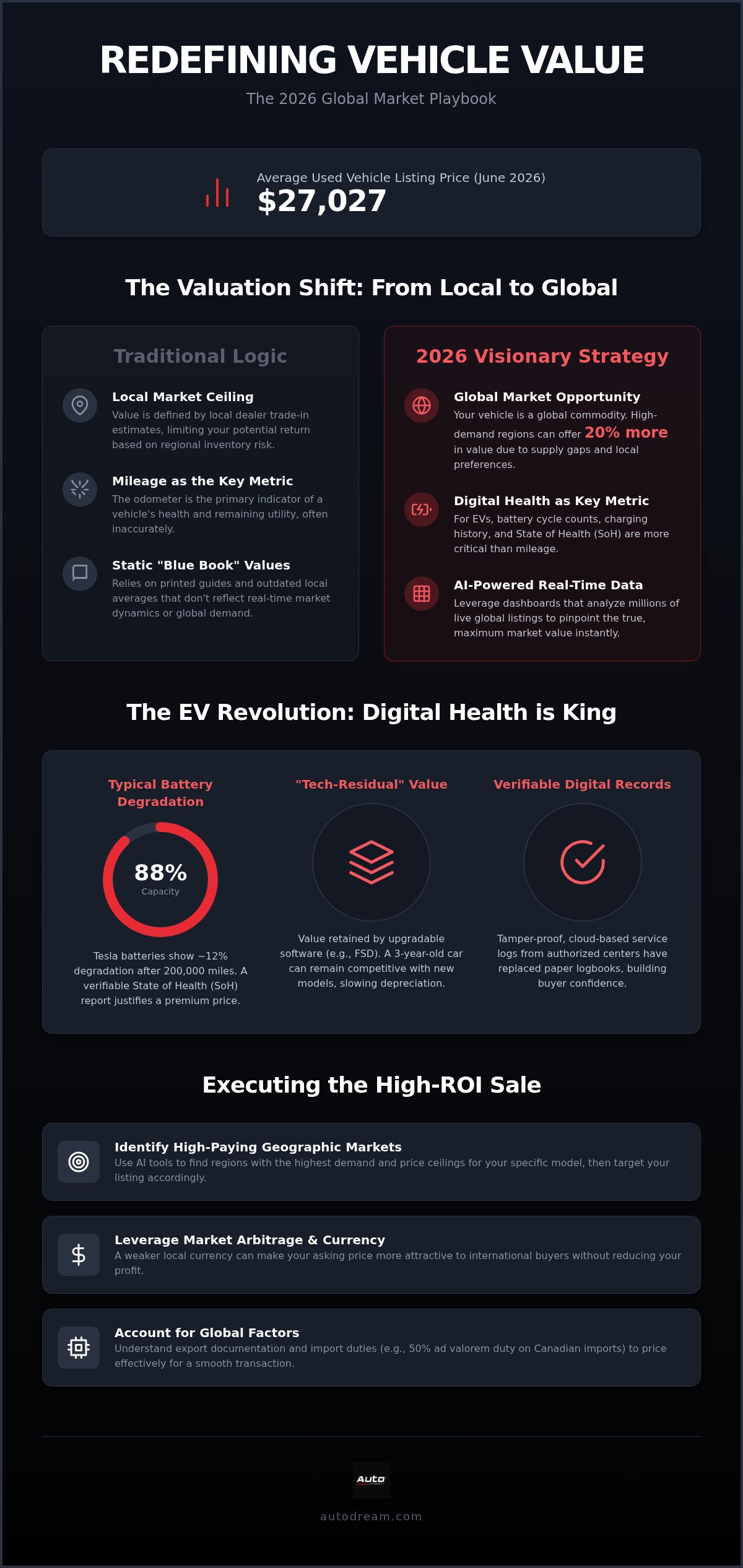
The era of relying on a single domestic "blue book" value has passed. To understand how to price my used car for sale in 2026, you must look beyond your immediate surroundings. Traditional vehicle valuation concepts often focus on static local averages, but the modern marketplace is borderless. While a local dealer might offer a conservative trade-in price to mitigate their own inventory risk, the global market value reflects what a motivated buyer in a high-demand region is willing to pay. This discrepancy creates a massive opportunity for sellers who prioritize data over tradition.
This shift is driven by price elasticity and regional demand fluctuations. For instance, a high-performance electric vehicle (EV) might command a significant premium in a country offering aggressive new-buyer subsidies or strict urban emission zones. In these markets, the scarcity of used inventory drives prices upward, allowing visionary sellers to bypass local price ceilings. By analyzing these variables, you can position your car where its value is maximized rather than where it's most convenient to sell.
The Death of the Local Price Ceiling
Your car isn't just a local asset; it's a global commodity. Data from 2026 shows that specific models can be worth 20% more in a neighboring country due to supply chain gaps or specific regional preferences. International buyers now use sophisticated online car shopping tools to scan for inventory across borders, making your listing visible to a much wider audience. Currency fluctuations also play a vital role. When your local currency is weaker relative to a buyer's currency, your asking price becomes more attractive without you sacrificing a single cent of profit. This global reach effectively removes the artificial price limits set by local dealerships.
The 2026 Tech-First Valuation Model
Physical condition is no longer the sole arbiter of worth. We've entered an era where "Digital Health" dictates the bottom line. Software versioning, Full Self-Driving (FSD) capability, and battery cycle counts are now the primary drivers of residual value. Over-the-air updates ensure that a three-year-old vehicle remains technologically competitive with newer models, effectively slowing the traditional depreciation curve. We define "Tech-Residual" as the value retained by a vehicle’s upgradable hardware. High Tech-Residual means your car stays relevant longer, empowering you to maintain a firm price point even as newer models enter the market. When you determine how to price my used car for sale, you aren't just selling a chassis; you're selling a platform that continues to evolve through software updates.
Analyzing the Core Variables of Vehicle Worth
The odometer is no longer the primary indicator of a vehicle’s health or its eventual market value. For those determining how to price my used car for sale in 2026, the focus has shifted toward battery cycle counts. A low-mileage vehicle that has endured frequent, shallow charging cycles or extreme temperature exposure may actually possess a lower residual value than a high-mileage car maintained with optimal charging discipline. Understanding this data allows you to position your vehicle based on its actual remaining utility rather than an outdated mechanical metric.
Battery Health and EV Residuals
Documenting your vehicle’s State of Health (SoH) is the most effective way to justify a premium price point. While Tesla batteries typically demonstrate a degradation of approximately 12% after 200,000 miles, BYD’s Blade Battery technology often shows even higher structural resilience over similar cycles. Buyers in a buy used tesla international scenario are specifically looking for transferable warranties and verifiable battery diagnostics. By providing a transparent SoH report, you eliminate the primary fear of the modern buyer and secure a much stronger negotiating position.
Service history has also undergone a digital transformation. Verifiable cloud-based records from authorized service centers have replaced the traditional paper logbook. These records are essential because they provide a tamper-proof narrative of the vehicle's maintenance. Additionally, the "Rare Spec" factor can significantly influence your final number. Limited-edition software packages, unique interior finishes, or high-performance tech modules that are no longer available in new models can drive your asking price well above the local average.
The Aesthetic and Mechanical Audit
Traditional curb appeal has evolved into "High-Resolution Digital Appeal." In a globalized market, your vehicle’s first impression is made through a screen, often thousands of miles away. Professional detailing is no longer just about cleanliness; it’s about showcasing "Invisible Value" like ceramic coatings or paint protection films (PPF). These features signal to a sophisticated buyer that the vehicle has been treated as a high-value asset. Highlighting these protections, along with a clean mechanical audit, helps you bypass common low-ball objections. To see which specific features are currently commanding the highest premiums in different regions, you can utilize an AI-powered dealer dashboard to refine your strategy.
Leveraging AI and Real-Time Market Data for Precision
Precision is the new currency in automotive retail. Traditional valuation relies on what a car sold for last month, but in a market where the Manheim Used Vehicle Value Index reached 207.4 in August 2026, relying on rear-view data is a significant financial risk. Predictive AI shifts the focus to what your car will sell for tomorrow. This foresight is crucial when determining how to price my used car for sale, as it accounts for emerging global trends before they hit the local mainstream. By moving beyond historical averages, you can capture the exact moment when demand peaks.
The Power of AI-Driven Market Analysis
Sophisticated platforms leverage an AI-powered dealer dashboard to analyze millions of data points across 15 countries instantly. Using AI for auto dealers allows individual sellers to access the same high-level intelligence as global conglomerates. These tools identify "Hot Zones" where specific models, such as the Tesla Model Y or BYD Seal, are in critical undersupply. Predictive analytics help you time your entry with surgical accuracy. If data suggests a 1.0% price increase for luxury sedans is currently peaking, the AI signals an immediate listing opportunity to capture the highest possible ROI.
Modern valuation also requires an understanding of "Distance Insights" to calculate the potential landed cost for international buyers. When a buyer in a high-demand region views your vehicle, they're assessing the total investment, including baseline customs duties and standard passenger car fees. Your pricing strategy must reflect this borderless reality to remain competitive. Additionally, you should monitor real-time engagement metrics like "Save" and "View" counts. If your listing has high views but few saves, the market is signaling that your price is slightly ahead of the curve. Dynamic adjustments based on these live behavioral signals ensure your vehicle stays at the forefront of buyer interest.
Data Transparency as a Sales Tool
Transparency isn't just a moral choice; it's a high-efficiency sales tactic that removes friction. When you share automated valuation reports and verified data sources directly in your listing, you anchor the price in objective reality. This eliminates the need for exhausting back-and-forth negotiations because the value is already proven by the data. High transparency in pricing data correlates to 30% faster sales cycles. By providing a clear, data-backed narrative, you empower the buyer to make a confident decision and clarify exactly how to price my used car for sale for a global audience. This approach moves them from a "viewer" to a "buyer" with unprecedented speed.
Strategic Pricing for International and Luxury Markets
Global market arbitrage is the most potent tool for the modern seller. While domestic markets might be saturated, specific international regions often face inventory shortages that drive prices significantly higher. Determining how to price my used car for sale requires analyzing these global "Hot Zones" to identify where your vehicle commands the highest premium. This isn't just about the car; it's about the data-driven opportunity to sell into a market with higher purchasing power or more aggressive subsidies. By positioning your asset globally, you bypass local economic stagnation and tap into regions with a high appetite for high-tech inventory.
Navigating Global Demand Patterns
A prime example is the European used car market, which in 2026 remains a high-demand hub for sophisticated EVs and luxury sedans. When targeting these regions, you must account for local Value Added Tax (VAT) and specific import tax implications, such as the 25% tariff on certain vehicle imports announced in May 2026. Pricing for a "sight unseen" buyer requires a different strategy. You aren't just selling a vehicle; you're selling a narrative of trust and transparency. Verifiable digital health reports and high-resolution media build the necessary confidence for a buyer to execute a remote transaction without hesitation.
Psychological Pricing in the High-End Segment
Luxury brands like Mercedes-Benz and Tesla exist in a space where "Aspirational Value" often supersedes standard market averages. A sophisticated pricing narrative justifies a top-of-market position by highlighting exclusive features or pristine digital records. In the era of digital search filters, psychological pricing remains critical. A price of $99,900 often generates significantly more visibility than $100,000 because it stays within more common search parameters. You can further solidify this premium position by using Featured Listing Placement to ensure your vehicle remains at the top of the global search results.
Mitigating the logistical hurdles of these transactions is essential for protecting your final price. Using secure cross-border vehicle transactions ensures that payment and documentation are handled with the same efficiency as a local sale. When the buyer pays for shipping, your pricing should remain firm, as you've already solved the most difficult part of the equation: sourcing the right vehicle. By leveraging these strategic insights, you move from being a passive seller to a global market participant with the power to dictate exactly how to price my used car for sale for maximum ROI.
Executing the Sale: From Valuation to Global Listing
Finalizing your price is where data-driven strategy meets real-world execution. When you determine how to price my used car for sale, you must build in a "Negotiation Buffer" to protect your target ROI. This isn't about arbitrary markups; it's about providing psychological breathing room for the buyer. A strategic buffer of 5% to 7% above your desired net return allows you to concede a small amount during final talks without dipping below the vehicle's global market value. In a borderless market where currency conversions fluctuate, this margin ensures you maintain your profit goals regardless of the buyer's location.
Communication is the next hurdle in a globalized transaction. You don't need to stay awake to manage inquiries from different time zones. Utilizing AI-powered multilingual chat facilitators allows you to handle international leads 24/7. These facilitators provide instant, technical answers regarding battery cycle counts or software versioning, maintaining the momentum of the sale while you're offline. This level of automation removes the friction traditionally associated with international commerce, ensuring that a motivated buyer in a "Hot Zone" never waits for a response.
The Sophisticated Listing Strategy
The first 48 hours after you list a car for sale are the most critical for algorithmic momentum. High-resolution photography serves as your primary tool for validating a premium price point. It provides the visual evidence required for "Sight Unseen" confidence, which is essential for remote buyers. By showcasing every technological detail, from the infotainment interface to the pristine paint protection film, you justify your top-tier valuation. This digital-first approach allows you to bypass local market stagnation and connect with buyers who specifically seek your vehicle's tech-residual.
Closing the Loop with AutoDream
Featured Listing Placement acts as a powerful catalyst for your sale. Data indicates that featured listings can increase visibility by up to 5x compared to standard placements, ensuring your vehicle stays at the forefront of global search results. Once engagement begins, automated lead management streamlines the transition from "For Sale" to "Sold." The system organizes inquiries by buyer intent and geographic priority, allowing you to focus on the most serious offers. This comprehensive ecosystem transforms a complex international sale into a streamlined, high-efficiency event. Ready to capture global value? List your vehicle on AutoDream today.
Own the Future of Your Vehicle's Value
The transition from a local seller to a global market participant is no longer a luxury; it's a strategic necessity. By shifting your focus from traditional mileage to tech-residuals like battery health and software integrity, you unlock a level of value that local trade-in estimates simply cannot match. Mastering how to price my used car for sale in 2026 means moving beyond historical data and embracing predictive AI to capture peak demand in high-growth regions. You've learned how to leverage global arbitrage and sophisticated digital health reports to anchor your premium price point with absolute transparency.
The logistical hurdles of the past have been replaced by seamless, automated ecosystems. You now have the intelligence to bypass local market stagnation and connect with motivated buyers across borders. It's time to transform your vehicle from a depreciating asset into a high-ROI opportunity. Maximize your vehicle’s value on the AutoDream global marketplace by accessing buyers in 15+ countries. With AI-powered multilingual sales tools and advanced distance and logistics insights at your fingertips, the path to a high-efficiency sale is clear. Your visionary pricing strategy is ready for the world stage.
Frequently Asked Questions
How do I know if my used car price is too high for the current market?
You know your price is too high when your listing generates high view counts but zero saves or inquiries over a 48 hour period. This engagement gap suggests that while your vehicle is visible, the price point creates immediate friction for potential buyers. Use real time data from an AI powered dashboard to compare your listing against current global averages. If your car sits above the 207.4 Manheim Index average without unique tech residuals, a downward adjustment is necessary.
Does a higher mileage always mean a lower price for an electric car?
Higher mileage does not automatically dictate a lower price for electric vehicles in 2026. Buyers now prioritize verified battery State of Health (SoH) and software versioning over traditional odometer readings. A vehicle with 100,000 miles but a 95% SoH and the latest FSD updates often commands a higher premium than a low mileage car with significant battery degradation. This shift reflects the modern understanding of Tech Residual value in the smart car marketplace.
How much should I lower my price if I want a quick sale?
To achieve a rapid sale, position your vehicle within the bottom 10% of the global price range for its specific category. This strategy creates an immediate value proposition that triggers algorithmic priority on major platforms. While the average used car price was $27,027 in mid 2026, a slight discount below the regional average can lead to a 30% faster sales cycle. Ensure your data backed valuation is transparent to build instant trust with the buyer.
Can I price my car higher if I am selling to an international buyer?
You can often price your car higher when targeting international buyers in regions facing inventory shortages or high EV demand. This is the core of market arbitrage. For instance, a vehicle that is common in your local market might be a Rare Spec in a neighboring country. When considering how to price my used car for sale, identify Hot Zones where local subsidies or regulations increase the buyer's willingness to pay a premium for imported inventory.
What tools provide the most accurate car valuation in 2026?
The most accurate valuations in 2026 come from AI powered dealer dashboards that synthesize millions of global data points in real time. Unlike traditional guides that rely on historical sales, these tools use predictive analytics to forecast future value based on emerging tariffs and seasonal demand. Platforms like AutoDream provide automatic distance and logistics insights. This allows you to see the true landed cost for buyers in 15 different countries, ensuring your asking price remains globally competitive.
How does the "Zöld Rendszám" status in Hungary or similar incentives abroad affect my car’s value?
Local incentives like the Zöld Rendszám in Hungary significantly boost a vehicle's resale value by offering tangible benefits such as tax exemptions and free parking. These perks increase the Aspirational Value for buyers in those specific regions. When pricing your car for export, highlight these compatible incentives in your listing. A vehicle that qualifies for local green benefits can often justify a 5% to 8% price premium over non qualifying models in the same category.
Should I fix small dents and scratches before setting my asking price?
Fixing small aesthetic imperfections is essential for maintaining a premium price point in a digital first market. High resolution photography highlights every detail; therefore, even minor scratches can undermine the perceived value of a high tech asset. Investing in professional detailing or ceramic coating signals to the buyer that the vehicle has been meticulously maintained. This High Resolution Digital Appeal helps you maintain a firm asking price and reduces the likelihood of low ball offers during negotiations.
How do I factor in the cost of export regulations when pricing my car?
Factor in the impact of new tariffs, such as the 50% ad valorem duty on certain imports or the 25% tariff on EU vehicles effective May 2026. While the buyer typically handles shipping and logistics, these regulatory costs affect their total investment. Understanding how to price my used car for sale involves calculating the buyer's final landed cost. If your asking price plus the required duties exceeds their local market average, your vehicle will likely remain unsold.
Ready to list your car?
Put your vehicle details and photos together, then start your listing on AutoDream.
Create your listing

