
In a hyper-connected 2026, the value of a vehicle is no longer a fixed number on a local sticker; it's a fluid calculation of global arbitrage and logistical reality. You've likely felt the frustration when local pricing guides fail to account for the 25% Section 232 tariffs or the removal of the European Union duty-free exemption threshold. This international car valuation guide provides the sophisticated data insights and AI-powered frameworks you need to master cross-border pricing with precision. We understand that currency fluctuations and hidden import costs often distort the real value of an asset, leaving you uncertain during high-stakes negotiations.
You deserve a reliable framework that turns these complexities into a competitive advantage. This article promises to demystify the total landed cost of any vehicle, from a classic United Kingdom import with its 5% reduced VAT to the surge of Chinese passenger car exports. We'll preview the essential mechanisms of modern valuation, ensuring you move from a state of uncertainty to one of total confidence in the global marketplace. It's time to bridge the gap between local listings and international success.
Key Takeaways
- Understand how a modern international car valuation guide accounts for shifting regional demand, ensuring you don't overpay when sourcing vehicles from EV-heavy markets.
- Identify the critical impact of regional specifications on a car's worth, ensuring you accurately price "US spec" or "GCC spec" vehicles for the global stage.
- Move beyond static pricing by using machine learning to synthesize auction data and marketplace listings into one cohesive valuation strategy.
- Calculate the complete landed cost of any cross-border transaction, accounting for volatile currency exchange rates and specific import duties.
- Empower your sales strategy with an AI-Powered Dealer Dashboard to streamline international listings and eliminate the friction of global negotiations across 15 markets.
Table of Contents
What is an International Car Valuation Guide?
An international car valuation guide serves as a sophisticated framework for determining a vehicle's worth across diverse geographic markets. It's far more than a simple price list; it's a dynamic logic model that accounts for regional supply and demand imbalances. For example, while the European market currently experiences a high premium for electric vehicles, the Middle East often maintains a stronger value floor for high-performance internal combustion engines. This guide integrates these regional nuances with real-time currency exchange rates and cross-border regulatory impacts to reveal the true market position of an asset. Visionary buyers and dealers use these frameworks to identify arbitrage opportunities, capitalizing on price discrepancies that local guides simply can't see.
A global approach to car valuation requires a shift in perspective. You aren't just looking at what a car is worth in your zip code; you're evaluating its liquidity in a global ecosystem. By using an international car valuation guide, you gain the ability to synthesize data from 15 global markets, moving beyond the limitations of regional data silos. This systemic view is essential for anyone looking to navigate the complexities of 2026's automotive trade, where a vehicle's value is as much about its location as its mileage.
The Shift from Local to Global Pricing
Traditional "Blue Books" often fail in a cross-border context because they're built on the assumption of a closed market. They don't account for the fact that a Mercedes-Benz might be undervalued in North America while commanding a premium in Southeast Asia. Digital marketplaces have dismantled these silos, creating a transparent global price floor that prevents localized undervaluation. To maintain a competitive edge, successful traders rely on AutoDream to access essential online car shopping tools for real-time comparison. This connectivity ensures that pricing is no longer a guess, but a data-driven certainty based on global movement.
Key Terminology for Global Appraisals
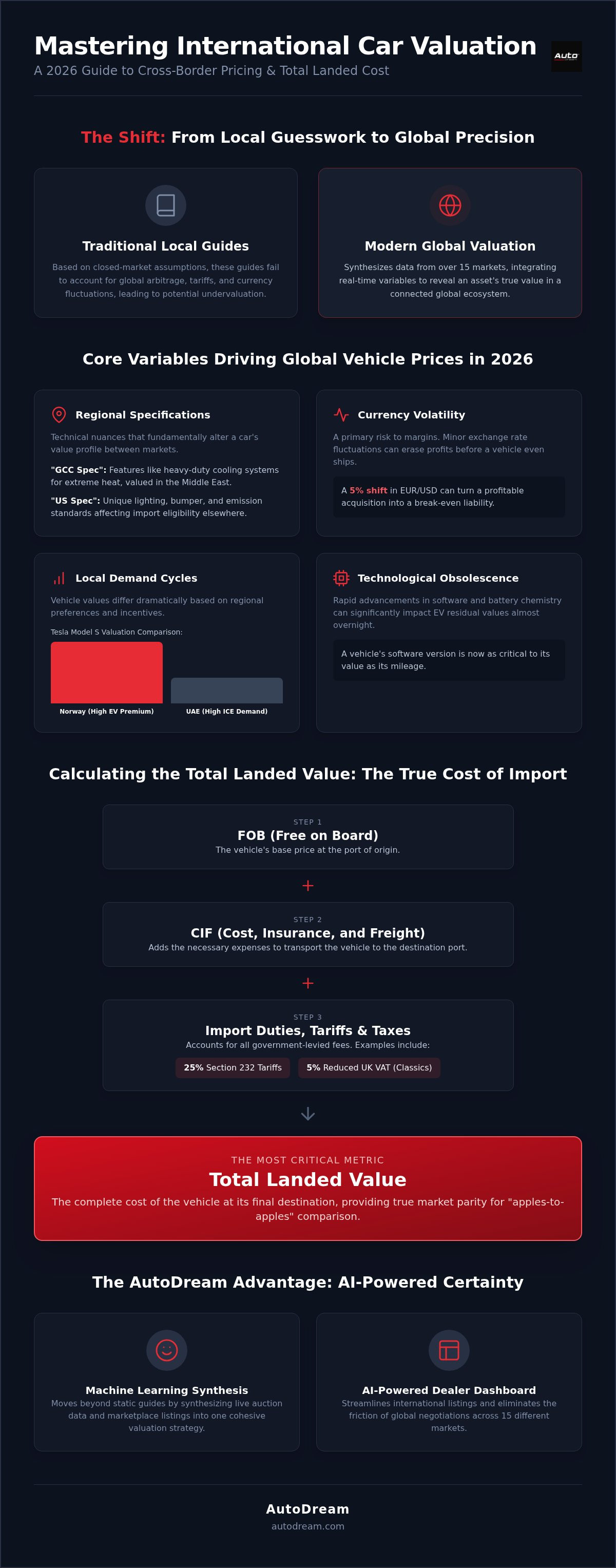
Mastering global pricing requires a command of specific trade terms that define the transition of value across borders. You'll need to distinguish between Free on Board (FOB) and Cost, Insurance, and Freight (CIF) pricing. FOB indicates the vehicle's price at the port of origin, while CIF includes the necessary expenses to reach the destination port. However, the most critical metric for any visionary buyer is the Landed Value. This represents the total cost of the vehicle once it reaches its final destination, including all duties, taxes, and fees. Finally, achieving Market Parity involves adjusting these prices to account for local tax environments, ensuring you're comparing "apples to apples" whether the car is in Tokyo, Berlin, or New York.
Core Variables Driving Global Vehicle Prices in 2026
Global pricing is a moving target influenced by more than just wear and tear. An effective international car valuation guide must account for regional specifications that fundamentally alter an asset's desirability. For instance, a vehicle with "GCC spec" features, designed for extreme heat with heavy-duty cooling systems, carries a different value profile in the European used car market than a "US spec" model with varied lighting and bumper standards. These technical nuances aren't just details; they're the difference between a profitable trade and a logistical hurdle.
Currency volatility remains a primary risk to your margins. Even a minor fluctuation in exchange rates can transform a high-value acquisition into a break-even liability before the ship even leaves the dock. Smart traders balance this risk against local demand cycles. A Tesla Model S currently commands a premium in Norway's EV-centric economy that far exceeds its valuation in the UAE, where internal combustion engines still hold significant market share. Understanding these cycles allows you to move inventory where it's most appreciated. You can leverage advanced market insights to track these shifts in real-time.
Technological obsolescence also plays a critical role in 2026. Rapid software updates and battery chemistry advancements can impact EV residual values almost overnight. An international car valuation guide that ignores the software version or hardware generation of a modern vehicle is essentially obsolete. To price accurately, you've got to look beyond the model year and evaluate the digital ecosystem the car inhabits.
The Impact of Regional Regulations
Regulatory landscapes are shifting faster than ever. The implementation of Euro 7 emission standards has significantly impacted the resale value of internal combustion engines across the continent. Simultaneously, many developing markets have introduced strict age bans on imported vehicles to modernize their fleets. When you're Importing a Motor Vehicle, you must also consider how local EV subsidies paradoxically lower used car valuations by making new models more accessible. These policy shifts create a "valuation ceiling" that traditional local guides often miss.
Supply Chain and Port Liquidity
The physical journey of a vehicle dictates its final price just as much as its brand. Shipping delays at critical hubs like Jebel Ali or Rotterdam don't just slow down delivery; they tie up capital and increase the "time-to-market" cost. In the world of international arbitrage, speed is a component of value. Port congestion creates temporary local price spikes by restricting the immediate supply of fresh inventory. Mastering these logistical variables ensures your pricing strategy remains robust regardless of global transit friction.
Beyond Static Guides: Modern Tools for Cross-Border Pricing
Static PDFs and month-old appraisal books have no place in a high-velocity global market. In 2026, a truly visionary international car valuation guide is a living data ecosystem that absorbs millions of real-time price signals. AI-powered analytics now identify global price outliers in milliseconds, flagging vehicles that are undervalued in one region compared to the global average. This allows you to spot arbitrage opportunities before they're corrected by the market. By synthesizing auction data, marketplace listings, and private sale records, these tools provide a comprehensive view of value that no manual process could ever replicate. For professionals focused on the Australian region, platforms such as mycarvalue.com.au serve as an essential data point for establishing an accurate local baseline.
Net value isn't just about the car; it's about where that car sits on the map. Distance insights are now a fundamental component of the valuation process. These tools factor in the physical location of the asset, calculating the transit cost to the nearest major shipping hub and how that proximity impacts the final appraisal. If a vehicle is 500 miles from a port, its "as-is" value must reflect the logistical friction of moving it. AutoDream integrates these distance insights directly into the platform, ensuring your valuation is grounded in physical reality.
Verifying seller claims is the final hurdle in cross-border pricing. AutoDream's AI-powered multilingual chat facilitates instant negotiation and verification, allowing you to ask technical questions in your native language while the seller receives them in theirs. This removes the "language premium" that often inflates prices in foreign markets. When you can communicate with the precision of a local, you negotiate with the confidence of a local.
Comparing Traditional vs. AI-Driven Valuation
Traditional appraisals rely on lagging data and limited geography, often resulting in missed opportunities. AI-driven models use real-time API feeds and automated sentiment analysis to gauge market heat instantly. The adoption of AI for auto dealers is no longer optional for those managing high-volume global inventory. It transforms valuation from a guessing game into a precise science, ensuring every listing aligns with current global demand.
The Role of Multilingual Market Data
Accurate valuation requires the ability to read and interpret local listings in their native context. Automated translation tools have evolved to understand automotive slang and regional technical terms, removing the barriers that once made foreign markets opaque. By following U.S. Customs and Border Protection guidelines and using AutoDream's sophisticated interface, you can bridge the communication gap and access data that was previously hidden behind a language barrier. This level of transparency is what defines a modern international car valuation guide.
Calculating the Landed Value: Hidden Costs of Importing a Car
A vehicle's true worth is never found on its foreign sticker price. In the sophisticated world of cross-border trade, valuation is incomplete without factoring in the "hidden costs" that accumulate during the import process. This is where a visionary international car valuation guide transforms from a simple price list into a comprehensive financial blueprint. To determine the actual investment required, you must calculate the Landed Value, the total cost of the vehicle once it reaches its final destination and clears all regulatory hurdles. Failing to account for these variables can turn a perceived arbitrage opportunity into a costly oversight.
Mastering this calculation requires a structured, four-step approach. First, establish the base vehicle price in the source market. Second, integrate international logistics, which includes marine insurance and port handling fees. For shipments entering the United States, for instance, you'll need to account for the Merchandise Processing Fee (MPF) at 0.3464% and the Harbor Maintenance Fee (HMF) at 0.125% for ocean freight. Third, apply destination-specific import duties and Value Added Tax (VAT). Finally, factor in compliance modifications, such as lighting adjustments or software recalibrations, to meet local road laws. Only then do you have a figure that reflects reality.
Taxes and Duties: The Valuation Killer
Understanding "Ad Valorem" taxes, which are based on the assessed value of the vehicle, is critical for protecting your margins. As of July 2026, the standard US import duty for passenger cars remains 2.5%, while light trucks are subject to a significant 25% duty. Free trade agreements (FTAs), such as the USMCA framework, can drastically lower these barriers, yet luxury taxes still pose a threat to high-end used Tesla international purchases in various jurisdictions. In the United Kingdom, most imports face a 10% duty plus a 20% VAT, though classic cars over 30 years old benefit from a reduced 5% VAT. These nuances dictate the competitive value of every asset you source.
Logistics and Inspection Overheads
The physical journey of a car involves more than just freight. You must account for third-party physical inspections by agencies like SGS or TUV at foreign ports to verify the vehicle's condition before it ships. Additionally, secure payment processing and escrow fees add another layer of overhead. These "soft costs" explain why "cheap" cars found in distant markets often become "expensive" cars once landed. To streamline this complex process and manage your global inventory with precision, access our AI-Powered Dealer Dashboard and take control of your international trade logistics.
Navigating the Global Marketplace with AutoDream
AutoDream represents the culmination of the modern automotive trade, acting as a sophisticated ecosystem where data and action converge. By integrating the core principles of this international car valuation guide directly into its digital architecture, the platform removes the traditional barriers to global commerce. You aren't just browsing listings; you're accessing a high-tech bridge that spans 15 global markets. This connectivity allows users to move beyond the limitations of their local economy and tap into the lucrative world of global vehicle arbitrage with absolute precision.
The AI-Powered Dealer Dashboard serves as the command center for this experience. It enables professionals to manage international listings with a level of granularity that was previously impossible. You can optimize your inventory based on real-time global demand signals, ensuring that every asset is positioned where its value is highest. When you utilize featured listing placement, your vehicle doesn't just gain visibility; it gains the right kind of visibility among an audience specifically primed for its unique regional specifications.
Transparency is the cornerstone of the AutoDream experience. Our platform leverages distance insights to provide buyers with a clear, honest view of the total acquisition cost from the very beginning. This includes the logistical reality of moving the vehicle from its current location to its final destination. By automating the calculation of these variables, we ensure that the "landed value" discussed earlier in this international car valuation guide is a visible, actionable metric rather than a hidden risk.
The Frictionless Transaction Experience
Our smart marketplace is designed to eliminate the logistical friction that often stalls cross-border deals. We prioritize secure cross-border vehicle transactions to protect your investment at every stage of the journey. A buyer using AutoDream’s data tools feels a profound sense of command, knowing they’re making decisions backed by global intelligence rather than local guesswork. Complexity vanishes, replaced by a streamlined process that values your time as much as your capital.
This commitment to transparency and security mirrors the approach taken by Tyrian Trade, which establishes a trust layer for modern financial markets through verified participation and community engagement.
Next Steps for Visionary Buyers and Sellers
The future of your automotive portfolio starts with a proactive strategy. You can set up custom alerts for specific models across our entire network, ensuring you're the first to know when an arbitrage opportunity arises in a distant market. Use the AI dealer platform to refine your inventory and align it with the shifting needs of a worldwide audience. It's time to stop reacting to the market and start leading it. Explore the AutoDream Marketplace today and redefine what's possible in the global automotive landscape.
Mastering the Global Horizon of Automotive Trade
The transition from local pricing to global arbitrage is no longer a future prediction; it's the current standard for visionary traders. By utilizing a comprehensive international car valuation guide, you've moved beyond the constraints of regional data silos and entered a world defined by real-time intelligence. You now understand that a vehicle's true worth is a dynamic synthesis of its technical specifications, shifting currency trends, and the precise landed costs associated with its international journey.
AutoDream acts as your catalyst in this digital evolution. We provide the high-tech bridge you need to operate across 15 countries with absolute clarity and efficiency. Our ecosystem empowers you with advanced AI multilingual support to remove communication barriers and distance-aware pricing insights to eliminate logistical guesswork. It's time to leverage these sophisticated tools to secure your competitive edge and achieve your goals in the global marketplace.
Discover Your Vehicle's Global Potential on AutoDream
Success in 2026 belongs to those who see the world as a single, connected market. We're here to help you lead that charge and turn global complexity into your greatest advantage.
Frequently Asked Questions
How do I find the fair market value of a car in another country?
You find the fair market value by synthesizing real-time data from global marketplaces and auction platforms rather than relying on static local books. This approach allows you to see beyond regional price bubbles and understand an asset's true liquidity in a global context. It's essential to adjust for regional demand cycles, such as the premium currently placed on electric vehicles in the European market compared to traditional models elsewhere.
What are the most common hidden costs when importing a vehicle?
The most frequent hidden costs include marine insurance, port handling fees, and destination-specific import duties. For example, US imports are subject to a 0.3464% Merchandise Processing Fee and a 0.125% Harbor Maintenance Fee for ocean shipments. You must also factor in the cost of compliance modifications, such as lighting adjustments or emissions tuning, to ensure the vehicle meets local road standards upon arrival.
Does a car's VIN tell me its international value?
A VIN provides the essential technical foundation for valuation by identifying the vehicle's manufacturing origin and regional specifications. While it confirms whether a car is "US spec" or "GCC spec," it doesn't reflect the current market demand or the logistical costs of moving the asset. You should use the VIN as a starting point within an international car valuation guide to verify authenticity before calculating the final landed value.
How do currency exchange rates affect my car's valuation?
Volatile exchange rates can fundamentally alter your margins between the moment of purchase and the final delivery. If the target currency strengthens during transit, your acquisition cost effectively increases. Smart traders use real-time currency integration to monitor these fluctuations, ensuring that the valuation remains accurate and the investment stays protected against sudden shifts in the global financial landscape. It's a critical variable in any cross-border deal.
Is it worth paying for a professional international appraisal?
Paying for a professional appraisal is a wise investment for high-value or rare vehicles where condition is paramount. These experts verify the physical state and technical compliance of the car at the origin port, preventing expensive surprises once the vehicle lands. In a market where regional regulations can impact resale value, a professional eyes-on-ground report provides the necessary confidence for high-stakes, long-distance negotiations.
What is the difference between FOB and CIF pricing in car valuation?
FOB (Free on Board) pricing represents the cost of the vehicle at the port of origin, while CIF (Cost, Insurance, and Freight) includes the expenses required to reach your destination port. CIF is the preferred metric for accurate valuation because it accounts for the logistical journey. Understanding this distinction is vital for calculating the true landed value and avoiding underestimated budgets during your international sourcing process.
How does AutoDream's AI help with vehicle pricing?
AutoDream's AI processes millions of global data points to identify price arbitrage opportunities and real-time demand shifts across 15 countries. It uses distance insights to factor transit costs into the appraisal and provides multilingual chat to facilitate precise negotiations with foreign sellers. This technology transforms valuation from a manual, lagging process into a high-speed, data-driven advantage that removes friction from every transaction.
Can I use a US Blue Book for a car located in Europe or the UAE?
You shouldn't use a US-centric guide for cars in Europe or the UAE because they ignore critical regional variables. Local guides in the US don't account for foreign VAT structures, regional spec premiums, or the impact of European emission standards on resale value. For an accurate appraisal, you need an international car valuation guide that synthesizes data from the specific market where the vehicle is currently located.
Ready to list your car?
Put your vehicle details and photos together, then start your listing on AutoDream.
Create your listing